Kirjojen hintavertailu – 12 903 725 kirjaa ja 27 kauppaa

Kirjailija

Vladislava Stoyanova

Kirjat ja teokset yhdessä paikassa: 4 kirjaa, julkaisuja vuosilta 2017–2023, suosituimpiin kuuluu European Yearbook on Human Rights 2018. Vertaile teosten hintoja ja tarkista saatavuus suomalaisista kirjakaupoista.

4 kirjaa

Kirjojen julkaisuvuodet: 2017–2023.

European Yearbook on Human Rights 2018

European Yearbook on Human Rights 2018

Lize Glas; Filippo Fontanelli; Theodor Rathgeber; Monika Mayrhofer; Agnieszka Szklanna; Vladislava Stoyanova; Hans-Peter Folz; Alma Stankovic; Adina Portaru; David Reichel; Mathieu Leluup; Claudia Elion; Jean P. Froehly; Gregor Fischer; Joyce De Coninck; Johanna Pruessing; Ewa Sapiezynska; Jacopo Leone; Christian Strohal; Stefan Kieber; Mathilde Duhaâ; Miroslaw Wyrzykowski; Danaé Coquelet; Ajla van Heel; Elspeth Guild; Gareth Davies; Kanstantsin Dzehtsiarou

Intersentia Ltd
2018
nidottu
Both in Europe and around the world, 2017 has been another difficult year for the protection of human rights. Examples of the increased pressure on the European human rights system are apparent: the attack on the independence of the judiciary in Poland, which was responded to by the first time initiation of the rule of law procedure by the European Commission; the increasing human rights issues arising from European migration policy; Russia's suspension of its financial contribution to the Council of Europe and Turkey's lowering of its contribution; and the difficulties in appointing key human rights positions in the Organization for Security and Cooperation in Europe. Split into its customary four parts and complemented by book reviews of recent publications on human rights in Europe, the tenth volume of the European Yearbook on Human Rights brings together renowned scholars to analyse some of the most pressing and topical human rights issues being faced in Europe today.
Positive Obligations under the European Convention on Human Rights

Positive Obligations under the European Convention on Human Rights

Vladislava Stoyanova

Oxford University Press
2023
sidottu

Halvin toimitettuna 194,30 €

It is beyond question that States have positive obligations under the European Convention on Human Rights (ECHR) to prevent and address harm and risks of harm. However, given the difficulties of determining and delimiting the role of the State, the conditions under which positive obligations may apply can be unclear. The search for balance between intrusion and restraint by the State—between protection and freedom from interference—further complicates the question of state responsibility for breach of positive obligations. Vladislava Stoyanova directly addresses these challenges in Positive Obligations under the European Convention on Human Rights. By systematising the case law of the European Court of Human Rights, the book provides key insights into the elements crucial for ascertaining state responsibility for omissions - state knowledge, causation, and reasonableness. It outlines different kinds of positive human rights obligations and identifies the circumstances under which they can be breached. Stoyanova reflects upon what is at stake for political communities when the triggering, content, and scope of positive obligations has been determined. She offers serious evaluation of the dangers of ECHR obligations whose scope might be too expansive or intrusive, as well as the conceptual hurdles of applying positive human rights obligations extraterritorially. The definitive resource on ECHR positive obligations, this book is essential reading for academics, legal practitioners, and policymakers working across the diverse fields in which positive human rights obligations may apply. This is an open access title available under the terms of a CC BY-NC-ND 4.0 International licence. It is free to read at Oxford Scholarship Online and offered as a free PDF download from OUP and selected open access locations.
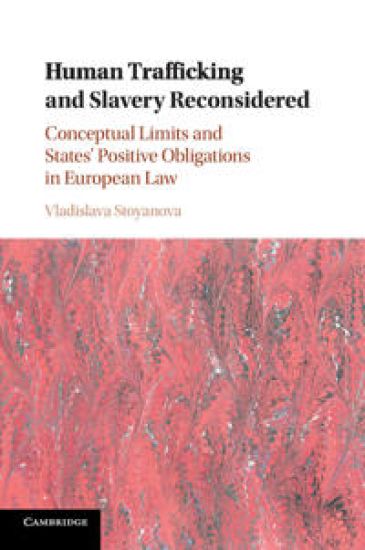
Human Trafficking and Slavery Reconsidered

Human Trafficking and Slavery Reconsidered

Vladislava Stoyanova

Cambridge University Press
2018
pokkari
By reconsidering the definitions of human trafficking, slavery, servitude and forced labour, Vladislava Stoyanova demonstrates how, in embracing the human trafficking framework, the international community has sidelined the human rights law commitments against slavery, servitude and forced labour that in many respects provide better protection for abused migrants. Stoyanova proposes two corrective steps to this development: placing a renewed emphasis on determining the definitional scope of slavery, servitude or forced labour, and gaining a clearer understanding of states' positive human rights obligations. This book compares anti-trafficking and human rights frameworks side-by-side and focuses its analysis on the Council of Europe's Trafficking Convention and Article 4 of the European Convention on Human Rights. With innovative arguments and pertinent case studies, this book is an important contribution to the field and will appeal to students, scholars and legal practitioners interested in human rights law, migration law, criminal law and EU law.
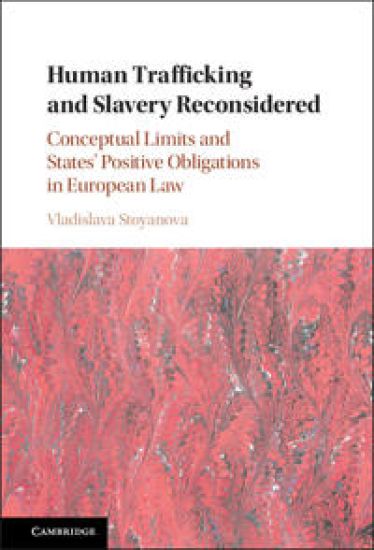
Human Trafficking and Slavery Reconsidered

Human Trafficking and Slavery Reconsidered

Vladislava Stoyanova

Cambridge University Press
2017
sidottu
By reconsidering the definitions of human trafficking, slavery, servitude and forced labour, Vladislava Stoyanova demonstrates how, in embracing the human trafficking framework, the international community has sidelined the human rights law commitments against slavery, servitude and forced labour that in many respects provide better protection for abused migrants. Stoyanova proposes two corrective steps to this development: placing a renewed emphasis on determining the definitional scope of slavery, servitude or forced labour, and gaining a clearer understanding of states' positive human rights obligations. This book compares anti-trafficking and human rights frameworks side-by-side and focuses its analysis on the Council of Europe's Trafficking Convention and Article 4 of the European Convention on Human Rights. With innovative arguments and pertinent case studies, this book is an important contribution to the field and will appeal to students, scholars and legal practitioners interested in human rights law, migration law, criminal law and EU law.