Kirjojen hintavertailu – 12 859 819 kirjaa ja 27 kauppaa

Kirjailija

Voltaire

Kirjat ja teokset yhdessä paikassa: 1 822 kirjaa, julkaisuja vuosilta 1800–2026, suosituimpiin kuuluu OEuvres complètes de Voltaire 79A(II). Vertaile teosten hintoja ja tarkista saatavuus suomalaisista kirjakaupoista.

Nimi esiintyy myös muodoissa: - Voltaire, Voltaire., * Voltaire

1 822 kirjaa

Kirjojen julkaisuvuodet: 1800–2026.

Candide

Candide

Voltaire

WAKING LION PRESS
2012
sidottu
Why do bad things happen to good people? Well, why not? The handsome young Candide, having been taught that this is the best of all possible worlds, quickly learns that is far from true. Literally booted out of his home, he is conscripted as a soldier, beaten, and subjected to nearly every indignity Voltaire's fertile imagination could conceive. In spite of it all, he continues to search for happiness--and for love. Alive with wit, brilliance, and graceful storytelling, "Candide" has become Voltaire's most celebrated work. And rightfully so. When we observe such things as the horrors of religious fanaticism and the appalling dangers of political and corporate stupidity, we must surely conclude that we can still profit by the example of lucidity, the acumen, the intellectual honesty, and the moral courage of Voltaire's Candide. Newly designed and typeset by Waking Lion Press.
Un Jeu de Lettres

Un Jeu de Lettres

Voltaire

Editions Paradigme
2011
nidottu
Seventy-eight letters, coming from the Institut et Musee Voltaire de Geneve. Most of them were unpublished, addressed to or sent by Voltaire. This corpus makes it possible to shed light on some aspects of the construction of his work.
Commentaires sur Corneille I

Commentaires sur Corneille I

Voltaire

Voltaire Foundation Ltd
2011
sidottu
Sold as a multi-volume set - the individual volumes are not available for purchase. Voltaire claimed that his monumental "Commentaires sur Corneille" was among his proudest achievements. However, though highly influential within his own lifetime the commentary quickly generated hostility from critics, and even embarrassment, after the eighteenth century. This set of three volumes is the only modern critical edition of Voltaire's longest, most sustained piece of literary criticism, and demonstrates ably that the commentary is not simply concerned with Pierre Corneille, but covers an enormously rich territory outside the immediate area of Corneilian theatre, with its treatment of plays by Shakespeare, Calderon, Racine and Thomas Corneille. Furthermore, Voltaire's notes reflect his thoughts, distilled over half a century, on literature, language, taste, beauty and decadence, at a pivotal stage of his evolution as a critic of French and European culture.
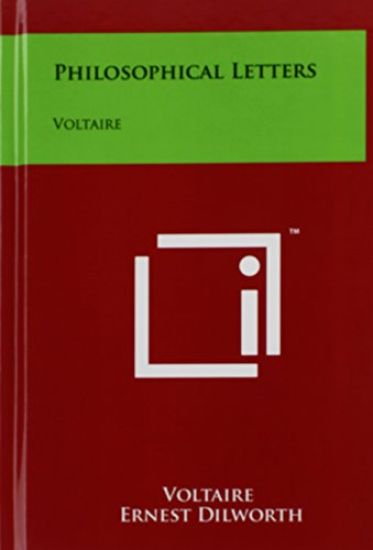
Philosophical Letters: Voltaire

Philosophical Letters: Voltaire

Voltaire

Literary Licensing, LLC
2011
nidottu
The voice of the Age of Reason remarks on English religion and politics during the early 18th century: Quakers, Church of England, Presbyterians, Anti-Trinitarians, Parliament, government, commerce, plus essays on Locke, Descartes, and Newton. Voltaire's observations on English tolerance sounded a revolutionary note among European readers that resonated long after the book's first publication.
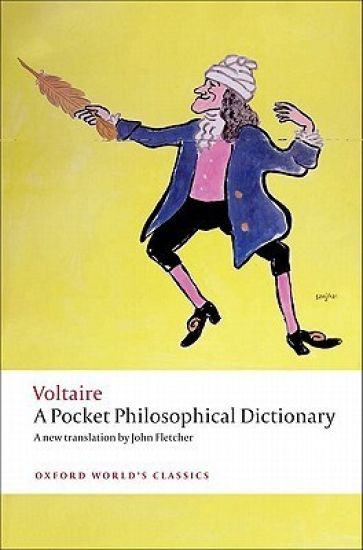
A Pocket Philosophical Dictionary

A Pocket Philosophical Dictionary

Voltaire

Oxford University Press
2011
nidottu
'What can you say to a man who tells you he prefers obeying God rather than men, and that as a result he's certain he'll go to heaven if he cuts your throat?' Voltaire's Pocket Philosophical Dictionary, first published in 1764, is a major work of the European Enlightenment. It is also a highly entertaining book: this is no 'dictionary' in the ordinary sense, nor does it treat 'philosophy' in the modern meaning of the term. It consists of a sequence of short essays or articles, arranged in alphabetical order, and covering everything from Apocalypse and Atheism to Tolerance and Tyranny. The unifying thread of these articles is Voltaire's critique of established religion: ridicule of established dogma, attacks on superstition, and pleas for toleration. Witty and ironic, this is very much a work of combat, part of Voltaire's high-profile political struggle in the 1760s to defend the victims of religious and political intolerance. This new translation is based on the definitive French text, and reprints the edition that provoked widespread controversy and condemnation. In his Introduction Nicholas Cronk considers the work's continuing relevance to modern debates about religious intolerance and its consequences. ABOUT THE SERIES: For over 100 years Oxford World's Classics has made available the widest range of literature from around the globe. Each affordable volume reflects Oxford's commitment to scholarship, providing the most accurate text plus a wealth of other valuable features, including expert introductions by leading authorities, helpful notes to clarify the text, up-to-date bibliographies for further study, and much more.
Philosophical Letters: Voltaire

Philosophical Letters: Voltaire

Voltaire

Literary Licensing, LLC
2011
sidottu
Philosophical Letters: Voltaire is a collection of letters written by the French philosopher and writer, Voltaire. The book is a compilation of 24 letters, originally published in 1734, which were written during Voltaire's stay in England between 1726 and 1729. The letters are written in the form of essays and cover a wide range of topics such as religion, politics, science, and literature. In these letters, Voltaire provides a critical analysis of English society, culture and politics, and compares them with those of France. He praises the English for their religious tolerance, freedom of speech, and their scientific advancements. He also criticizes the English monarchy, the Church of England, and their legal system. Voltaire's writing style is witty, satirical, and often humorous, making his criticisms more palatable. The letters are written in a conversational tone, making them accessible to a wider audience. Overall, Philosophical Letters: Voltaire is a significant work of the Enlightenment period, which had a profound impact on the intellectual and cultural development of Europe. It is a must-read for anyone interested in philosophy, politics, and literature. This scarce antiquarian book is a facsimile reprint of the old original and may contain some imperfections such as library marks and notations. Because we believe this work is culturally important, we have made it available as part of our commitment for protecting, preserving, and promoting the world's literature in affordable, high quality, modern editions, that are true to their original work.
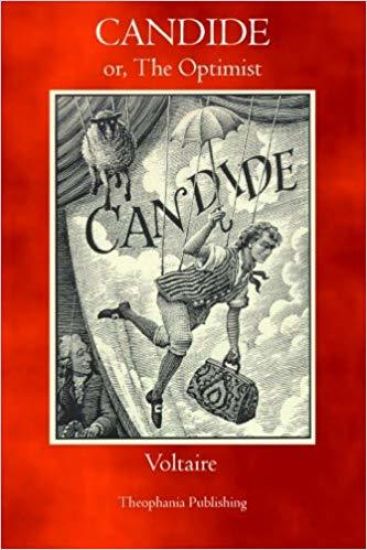
Candide

Candide

Voltaire

Theophania Publishing
2011
nidottu
Thank you for checking out this book by Theophania Publishing. We appreciate your business and look forward to serving you soon. We have thousands of titles available, and we invite you to search for us by name, contact us via our website, or download our most recent catalogues. Candide, ou l'Optimisme is a French satire written in 1759 by Voltaire, a philosopher of the Age of Enlightenment. The novella has been widely translated, with English versions titled Candide: or, All for the Best (1759); Candide: or, The Optimist (1762); and Candide: or, Optimism (1947). It begins with a young man, Candide, who is living a sheltered life in an Edenic paradise and being indoctrinated with Leibnizian optimism (or simply Optimism) by his mentor, Pangloss. The work describes the abrupt cessation of this lifestyle, followed by Candide's slow, painful disillusionment as he witnesses and experiences great hardships in the world. Voltaire concludes with Candide, if not outright rejecting optimism, advocating an enigmatic precept, "we must cultivate our garden", in lieu of the Leibnizian mantra of Pangloss, "all is for the best in the best of all possible worlds". Candide is characterised by its sarcastic tone, as well as by its erratic, fantastical and fast-moving plot. A picaresque novel with a story similar to that of a more serious bildungsroman, it parodies many adventure and romance clich s, the struggles of which are caricatured in a tone that is mordantly matter of fact. Still, the events discussed are often based on historical happenings, such as the Seven Years' War and the 1755 Lisbon earthquake. As philosophers of Voltaire's day contended with the problem of evil, so too does Candide in this short novel, albeit more directly and humorously. Voltaire ridicules religion, theologians, governments, armies, philosophies, and philosophers through allegory; most conspicuously, he assaults Leibniz and his optimism.

A Philosophical Dictionary: Volumes IX & X

A Philosophical Dictionary: Volumes IX & X

Voltaire

Theophania Publishing
2011
nidottu
Thank you for checking out this book by Theophania Publishing. We appreciate your business and look forward to serving you soon. We have thousands of titles available, and we invite you to search for us by name, contact us via our website, or download our most recent catalogues. "Between two servants of Humanity, who appeared eighteen hundred years apart, there is a mysterious relation. Let us say it with a sentiment of profound respect: JESUS WEPT: VOLTAIRE SMILED. Of that divine tear and of that human smile is composed the sweetness of the present civilization." -- Victor Hugo. A PHILOSOPHICAL DICTIONARY. The DICTIONNAIRE PHILOSOPHIQUE is Voltaire's principal essay in philosophy, though not a sustained work. The miscellaneous articles he contributed to Diderot's ENCYCLOP DIE which compose this Dictionary embody a mass of scholarly research, criticism, and speculation, lit up with pungent sallies at the formal and tyrannous ecclesiasticism of the period and the bases of belief on which it stood. These short studies reflect every phase of Voltaire's sparkling genius. Though some of the views enunciated in them are now universally held, and others have become obsolete through extended knowledge, they were startlingly new when Voltaire, at peril of freedom and reputation, spread them before the people of all civilized nations, who read them still with their first charm of style and substance. -- Oliver H. G. Leigh.
A Philosophical Dictionary: Volumes VII & VIII
Thank you for checking out this book by Theophania Publishing. We appreciate your business and look forward to serving you soon. We have thousands of titles available, and we invite you to search for us by name, contact us via our website, or download our most recent catalogues. "Between two servants of Humanity, who appeared eighteen hundred years apart, there is a mysterious relation. Let us say it with a sentiment of profound respect: JESUS WEPT: VOLTAIRE SMILED. Of that divine tear and of that human smile is composed the sweetness of the present civilization." -- Victor Hugo. A PHILOSOPHICAL DICTIONARY. The DICTIONNAIRE PHILOSOPHIQUE is Voltaire's principal essay in philosophy, though not a sustained work. The miscellaneous articles he contributed to Diderot's ENCYCLOP DIE which compose this Dictionary embody a mass of scholarly research, criticism, and speculation, lit up with pungent sallies at the formal and tyrannous ecclesiasticism of the period and the bases of belief on which it stood. These short studies reflect every phase of Voltaire's sparkling genius. Though some of the views enunciated in them are now universally held, and others have become obsolete through extended knowledge, they were startlingly new when Voltaire, at peril of freedom and reputation, spread them before the people of all civilized nations, who read them still with their first charm of style and substance. -- Oliver H. G. Leigh.
A Philosophical Dictionary: Volumes V & VI

A Philosophical Dictionary: Volumes V & VI

Voltaire

Theophania Publishing
2011
nidottu
Thank you for checking out this book by Theophania Publishing. We appreciate your business and look forward to serving you soon. We have thousands of titles available, and we invite you to search for us by name, contact us via our website, or download our most recent catalogues. "Between two servants of Humanity, who appeared eighteen hundred years apart, there is a mysterious relation. Let us say it with a sentiment of profound respect: JESUS WEPT: VOLTAIRE SMILED. Of that divine tear and of that human smile is composed the sweetness of the present civilization." -- Victor Hugo. A PHILOSOPHICAL DICTIONARY. The DICTIONNAIRE PHILOSOPHIQUE is Voltaire's principal essay in philosophy, though not a sustained work. The miscellaneous articles he contributed to Diderot's ENCYCLOP DIE which compose this Dictionary embody a mass of scholarly research, criticism, and speculation, lit up with pungent sallies at the formal and tyrannous ecclesiasticism of the period and the bases of belief on which it stood. These short studies reflect every phase of Voltaire's sparkling genius. Though some of the views enunciated in them are now universally held, and others have become obsolete through extended knowledge, they were startlingly new when Voltaire, at peril of freedom and reputation, spread them before the people of all civilized nations, who read them still with their first charm of style and substance. -- Oliver H. G. Leigh.
A Philosophical Dictionary: Volumes I & II

A Philosophical Dictionary: Volumes I & II

Voltaire

Theophania Publishing
2011
nidottu
Thank you for checking out this book by Theophania Publishing. We appreciate your business and look forward to serving you soon. We have thousands of titles available, and we invite you to search for us by name, contact us via our website, or download our most recent catalogues. "Between two servants of Humanity, who appeared eighteen hundred years apart, there is a mysterious relation. Let us say it with a sentiment of profound respect: JESUS WEPT: VOLTAIRE SMILED. Of that divine tear and of that human smile is composed the sweetness of the present civilization." -- Victor Hugo. A PHILOSOPHICAL DICTIONARY. The DICTIONNAIRE PHILOSOPHIQUE is Voltaire's principal essay in philosophy, though not a sustained work. The miscellaneous articles he contributed to Diderot's ENCYCLOP DIE which compose this Dictionary embody a mass of scholarly research, criticism, and speculation, lit up with pungent sallies at the formal and tyrannous ecclesiasticism of the period and the bases of belief on which it stood. These short studies reflect every phase of Voltaire's sparkling genius. Though some of the views enunciated in them are now universally held, and others have become obsolete through extended knowledge, they were startlingly new when Voltaire, at peril of freedom and reputation, spread them before the people of all civilized nations, who read them still with their first charm of style and substance. -- Oliver H. G. Leigh.