Kirjojen hintavertailu – 12 866 730 kirjaa ja 27 kauppaa
Kirjailija
W. Brian Arthur
Kirjat ja teokset yhdessä paikassa: 6 kirjaa, julkaisuja vuosilta 1994–2019, suosituimpiin kuuluu The Economy As An Evolving Complex System II. Vertaile teosten hintoja ja tarkista saatavuus suomalaisista kirjakaupoista.
Nimi esiintyy myös muodoissa: W Brian Arthur, W.Brian Arthur
A new view of the economy as an evolving, complex system has been pioneered at the Santa Fe Institute over the last ten years, This volume is a collection of articles that shape and define this view?a view of the economy as emerging from the interactions of individual agents whose behavior constantly evolves, whose strategies and actions are always adapting. The traditional framework in economics portrays activity within an equilibrium steady state. The interacting agents in the economy are typically homogenous, solve well-defined problems using perfect rationality, and act within given legal and social structures. The complexity approach, by contrast, sees economic activity as continually changing?continually in process. The interacting agents are typically heterogeneous, they must cognitively interpret the problems they face, and together they create the structures?markets, legal and social institutions, price patters, expectations?to which they individually react. Such structures may never settle down. Agents may forever adapt and explore and evolve their behaviors within structures that continually emerge and change and disappear?structures these behaviors co-create. This complexity approach does not replace the equilibrium one?it complements it. The papers here collected originated at a recent conference at the Santa Fe Institute, which was called to follow up the well-known 1987 SFI conference organized by Philip Anderson, Kenneth Arrow, and David Pines. They survey the new study of complexity and the economy. They apply this approach to real economic problems and they show the extent to which the initial vision of the 1987 conference has come to fruition.
Economics is changing. In the last few years it has generated a number of new approaches. One of the most promising - complexity economics - was pioneered in the 1980s and 1990s by a small team at the Santa Fe Institute. Economist and complexity theorist W. Brian Arthur led that team, and in this book he collects many of his articles on this new approach. The traditional framework sees behavior in the economy as in an equilibrium steady state. People in the economy face well-defined problems and use perfect deductive reasoning to base their actions on. The complexity framework, by contrast, sees the economy as always in process, always changing. People try to make sense of the situations they face using whatever reasoning they have at hand, and together create outcomes they must individually react to anew. The resulting economy is not a well-ordered machine, but a complex evolving system that is imperfect, perpetually constructing itself anew, and brimming with vitality. The new vision complements and widens the standard one, and it helps answer many questions: Why does the stock market show moods and a psychology? Why do high-tech markets tend to lock in to the dominance of one or two very large players? How do economies form, and how do they continually alter in structure over time? The papers collected here were among the first to use evolutionary computation, agent-based modeling, and cognitive psychology. They cover topics as disparate as how markets form out of beliefs; how technology evolves over the long span of time; why systems and bureaucracies get more complicated as they evolve; and how financial crises can be foreseen and prevented in the future.
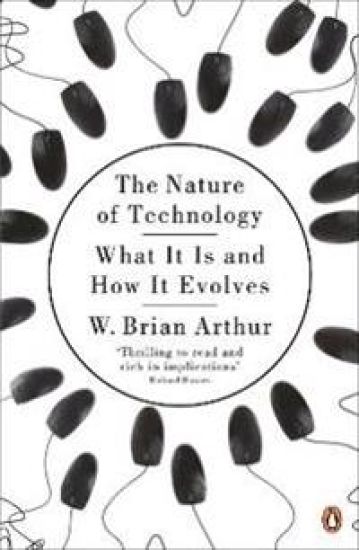
"More than anything else technology creates our world. It creates our wealth, our economy, our very way of being," says W. Brian Arthur. Yet despite technology's irrefutable importance in our daily lives, until now its major questions have gone unanswered. Where do new technologies come from? What constitutes innovation, and how is it achieved? Does technology, like biological life, evolve? In this groundbreaking work, pioneering technology thinker and economist W. Brian Arthur answers these questions and more, setting forth a boldly original way of thinking about technology. The Nature of Technology is an elegant and powerful theory of technology's origins and evolution. Achieving for the development of technology what Thomas Kuhn's The Structure of Scientific Revolutions did for scientific progress, Arthur explains how transformative new technologies arise and how innovation really works. Drawing on a wealth of examples, from historical inventions to the high-tech wonders of today, Arthur takes us on a mind-opening journey that will change the way we think about technology and how it structures our lives. The Nature of Technology is a classic for our times.
In The Nature of Technology, ground-breaking economist W. Brian Arthur explores the extraordinary way in which the technology that surrounds us and allows us to live our modern lives has actually been developed. Rather than coming from a series of one-off inventions, almost all the technology we use today comes from previous developments: these technologies are not being created, but are instead evolving. With fascinating examples, from laser printers to powerplants, Arthur reveals how our own problem-solving skills and creative vision can evolve alongside these technologies, and how this understanding can even improve our understanding of the wider world.
A new view of the economy as an evolving, complex system has been pioneered at the Santa Fe Institute over the last ten years, This volume is a collection of articles that shape and define this view,a view of the economy as emerging from the interactions of individual agents whose behaviour constantly evolves, whose strategies and actions are always adapting. The traditional framework in economics portrays activity within an equilibrium steady state. The interacting agents in the economy are typically homogenous, solve well-defined problems using perfect rationality, and act within given legal and social structures. The complexity approach, by contrast, sees economic activity as continually changing,continually in process. The interacting agents are typically heterogeneous, they must cognitively interpret the problems they face, and together they create the structures,markets, legal and social institutions, price patters, expectations,to which they individually react. Such structures may never settle down. Agents may forever adapt and explore and evolve their behaviours within structures that continually emerge and change and disappear,structures these behaviours co-create. This complexity approach does not replace the equilibrium one,it complements it. The papers here collected originated at a recent conference at the Santa Fe Institute, which was called to follow up the well-known 1987 SFI conference organized by Philip Anderson, Kenneth Arrow, and David Pines. They survey the new study of complexity and the economy. They apply this approach to real economic problems and they show the extent to which the initial vision of the 1987 conference has come to fruition.
This book brings together Professor Arthur’s pioneering article and provide a comprehensive presentation of his exciting vision of an economics that incorporates increasing returns. After a decade of resistance from economists, these ideas are now being widely discussed and adopted, as Kenneth Arrow recounts in his foreword. In fundamental ways they are changing our views of the working economy.