

Kirjailija
W. E. Gladstone
Kirjat ja teokset yhdessä paikassa: 53 kirjaa, julkaisuja vuosilta 1982–2025, suosituimpiin kuuluu The Speeches, In Full, Of Rt. Hon. W. E. Gladstone, And William O'Brien On Home Rule. Vertaile teosten hintoja ja tarkista saatavuus suomalaisista kirjakaupoista.
Nimi esiintyy myös muodoissa: W E Gladstone
53 kirjaa
Kirjojen julkaisuvuodet: 1982–2025.
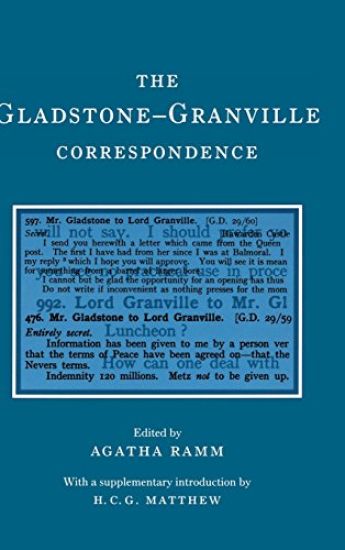
The Gladstone-Granville Correspondence
W. E. Gladstone; Lord Granville
Cambridge University Press
1998
sidottu
Agatha Ramm’s two volumes containing correspondence between Gladstone and his Foreign Secretary, Lord Granville, conducted at the height of British colonial power during the years 1868–1876, were published originally in 1952. This correspondence is now available in a single volume, and lends the mass of government papers usually studied by historians ‘the enlivening touch’. The correspondence contained in the volumes is between two men who wrote to each other privately, but about matters which were, as Professor Matthew states in his introduction, ‘the very stuff of official diplomatic exchange’. It also deals with the period of opposition during Disraeli’s government of 1874-1880, as well as a wide range of non-political matters, in which the two men were active whether in or out of government. This Reprint gives the reader a valuable insight into the two correspondents and will, therefore, be of great interest to scholars of British history.
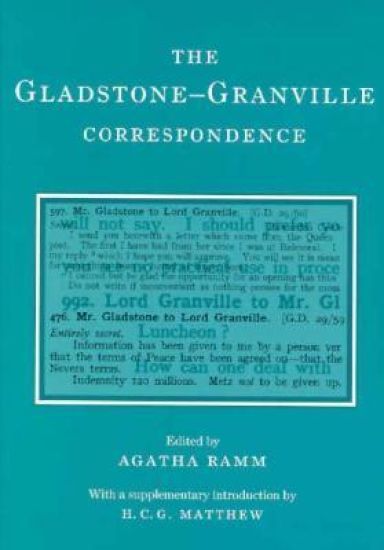
The Gladstone-Granville Correspondence
W. E. Gladstone; Lord Granville
Cambridge University Press
1998
pokkari
Agatha Ramm’s two volumes containing correspondence between Gladstone and his Foreign Secretary, Lord Granville, conducted at the height of British colonial power during the years 1868–1876, were published originally in 1952. This correspondence is now available in a single volume, and lends the mass of government papers usually studied by historians ‘the enlivening touch’. The correspondence contained in the volumes is between two men who wrote to each other privately, but about matters which were, as Professor Matthew states in his introduction, ‘the very stuff of official diplomatic exchange’. It also deals with the period of opposition during Disraeli’s government of 1874-1880, as well as a wide range of non-political matters, in which the two men were active whether in or out of government. This Reprint gives the reader a valuable insight into the two correspondents and will, therefore, be of great interest to scholars of British history.
The last two volumes of Gladstone's diaries depict the extraordinary energy of a remarkable octogenarian: Gladstone was eighty-four when he resigned the Premiership in 1894 to close his fourth administration. His pursuit of `justice for Ireland' through the successful passage of a Home Rule Bill through the Commons in 1893 forms the political centrepiece of these volumes. But there is also a wealth of material on imperial, foreign, domestic, and religious politics contained in the daily diary enteries, the minutes of the Cabinets of the 1892-4 government, and the five hundred letters which accompany the enteries for the governmental period. Gladstone's life-style made few concessions to his age: his reading, writing, theatre-going, and trips abroad continue, as do his speech-writing and his church-going. His declining eyesight eventually curtailed his reading and led to the end of regular diary-writing in 1894. His vast diary, which he began in 1825, ends in 1896. Its final entries are a moving conclusion to one of the most remarkable and one the most curious documents of British history.
The index to the thirteen text volumes of The Gladstone Diaries 1825-1896 has three parts. First `Dramatis Personae', a list of the 20,500 people mentioned by Gladstone in his diaries. Secondly `Gladstone's Lifetime Reading', a bibliography of the 20,000 books, pamphlets, and articles, whose reading he records in his diaries, with the dates when he read them. This is a bibliography of remarkable cultural interest. It is probably the most ambitious attempt by a public figure to note his or her reading and it is certainly unique as a printed record of the lifetime's reading of am eminent Briton. Thirdly, a `Subject Index' which is the reader's most direct way into the extraordinary range of subjects covered in the thirteen text volumes. It is effectively an index to most of British public life from 1830 until 1896. About two hundred of the people who figure most prominently in the diaries are included in the Subject Index (in addition to the `Dramatis Personae') with detailed analytic entries. It also includes a bibliography of Gladstone's own writings as he recorded them in his diaries. This is a culmination of H. C. G. Matthew's acclaimed edition of Gladstone's diaries, correspondence, and other papers. It is an invaluable reference tool and an essential key to a magisterial work of scholarship.
The last two volumes of Gladstone's diaries depict the extraordinary energy of a remarkable octogenarian: Gladstone was eighty-four when he resigned the Premiership in 1894 to close his fourth administration. His pursuit of 'justice for Ireland' through the successful passage of a Home Rule Bill through the Commons in 1893 forms the political centrepiece of these volumes. But there is also a wealth of material on imperial, foreign, domestic, and religious politics contained in the daily diary entries, the minutes of the Cabinets of the 1892-4 government, and the five hundred letters which accompany the entries for the governmental period. Gladstone's life-style made few concessions to his age: his reading, writing, theatre-going, and trips abroad continue, as do his speech-making and his church-going. His declining eyesight eventually curtailed his reading and led to the end of regular diary-writing in 1894. His vast diary, which he began in 1825, ends in 1896. Its final entries are a moving conclusion to one of the most remarkable and one of the most curious documents of British history.
The Gladstone Diaries: Volume 10: January 1881-June 1883
W. E. Gladstone
Clarendon Press
1990
sidottu
The tenth and eleventh volumes of Gladstone's diaries (1881-1886) cover the years of his dramatic second and third administrations. The second administration confronted a series of crises: the Land League Campaign and the Phoenix Park murders, Majuba Hill and South Africa, Gordon and the Sudan, and the obstruction of franchise reform by the House of Lords. The administration met these with determined assertion of administrative and legislative reforms, more coherent in policy and more consistent in practice than is often realized. Gladstone's third administration in 1886 attempted to pacify Ireland by granting Home Rule and in doing so provided one of the most exciting and controversial twelve months in British politics since the Civil War. These volumes include not only the daily text of Gladstone's private diaries (maintained almost without a break) but also all of his Cabinet Minutes, hitherto unpublished and themselves a remarkable, and for the Victorian period, unique diary of decision-making. There are over 1400 of the letters (the vast majority hitherto unpublished) which he wrote in those years. These letters flesh out the daily diary and the Cabinet Minutes, and cover the Church, the Queen and the Court, literature, theatre, art, and domestic affairs. There is much material in these volumes on Gladstone's unsuccessful but repeated attempts to retire from political office. The volumes offer an extraordinary narrative of great force, a remarkable mixture of achievement and disappointment, of bold legislation and administrative and political disasters. They display some of the innermost thoughts of an astonishing political personality which mesmerized contemporaries and has continued to fascinate historians and general readers.
The Gladstone Diaries: Volume 11: July 1883-December 1886
W. E. Gladstone
Clarendon Press
1990
sidottu
The tenth and eleventh volumes of Gladstone's Diaries cover the years of his extraordinary second and third administrations. There is much new material on the occupation of Egypt, the `scramble for Africa', the third Reform Bill, and the crisis in Ireland leading eventually to the proposed Home Rule settlement in 1886 and the split of the Liberal Party. The volumes include not only the daily text of Gladstone's personal diary for these years, but also the minutes that he kept of his Cabinets - over 250 in these volumes - and over 1400 of the letters on politics, religion, literature, and personal affairs which he wrote in these years. The editors long introduction offers an interpretation of this remarkable material and in itself constitutes an important contribution to our understanding of Victorian Britain. The governments of the 1880s are the most controversial of Gladstone's career. These two volumes - both in the quality and the quantity of the material they contain - vastly increase our knowledge of late-Victorian government and politics and will be an essential source for many generations of historians.
The Gladstone Diaries: Volume 9: January 1875-December 1880
W. E. Gladstone
Oxford University Press
1986
sidottu
This volume covers some of the most dramatic years of Gladstone's political life: his formal retirement from politics in 1875, his return to take the lead in the Bulgarian Atrocities campaign in 1876, the Midlothian Campaigns of 1879-80, and the opening months of his return to power in 1880.
The Gladstone Diaries: Volume 7: January 1869-June 1871
W. E. Gladstone
Oxford University Press
1982
sidottu
The Gladstone Diaries Volume 7: January 1869-June 1871
The Gladstone Diaries: Volume 8: July 1871-December 1874
W. E. Gladstone
Oxford University Press
1982
sidottu
Volume XIV contains comprehensive indexes to the entire thirteen volumes of W. E. Gladstone's diaries, comprising the Index of Persons, the Subject Index, and the Index of Gladstone's Reading. It is effectively an index to most of British public life from 1830 to 1896.