Kirjojen hintavertailu – 12 903 725 kirjaa ja 27 kauppaa

Kirjailija

W. Lance Bennett

Kirjat ja teokset yhdessä paikassa: 10 kirjaa, julkaisuja vuosilta 1997–2020, suosituimpiin kuuluu Reconstructing Reality in the Courtroom: Justice and Judgment in American Culture. Vertaile teosten hintoja ja tarkista saatavuus suomalaisista kirjakaupoista.

Nimi esiintyy myös muodoissa: W Lance Bennett

10 kirjaa

Kirjojen julkaisuvuodet: 1997–2020.

Communicating the Future

Communicating the Future

W. Lance Bennett

Polity Press
2020
nidottu
We are facing an unprecedented environmental crisis. How can we communicate and act more effectively to make the political and economic changes required to survive and even thrive within the life-support capacities of our planet? This is the question at the heart of W. Lance Bennett’s much-anticipated book. Bennett challenges readers to consider how best to approach the environmental crisis by changing how we think about the relationships between environment, economy, and democracy. He introduces a framework that citizens, practitioners, and scholars can use to evaluate common but unproductive communication that blocks thinking about change; develop more effective ways to define and approach problems; and design communication processes to engage diverse publics and organizations in developing understandings, goals, and political strategies. Until advocates develop economic programs with built-in environmental solutions, they will continue to lose policy fights. Putting “intersectional” communication into action requires acknowledging that communication is not only an exchange of messages, but an organizational process. Communicating the Future is important reading for students and scholars of media and communication, as well as general readers concerned about the environmental crisis.
Communicating the Future

Communicating the Future

W. Lance Bennett

Polity Press
2020
sidottu
We are facing an unprecedented environmental crisis. How can we communicate and act more effectively to make the political and economic changes required to survive and even thrive within the life-support capacities of our planet? This is the question at the heart of W. Lance Bennett’s much-anticipated book. Bennett challenges readers to consider how best to approach the environmental crisis by changing how we think about the relationships between environment, economy, and democracy. He introduces a framework that citizens, practitioners, and scholars can use to evaluate common but unproductive communication that blocks thinking about change; develop more effective ways to define and approach problems; and design communication processes to engage diverse publics and organizations in developing understandings, goals, and political strategies. Until advocates develop economic programs with built-in environmental solutions, they will continue to lose policy fights. Putting “intersectional” communication into action requires acknowledging that communication is not only an exchange of messages, but an organizational process. Communicating the Future is important reading for students and scholars of media and communication, as well as general readers concerned about the environmental crisis.

News

News

W. Lance Bennett

University of Chicago Press
2016
nidottu
For over thirty years, News: The Politics of Illusion has not simply reflected the political communication field it has played a major role in shaping it. Today, the familiar news organizations of the legacy press are operating in a fragmenting and expanding mediaverse that resembles a big bang of proliferating online competitors that are challenging the very definition of news itself. Audience-powered sites such as the Huffington Post and Vox blend conventional political reporting with opinion blogs, celebrity gossip, and other ephemera aimed at getting clicks and shares. At the same time, the rise of serious investigative organizations such as ProPublica presents yet a different challenge to legacy journalism. Lance Bennett's thoroughly revised tenth edition offers the most up-to-date guide to understanding how and why the media and news landscapes are being transformed. It explains the mix of old and new, and points to possible outcomes. Where areas of change are clearly established, key concepts from earlier editions have been revised. There are new case studies, updates on old favorites, and insightful analyses of how the new media system and novel kinds of information and engagement are affecting our politics. As always, News presents fresh evidence and arguments that invite new ways of thinking about the political information system and its place in democracy.
The Logic of Connective Action

The Logic of Connective Action

W. Lance Bennett; Alexandra Segerberg

Cambridge University Press
2013
sidottu
The Logic of Connective Action explains the rise of a personalized digitally networked politics in which diverse individuals address the common problems of our times such as economic fairness and climate change. Rich case studies from the United States, the United Kingdom and Germany illustrate a theoretical framework for understanding how large-scale connective action is coordinated. In many of these mobilizations, communication operates as an organizational process that may replace or supplement familiar forms of collective action based on organizational resource mobilization, leadership, and collective action framing. In some cases, connective action emerges from crowds that shun leaders, as when Occupy protesters created media networks to channel resources and create loose ties among dispersed physical groups. In other cases, conventional political organizations deploy personalized communication logics to enable large-scale engagement with a variety of political causes. The Logic of Connective Action shows how power is organized in communication-based networks, and what political outcomes may result.
When the Press Fails

When the Press Fails

W. Lance Bennett; Regina G. Lawrence; Steven Livingston

University of Chicago Press
2008
nidottu

Halvin toimitettuna 28,10 €

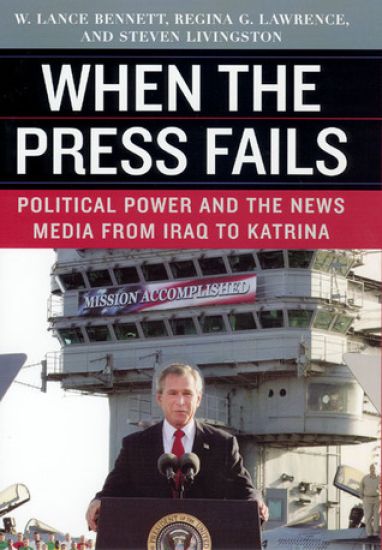
A sobering look at the intimate relationship between political power and the news media, "When the Press Fails" argues that the dependence of reporters on official sources disastrously thwarts coverage of dissenting voices from outside the Beltway. The result is both an indictment of official spin and an urgent call to action that questions why the mainstream press failed to challenge the Bush administration's arguments for an invasion of Iraq or to illuminate administration policies underlying the Abu Ghraib controversy. Drawing on revealing interviews with Washington insiders and analysis of content from major news outlets, the authors illustrate the media's unilateral surrender to White House spin whenever oppositional voices elsewhere in government fall silent. Contrasting these grave failures with the refreshingly critical reporting on Hurricane Katrina - a rare event that caught officials off guard, enabling journalists to enter a nospin zone - "When the Press Fails" concludes by proposing new practices to reduce reporters' dependence on power.
Democracy and the Marketplace of Ideas

Democracy and the Marketplace of Ideas

Erik Asard; W. Lance Bennett

Cambridge University Press
1997
sidottu
How do citizens and leaders in democratic nations communicate about their problems and prospects for the future? What can be learned from other nations about how to communicate in more effective and satisfying ways? These are important questions in an age of instant electronic communication in which the populations of the world's industrial democracies are wired for all manner of input. This book, first published in 1997, explores the institutional links between society and government that shape political communication. These regulators of national communication include parties and electoral representation systems, interest group processes, campaign finance mechanisms, and the media - factors that are familiar to anyone who follows politics yet that may not be recognized for their combined effects on the quality of political discourse. The authors show how these core elements of political systems affect the ways in which people communicate, and how effective that communication is at defining public problems and identifying workable solutions.
Democracy and the Marketplace of Ideas

Democracy and the Marketplace of Ideas

Erik Asard; W. Lance Bennett

Cambridge University Press
1997
pokkari
How do citizens and leaders in democratic nations communicate about their problems and prospects for the future? What can be learned from other nations about how to communicate in more effective and satisfying ways? These are important questions in an age of instant electronic communication in which the populations of the world's industrial democracies are wired for all manner of input. This book, first published in 1997, explores the institutional links between society and government that shape political communication. These regulators of national communication include parties and electoral representation systems, interest group processes, campaign finance mechanisms, and the media - factors that are familiar to anyone who follows politics yet that may not be recognized for their combined effects on the quality of political discourse. The authors show how these core elements of political systems affect the ways in which people communicate, and how effective that communication is at defining public problems and identifying workable solutions.