
Kirjojen hintavertailu – 12 903 725 kirjaa ja 27 kauppaa

Kirjailija

W. M. Goss

Kirjat ja teokset yhdessä paikassa: 3 kirjaa, julkaisuja vuosilta 2017–2023, suosituimpiin kuuluu Joe Pawsey and the Founding of Australian Radio Astronomy. Vertaile teosten hintoja ja tarkista saatavuus suomalaisista kirjakaupoista.

3 kirjaa

Kirjojen julkaisuvuodet: 2017–2023.

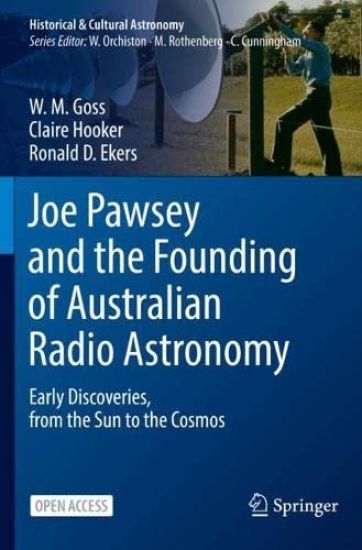
Joe Pawsey and the Founding of Australian Radio Astronomy

Joe Pawsey and the Founding of Australian Radio Astronomy

W. M. Goss; Claire Hooker; Ronald D. Ekers

Springer International Publishing AG
2023
nidottu
This open access book is a biography of Joseph L. Pawsey. It examines not only his life but the birth and growth of the field of radio astronomy and the state of science itself in twentieth century Australia. The book explains how an isolated continent with limited resources grew to be one of the leaders in the study of radio astronomy and the design of instruments to do so. Pawsey made a name for himself in the international astronomy community within a decade after WWII and coined the term radio astronomy. His most valuable talent was his ability to recruit and support bright young scientists who became the technical and methodological innovators of the era, building new telescopes from the Mills Cross and Chris (Christiansen) Cross to the Parkes radio telescope. The development of aperture synthesis and the controversy surrounding the cosmological interpretation of the first major survey which resulted in the Sydney research group's disagreements withNobel laureate Martin Ryle play major roles in this story. This book also shows the connections among prominent astronomers like Oort, Minkowski, Baade, Struve, famous scientists in the UK such as J. A. Ratcliffe, Edward Appleton and Henry Tizard, and the engineers and physicists in Australia who helped develop the field of radio astronomy. Pawsey was appointed the second Director of the National Radio Astronomy Observatory (Green Bank, West Virginia) in October 1961; he died in Sydney at the age of 54 in late November 1962. Upper level students, scientists and historians of astronomy and technology will find the information, much of it from primary sources, relevant to any study of Joseph L. Pawsey or radio astronomy. This open access book includes a Foreword by Woodruff T. Sullivan II.
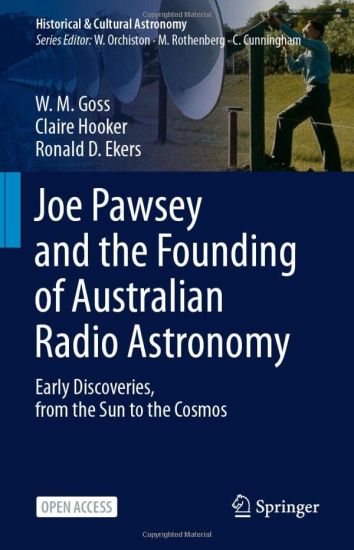
Joe Pawsey and the Founding of Australian Radio Astronomy

Joe Pawsey and the Founding of Australian Radio Astronomy

W. M. Goss; Claire Hooker; Ronald D. Ekers

Springer International Publishing AG
2023
sidottu
This open access book is a biography of Joseph L. Pawsey. It examines not only his life but the birth and growth of the field of radio astronomy and the state of science itself in twentieth century Australia. The book explains how an isolated continent with limited resources grew to be one of the leaders in the study of radio astronomy and the design of instruments to do so. Pawsey made a name for himself in the international astronomy community within a decade after WWII and coined the term radio astronomy. His most valuable talent was his ability to recruit and support bright young scientists who became the technical and methodological innovators of the era, building new telescopes from the Mills Cross and Chris (Christiansen) Cross to the Parkes radio telescope. The development of aperture synthesis and the controversy surrounding the cosmological interpretation of the first major survey which resulted in the Sydney research group's disagreements withNobel laureate Martin Ryle play major roles in this story. This book also shows the connections among prominent astronomers like Oort, Minkowski, Baade, Struve, famous scientists in the UK such as J. A. Ratcliffe, Edward Appleton and Henry Tizard, and the engineers and physicists in Australia who helped develop the field of radio astronomy. Pawsey was appointed the second Director of the National Radio Astronomy Observatory (Green Bank, West Virginia) in October 1961; he died in Sydney at the age of 54 in late November 1962. Upper level students, scientists and historians of astronomy and technology will find the information, much of it from primary sources, relevant to any study of Joseph L. Pawsey or radio astronomy. This open access book includes a Foreword by Woodruff T. Sullivan II.
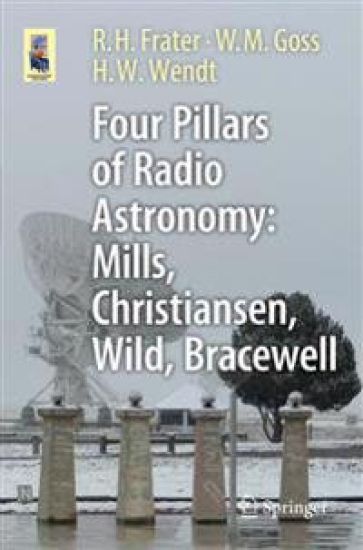
Four Pillars of Radio Astronomy: Mills, Christiansen, Wild, Bracewell

Four Pillars of Radio Astronomy: Mills, Christiansen, Wild, Bracewell

R. H. Frater; W. M. Goss; H. W. Wendt

Springer International Publishing AG
2017
nidottu
This is the story of Bernie Mills, Chris Christiansen, Paul Wild and Ron Bracewell, members of a team of radio astronomers that would lead Australia, and the world, into this new field of research. Each of the four is remembered for his remarkable work: Mills for the development the cross type instrument that now bears his name; Christiansen for the application of rotational synthesis techniques; Wild for the masterful joining of observations and theory to elicit the nature of the solar atmosphere; Bracewell for his contribution to imaging theory. As well, these Four Pillars are remembered for creating a remarkable environment for scientific discovery and for influencing the careers of future generations. Their pursuit of basic science helped pave the way for technological developments in areas ranging from Wi-Fi to sonar to medical imaging to air navigation, and for underpinning the foundations of modern cosmology and astrophysics.