Kirjojen hintavertailu – 12 903 725 kirjaa ja 27 kauppaa

Kirjailija

Walter Carnielli

Kirjat ja teokset yhdessä paikassa: 7 kirjaa, julkaisuja vuosilta 2008–2018, suosituimpiin kuuluu Paraconsistent Logic: Consistency, Contradiction and Negation. Vertaile teosten hintoja ja tarkista saatavuus suomalaisista kirjakaupoista.

7 kirjaa

Kirjojen julkaisuvuodet: 2008–2018.

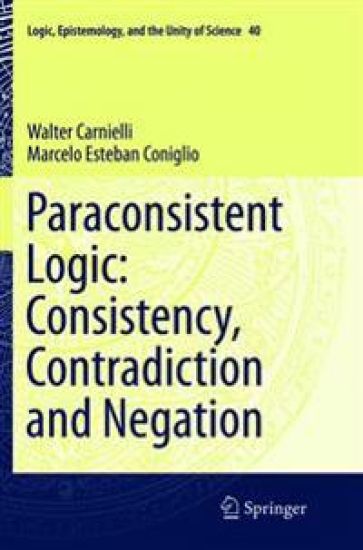
Paraconsistent Logic: Consistency, Contradiction and Negation

Paraconsistent Logic: Consistency, Contradiction and Negation

Walter Carnielli; Marcelo Esteban Coniglio

Springer International Publishing AG
2018
nidottu
This book is the first in the field of paraconsistency to offer a comprehensive overview of the subject, including connections to other logics and applications in information processing, linguistics, reasoning and argumentation, and philosophy of science. It is recommended reading for anyone interested in the question of reasoning and argumentation in the presence of contradictions, in semantics, in the paradoxes of set theory and in the puzzling properties of negation in logic programming. Paraconsistent logic comprises a major logical theory and offers the broadest possible perspective on the debate of negation in logic and philosophy. It is a powerful tool for reasoning under contradictoriness as it investigates logic systems in which contradictory information does not lead to arbitrary conclusions. Reasoning under contradictions constitutes one of most important and creative achievements in contemporary logic, with deep roots in philosophical questions involving negation and consistencyThis book offers an invaluable introduction to a topic of central importance in logic and philosophy. It discusses (i) the history of paraconsistent logic; (ii) language, negation, contradiction, consistency and inconsistency; (iii) logics of formal inconsistency (LFIs) and the main paraconsistent propositional systems; (iv) many-valued companions, possible-translations semantics and non-deterministic semantics; (v) paraconsistent modal logics; (vi) first-order paraconsistent logics; (vii) applications to information processing, databases and quantum computation; and (viii) applications to deontic paradoxes, connections to Eastern thought and to dialogical reasoning.
Paraconsistent Logic: Consistency, Contradiction and Negation

Paraconsistent Logic: Consistency, Contradiction and Negation

Walter Carnielli; Marcelo Esteban Coniglio

Springer International Publishing AG
2016
sidottu
This book is the first in the field of paraconsistency to offer a comprehensive overview of the subject, including connections to other logics and applications in information processing, linguistics, reasoning and argumentation, and philosophy of science. It is recommended reading for anyone interested in the question of reasoning and argumentation in the presence of contradictions, in semantics, in the paradoxes of set theory and in the puzzling properties of negation in logic programming. Paraconsistent logic comprises a major logical theory and offers the broadest possible perspective on the debate of negation in logic and philosophy. It is a powerful tool for reasoning under contradictoriness as it investigates logic systems in which contradictory information does not lead to arbitrary conclusions. Reasoning under contradictions constitutes one of most important and creative achievements in contemporary logic, with deep roots in philosophical questions involving negation and consistencyThis book offers an invaluable introduction to a topic of central importance in logic and philosophy. It discusses (i) the history of paraconsistent logic; (ii) language, negation, contradiction, consistency and inconsistency; (iii) logics of formal inconsistency (LFIs) and the main paraconsistent propositional systems; (iv) many-valued companions, possible-translations semantics and non-deterministic semantics; (v) paraconsistent modal logics; (vi) first-order paraconsistent logics; (vii) applications to information processing, databases and quantum computation; and (viii) applications to deontic paradoxes, connections to Eastern thought and to dialogical reasoning.
Modalities and Multimodalities

Modalities and Multimodalities

Walter Carnielli; Claudio Pizzi

Springer
2010
nidottu
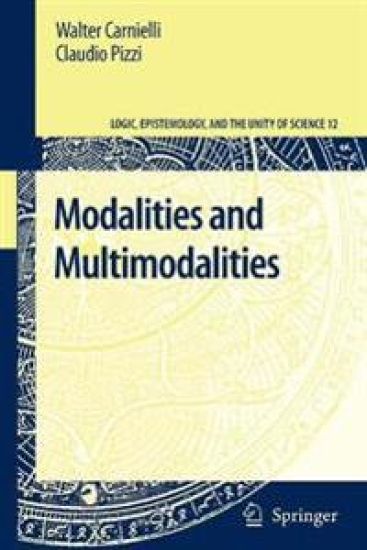
In the last two decades modal logic has undergone an explosive growth, to thepointthatacompletebibliographyofthisbranchoflogic,supposingthat someone were capable to compile it, would ?ll itself a ponderous volume. What is impressive in the growth of modal logic has not been so much the quick accumulation of results but the richness of its thematic dev- opments. In the 1960s, when Kripke semantics gave new credibility to the logic of modalities? which was already known and appreciated in the Ancient and Medieval times? no one could have foreseen that in a short time modal logic would become a lively source of ideas and methods for analytical philosophers,historians of philosophy,linguists, epistemologists and computer scientists. The aim which oriented the composition of this book was not to write a new manual of modal logic (there are a lot of excellent textbooks on the market, and the expert reader will realize how much we bene?ted from manyofthem)buttoo?ertoeveryreader,evenwithnospeci?cbackground in logic, a conceptually linear path in the labyrinth of the current panorama of modal logic. The notion which in our opinion looked suitable to work as a compass in this enterprise was the notion of multimodality, or, more speci?cally, the basic idea of grounding systems on languages admitting more than one primitive modal operator.
Analysis and Synthesis of Logics

Analysis and Synthesis of Logics

Walter Carnielli; Marcelo Coniglio; Dov M. Gabbay; Paula Gouveia; Cristina Sernadas

Springer
2010
nidottu
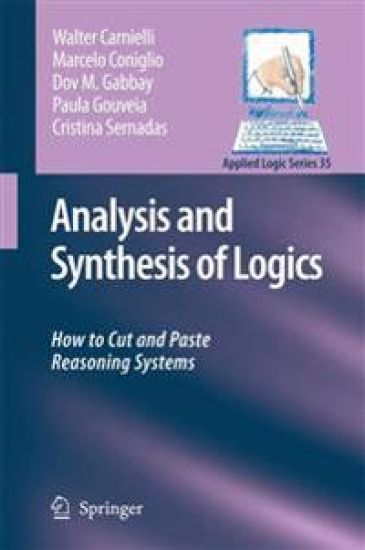
Starting with simple examples showing the relevance of cutting and pasting logics, the monograph develops a mathematical theory of combining and decomposing logics, ranging from propositional and first-order based logics to higher-order based logics as well as to non-truth functional logics. The theory covers mechanisms for combining semantic structures and deductive systems either of the same or different nature (for instance, two Hilbert calculi or a Hilbert calculus and a tableau calculus). The important issue of preservation of properties is extensively addressed. For instance, sufficient conditions are provided for a combined logic to be sound and complete when the original component logics are known to be sound and complete. The book brings the reader to the front line of current research in the field by showing both recent achievements and directions of future investigations (in particular, multiple open problems). It also provides examples of potential applications in emergent fields like security protocols, quantum computing, networks and argumentation theory, besides discussing more classical applications like software specification, knowledge representation, computational linguistics and modular automated reasoning. This monograph will be of interest to researchers and graduate students in mathematical logic, theory of computation and philosophical logic with no previous knowledge of the subject of combining and decomposing logics, but with a working knowledge of first-order logic. The book will also be relevant for people involved in research projects where logic is used as a tool and the need for working with several logics at the same time is mandatory (for instance, temporal, epistemic and probabilistic logics).
Modalities and Multimodalities

Modalities and Multimodalities

Walter Carnielli; Claudio Pizzi

Springer
2009
nidottu
In the last two decades modal logic has undergone an explosive growth, to thepointthatacompletebibliographyofthisbranchoflogic,supposingthat someone were capable to compile it, would ?ll itself a ponderous volume. What is impressive in the growth of modal logic has not been so much the quick accumulation of results but the richness of its thematic dev- opments. In the 1960s, when Kripke semantics gave new credibility to the logic of modalities? which was already known and appreciated in the Ancient and Medieval times? no one could have foreseen that in a short time modal logic would become a lively source of ideas and methods for analytical philosophers,historians of philosophy,linguists, epistemologists and computer scientists. The aim which oriented the composition of this book was not to write a new manual of modal logic (there are a lot of excellent textbooks on the market, and the expert reader will realize how much we bene?ted from manyofthem)buttoo?ertoeveryreader,evenwithnospeci?cbackground in logic, a conceptually linear path in the labyrinth of the current panorama of modal logic. The notion which in our opinion looked suitable to work as a compass in this enterprise was the notion of multimodality, or, more speci?cally, the basic idea of grounding systems on languages admitting more than one primitive modal operator.
Modalities and Multimodalities

Modalities and Multimodalities

Walter Carnielli; Claudio Pizzi

Springer-Verlag New York Inc.
2008
sidottu
In the last two decades modal logic has undergone an explosive growth, to thepointthatacompletebibliographyofthisbranchoflogic,supposingthat someone were capable to compile it, would ?ll itself a ponderous volume. What is impressive in the growth of modal logic has not been so much the quick accumulation of results but the richness of its thematic dev- opments. In the 1960s, when Kripke semantics gave new credibility to the logic of modalities? which was already known and appreciated in the Ancient and Medieval times? no one could have foreseen that in a short time modal logic would become a lively source of ideas and methods for analytical philosophers,historians of philosophy,linguists, epistemologists and computer scientists. The aim which oriented the composition of this book was not to write a new manual of modal logic (there are a lot of excellent textbooks on the market, and the expert reader will realize how much we bene?ted from manyofthem)buttoo?ertoeveryreader,evenwithnospeci?cbackground in logic, a conceptually linear path in the labyrinth of the current panorama of modal logic. The notion which in our opinion looked suitable to work as a compass in this enterprise was the notion of multimodality, or, more speci?cally, the basic idea of grounding systems on languages admitting more than one primitive modal operator.
Analysis and Synthesis of Logics

Analysis and Synthesis of Logics

Walter Carnielli; Marcelo Coniglio; Dov M. Gabbay; Paula Gouveia; Cristina Sernadas

Springer-Verlag New York Inc.
2008
sidottu
Starting with simple examples showing the relevance of cutting and pasting logics, the monograph develops a mathematical theory of combining and decomposing logics, ranging from propositional and first-order based logics to higher-order based logics as well as to non-truth functional logics. The theory covers mechanisms for combining semantic structures and deductive systems either of the same or different nature (for instance, two Hilbert calculi or a Hilbert calculus and a tableau calculus). The important issue of preservation of properties is extensively addressed. For instance, sufficient conditions are provided for a combined logic to be sound and complete when the original component logics are known to be sound and complete. The book brings the reader to the front line of current research in the field by showing both recent achievements and directions of future investigations (in particular, multiple open problems). It also provides examples of potential applications in emergent fields like security protocols, quantum computing, networks and argumentation theory, besides discussing more classical applications like software specification, knowledge representation, computational linguistics and modular automated reasoning. This monograph will be of interest to researchers and graduate students in mathematical logic, theory of computation and philosophical logic with no previous knowledge of the subject of combining and decomposing logics, but with a working knowledge of first-order logic. The book will also be relevant for people involved in research projects where logic is used as a tool and the need for working with several logics at the same time is mandatory (for instance, temporal, epistemic and probabilistic logics).