Kirjojen hintavertailu – 12 859 818 kirjaa ja 27 kauppaa
Kirjailija
Walter Kaufmann
Kirjat ja teokset yhdessä paikassa: 10 kirjaa, julkaisuja vuosilta 1991–2017, suosituimpiin kuuluu The Portable Nietzsche. Vertaile teosten hintoja ja tarkista saatavuus suomalaisista kirjakaupoista.
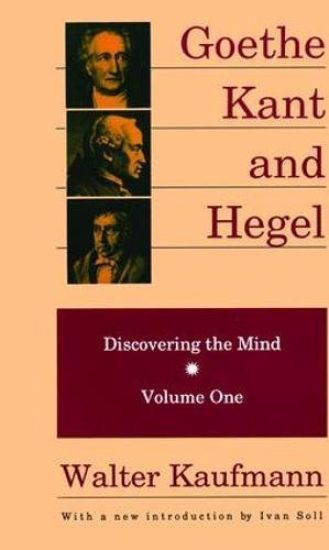
This immensely readable and absorbing book - the first of a three-volume series on understanding the human mind - concentrates on three major figures who have changed our image of human beings. Kaufmann drastically revises traditional conceptions of Goethe, Kant, and Hegel, showing how their ideas about the mind were shaped by their own distinctive mentalities. Kaufmann's version of psychohistory stays clear of gossip and is carefully documented. He offers us a radically new understanding of two centuries of intellectual history, but his primary focus is on self-knowledge. He is in a unique position to perform this task by virtue of being, according to Stephen Spender, "the best translator of Faust"; and in Sidney Hook's view, "unquestionably the most interesting and informative writer of Hegel in English." The foremost interpreter of Kant, Lewis White Beck, has called this book on Goethe, Kant, and. Hegel "fascinating" - a work which "will stir up a good many people by telling them things they have never heard, and providing an alternative to what is the accepted reading of that part of the history of philosophy. The story of how personality affects philosophy has never been better told." We are shown how Goethe advanced the discovery of the mind more than anyone before him, while Kant was in many ways a disaster. Hegel, like others between 1790 to 1990, tried to reconcile Kant and Goethe. Kaufmann shows this is impossible He paints a large picture, but he is always highly specific and details the major contributions of Goethe and Hegel as well as the ways in which Kant's immense influence proved catastrophic.
This book locates the humanities in six general fields of study: religion and philosophy, art and music, and literature and history. It offers suggestions for interdisciplinary work around topics such as punishment, and death and dying.
This book provides a description and preservation of Oriental notational systems, the study of which makes possible a deeper understanding of Eastern art music and demonstrates its character to the student more meaningfully than does the mere presentation of recordings and musical examples written in Western staff notation. The numerous problems arising from styles and techniques which are based upon improvisation and extramusical concepts are also considered. The purposes of this study will have been fulfilled if it serves as a stimulus toward further research in this fascinating, but, alas, quickly vanishing field. The presentation of Eastern notations may also provide some aesthetic pleasure from the study of unusual and often complex systems and symbols. —from the Preface
The present doctoral thesis was developed within the framework of the research project "Deformation Capacity of Structural Concrete". This project aims at developing a consistent and experimentally verified theory of the deformation capacity of structural concrete. Previous work included the development of a theoretical model, the so-called Tension Chord Model, which allows a comprehensive description of the load-deforma tion behaviour of tension members in non-prestressed and prestressed concrete struc tures. The present work focuses on a new theoretical model, the so-called Cracked Mem brane Model. For members subjected to in-plane forces this new model combines the ba sic concepts of the modified compression field theory and the tension chord model. Crack spacings and tension stiffening effects in cracked membranes are determined from first principles and the link to plasticity theory methods is maintained since equilibrium conditions are formulated in terms of stresses at the cracks rather than average stresses between the cracks. The research project "Deformation Capacity of Structural Concrete" has been funded by the Swiss National Science Foundation and the Association of the Swiss Cement Pro ducers. This support is gratefully acknowledged. Zurich, July 1998 Prof. Dr. Peter Marti Abstract This thesis aims at contributing to a better understanding of the load-carrying and defor mational behaviour of structural concrete subjected to in-plane shear and normal forces.
This book locates the humanities in six general fields of study: religion and philosophy, art and music, and literature and history. It offers suggestions for interdisciplinary work around topics such as punishment, and death and dying.
The works of Friedrich Nietzsche have fascinated readers around the world ever since the publication of his first book more than a hundred years ago. As Walter Kaufmann, one of the world’s leading authorities on Nietzsche, notes in his introduction, “Few writers in any age were so full of ideas,” and few writers have been so consistently misinterpreted. The Portable Nietzsche includes Kaufmann’s definitive translations of the complete and unabridged texts of Nietzsche’s four major works: Twilight of the Idols, The Antichrist, Nietzsche Contra Wagner and Thus Spoke Zarathustra. In addition, Kaufmann brings together selections from his other books, notes, and letters, to give a full picture of Nietzsche’s development, versatility, and inexhaustibility. “In this volume, one may very conveniently have a rich review of one of the most sensitive, passionate, and misunderstood writers in Western, or any, literature.” —Newsweek
This immensely readable and absorbing book - the first of a three-volume series on understanding the human mind - concentrates on three major figures who have changed our image of human beings. Kaufmann drastically revises traditional conceptions of Goethe, Kant, and Hegel, showing how their ideas about the mind were shaped by their own distinctive mentalities. Kaufmann's version of psychohistory stays clear of gossip and is carefully documented. He offers us a radically new understanding of two centuries of intellectual history, but his primary focus is on self-knowledge. He is in a unique position to perform this task by virtue of being, according to Stephen Spender, "the best translator of Faust"; and in Sidney Hook's view, "unquestionably the most interesting and informative writer of Hegel in English." The foremost interpreter of Kant, Lewis White Beck, has called this book on Goethe, Kant, and. Hegel "fascinating" - a work which "will stir up a good many people by telling them things they have never heard, and providing an alternative to what is the accepted reading of that part of the history of philosophy. The story of how personality affects philosophy has never been better told." We are shown how Goethe advanced the discovery of the mind more than anyone before him, while Kant was in many ways a disaster. Hegel, like others between 1790 to 1990, tried to reconcile Kant and Goethe. Kaufmann shows this is impossible He paints a large picture, but he is always highly specific and details the major contributions of Goethe and Hegel as well as the ways in which Kant's immense influence proved catastrophic.