Kirjailija
Walter Savage Landor
Kirjat ja teokset yhdessä paikassa: 180 kirjaa, julkaisuja vuosilta 2004–2026, suosituimpiin kuuluu Count Julian. Vertaile teosten hintoja ja tarkista saatavuus suomalaisista kirjakaupoista.
180 kirjaa
Kirjojen julkaisuvuodet: 2004–2026.
Reprint of the original, first published in 1859. The publishing house Anatiposi publishes historical books as reprints. Due to their age, these books may have missing pages or inferior quality. Our aim is to preserve these books and make them available to the public so that they do not get lost.
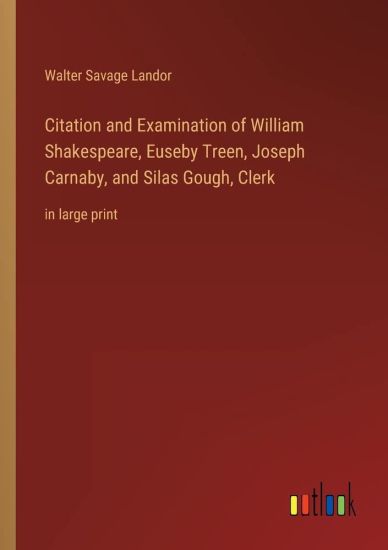
Citation and Examination of William Shakespeare, Euseby Treen, Joseph Carnaby, and Silas Gough, Clerk
Walter Savage Landor
Outlook Verlag
2023
pokkari
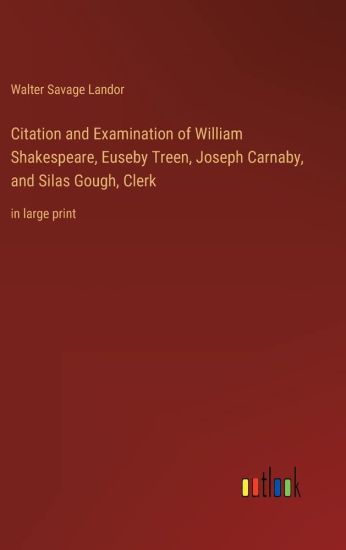
Citation and Examination of William Shakespeare, Euseby Treen, Joseph Carnaby, and Silas Gough, Clerk
Walter Savage Landor
Outlook Verlag
2023
sidottu
The book "" Citation and Examination of William Shakspeare, has been considered important throughout the human history, and so that this work is never forgotten we have made efforts in its preservation by republishing this book in a modern format for present and future generations. This whole book has been reformatted, retyped and designed. These books are not made of scanned copies and hence the text is clear and readable.
The book "" Gebir, and Count Julian, has been considered important throughout the human history, and so that this work is never forgotten we have made efforts in its preservation by republishing this book in a modern format for present and future generations. This whole book has been reformatted, retyped and designed. These books are not made of scanned copies and hence the text is clear and readable.
This book has been considered important throughout the human history, and so that this work is never forgotten we have made efforts in its preservation by republishing this book in a modern format for present and future generations. This whole book has been reformatted, retyped and designed. These books are not made of scanned copies and hence the text is clear and readable.
This book has been considered by academicians and scholars of great significance and value to literature. This forms a part of the knowledge base for future generations. So that the book is never forgotten we have represented this book in a print format as the same form as it was originally first published. Hence any marks or annotations seen are left intentionally to preserve its true nature.
Citation and Examination of William Shakspeare, Euseby Treen, Joseph Carnaby, and Silas Gough, Clerk, Before the Worshipful Sir Thomas Lucy, Knight, Touching Deer-Stealing on the Nineteenth Day of September in the Year of Grace 1582
Walter Savage Landor
Trieste Publishing
2018
nidottu
The 18th century was a wealth of knowledge, exploration and rapidly growing technology and expanding record-keeping made possible by advances in the printing press. In its determination to preserve the century of revolution, Gale initiated a revolution of its own: digitization of epic proportions to preserve these invaluable works in the largest archive of its kind. Now for the first time these high-quality digital copies of original 18th century manuscripts are available in print, making them highly accessible to libraries, undergraduate students, and independent scholars. Western literary study flows out of eighteenth-century works by Alexander Pope, Daniel Defoe, Henry Fielding, Frances Burney, Denis Diderot, Johann Gottfried Herder, Johann Wolfgang von Goethe, and others. Experience the birth of the modern novel, or compare the development of language using dictionaries and grammar discourses. ++++The below data was compiled from various identification fields in the bibliographic record of this title. This data is provided as an additional tool in helping to insure edition identification: ++++British LibraryT102809Author of Gebir = Walter Savage Landor. Not published. In 1802, pp.1-64 were published with a new titlepage and a new setting of pp.i-ii. Warwick]: Sharpe, printer, Warwick. Sold by Rivingtons, London, 1800]. 2], ii,111, 1]p.; 8

This work has been selected by scholars as being culturally important, and is part of the knowledge base of civilization as we know it. This work was reproduced from the original artifact, and remains as true to the original work as possible. Therefore, you will see the original copyright references, library stamps (as most of these works have been housed in our most important libraries around the world), and other notations in the work. This work is in the public domain in the United States of America, and possibly other nations. Within the United States, you may freely copy and distribute this work, as no entity (individual or corporate) has a copyright on the body of the work. As a reproduction of a historical artifact, this work may contain missing or blurred pages, poor pictures, errant marks, etc. Scholars believe, and we concur, that this work is important enough to be preserved, reproduced, and made generally available to the public. We appreciate your support of the preservation process, and thank you for being an important part of keeping this knowledge alive and relevant.