Kirjojen hintavertailu – 12 903 735 kirjaa ja 27 kauppaa

Kirjailija

Warren Carter

Kirjat ja teokset yhdessä paikassa: 32 kirjaa, julkaisuja vuosilta 2001–2025, suosituimpiin kuuluu 1, 2, and 3 John: An Introduction and Study Guide. Vertaile teosten hintoja ja tarkista saatavuus suomalaisista kirjakaupoista.

32 kirjaa

Kirjojen julkaisuvuodet: 2001–2025.

Israel and Empire

Israel and Empire

Leo G. Perdue; Warren Carter

T. T.Clark Ltd
2014
nidottu
This is an examination of Ancient Israel and the Hebrew Bible through the lens of Postcolonial interpretation and Empire Studies. "Israel and Empire" introduces students to the history, literature, and theology of the Hebrew Bible and texts of early Judaism, enabling them to read these texts through the lens of postcolonial interpretation. This approach should allow students to recognize not only how cultural and socio-political forces shaped ancient Israel and the worldviews of the early Jews but also the impact of imperialism on modern readings of the Bible. Perdue and Niang cover a broad sweep of history, from 1300 BCE to 72 CE, including the late Bronze age, Egyptian imperialism, Israel's entrance into Canaan, the Davidic-Solomonic Empire, the Assyrian Empire, the Babylonian Empire, the Persian Empire, the Greek Empire, the Maccabean Empire, and Roman rule. Additionally the authors show how earlier examples of imperialism in the Ancient Near East provide a window through which to see the forces and effects of imperialism in modern history.
For I Was Hungry and You Gave Me Food

For I Was Hungry and You Gave Me Food

Carol B Wilson; Warren Carter

Wipf Stock Publishers
2014
pokkari
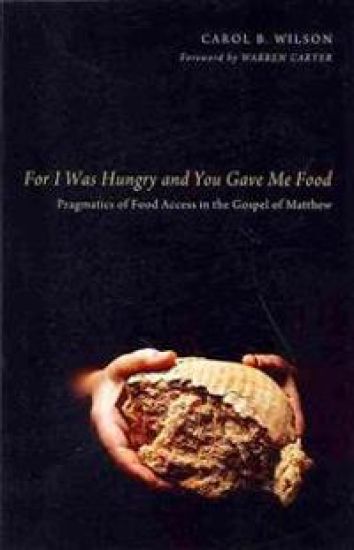
In the first century, endemic food shortages left 25 percent of the population below subsistence level and another 30 percent at risk of slipping below subsistence. In the face of such serious food shortages, the Gospel of Matthew advocates for a society in which all people can have access to sufficient food. Matthew critiques first-century practices and attitudes of both aristocrats and peasants that helped or hindered that goal. It does this by depicting Jesus teaching and performing positive practices that provided the Matthean community with an example to emulate, as well as condemning some negative practices and attitudes. For I Was Hungry and You Gave Me Food provides a pragmatic lens and a new descriptive paradigm of food access in the first century. The perspective and model are useful for analyzing passages concerned with life-and-death issues of the Matthean community--or situations for any other Christian community, past or present. Should not every person have enough food to sustain physical life?
The New Testament

The New Testament

Warren Carter

Abingdon Press
2013
pokkari
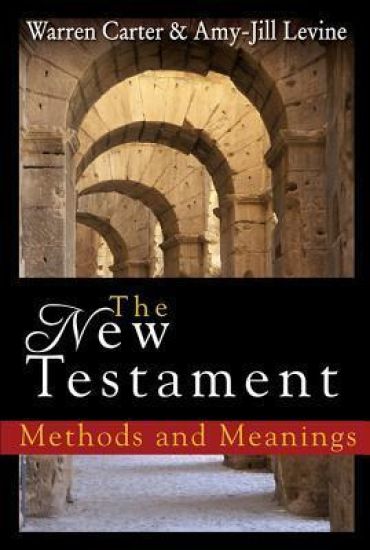
In this concise, accessible book, Warren Carter and A. J. Levine introduce three aspects of New Testament study: the world of the text (plots, characters, setting, and themes), the world behind the text (the concerns, circumstances, and experiences of the early Christian communities), and the world in front of the text (the meaning for contemporary readers). As students engage the New Testament, theyface a central issue that has confronted all students before them, namely, that these texts have been and are read in diverse and often quite conflicting ways. These multiple readingsinvolve different methods: historical-critical, traditional (history of interpretation), colonial, multicultural, and sociological, with feminist and liberationist implications for the first-century readers as well as the ongoing implications for today's reader. For example, Carter and Levineshow how a text can be used by both colonizer and colonized, feministand anti-feminist, or pro- and anti-Jewish. The authors also showhow scholarly work can be both constructive and threateningto the contemporary Church and how polemical texts can be used, whether for religious study, theological reflection, or homiletical practice.
Seven Events That Shaped the New Testament World

Seven Events That Shaped the New Testament World

Warren Carter

Baker Academic, Div of Baker Publishing Group
2013
nidottu
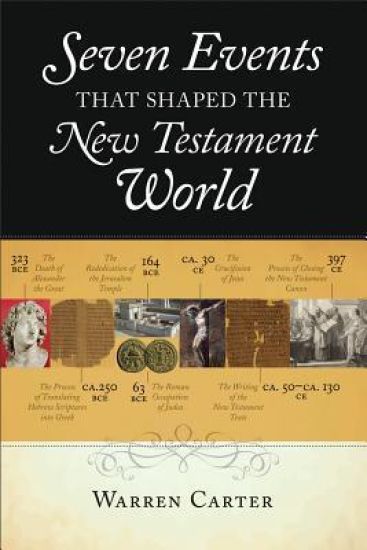
This useful, concise introduction to the worlds around the New Testament focuses on seven key moments in the centuries before and after Jesus. It enlightens readers about the beginnings of the Christian movement, showing how religious, political, and economic factors were interwoven in the fabric of the New Testament world. Leading New Testament scholar Warren Carter has a record of providing student-friendly texts. This introduction offers a "big picture" focus and is logically and memorably organized around seven events, which Carter uses as launching pads to discuss larger cultural dynamics and sociohistorical realities that were in some way significant for followers of Jesus and the New Testament. Photos and maps are included.
John and Empire

John and Empire

Warren Carter

T. T.Clark Ltd
2008
nidottu
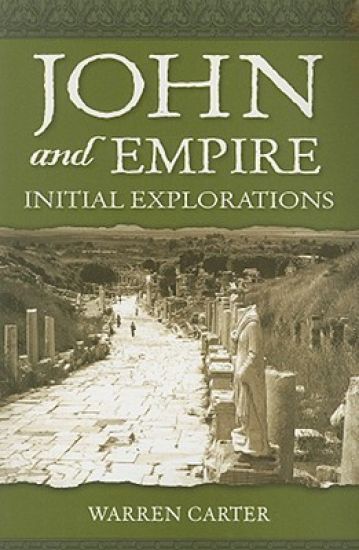
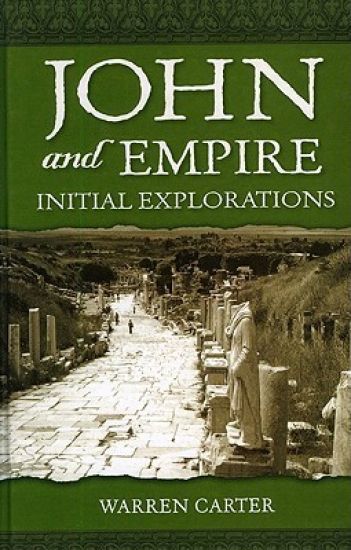
In this significant and innovative contribution, Warren Carter explores "John's Gospel" as a work of imperial negotiation in the context of Ephesus, capital of the Roman province of Asia. Carter employs multiple methods, rejects sectarian scenarios, and builds on other Christian writings and recent studies of diaspora synagogues that combined participationist lifestyles with observance of distinctive practices to argue that imperial negotiation was a contested issue for late first-century Jesus-believers. While a number of Jesus-believers probably lived societally-accommodated lives, John's Gospel employs a "rhetoric of distance" to urge much less accommodation and to create an alternative "anti-society" for followers of Jesus crucified by the empire but vindicated by God. In addition to establishing this tense historical setting, chapters identify various arenas and strategies of imperial negotiation in wide-ranging discussions of the gospel's genre, plot, Christological titles, developing traditions, eternal life, the image of God as father, ecclesiology, Jesus' conflict with Pilate, and resurrection and ascension. Carter has explored interactions between the emerging Christian movement and the Roman Empire in various articles and book-length studies such as "Matthew and the Margins" (Orbis), "Matthew and Empire" (Trinity Press International/Continuum), "Pontius Pilate: Portraits of a Roman Governor" (Liturgical), and "The Roman Empire and the New Testament" (Abingdon).
John and Empire

John and Empire

Warren Carter

T. T.Clark Ltd
2008
sidottu
In this significant and innovative contribution, Warren Carter explores John's Gospel as a work of imperial negotiation in the context of Ephesus, capital of the Roman province of Asia. Carter employs multiple methods, rejects sectarian scenarios, and builds on other Christian writings and recent studies of diaspora synagogues that combined participationist lifestyles with observance of distinctive practices to argue that imperial negotiation was a contested issue for late first-century Jesus-believers. While a number of Jesus-believers probably lived societally-accommodated lives, John's Gospel employs a "rhetoric of distance" to urge much less accommodation and to create an alternative "anti-society" for followers of Jesus crucified by the empire but vindicated by God. In addition to establishing this tense historical setting, chapters identify various arenas and strategies of imperial negotiation in wide-ranging discussions of the gospel's genre, plot, Christological titles, developing traditions, eternal life, the image of God as father, ecclesiology, Jesus' conflict with Pilate, and resurrection and ascension. Carter has explored interactions between the emerging Christian movement and the Roman Empire in various articles and book-length studies such as Matthew and the Margins (Orbis), Matthew and Empire (Trinity Press International/Continuum), Pontius Pilate: Portraits of a Roman Governor (Liturgical), and The Roman Empire and the New Testament (Abingdon).
The Roman Empire and the New Testament

The Roman Empire and the New Testament

Warren Carter

Abingdon Press
2006
pokkari
This work provides an indispensable introduction to Roman society, culture, law, politics, religion, and daily life as they relate to the study of the New Testament. The Roman Empire formed the central context in which the New Testament was written. Anyone who wishes to understand the New Testament texts must become familiar with the political, economic, societal, cultural, and religious aspects of Roman rule. Much of the New Testament deals with enabling its readers to negotiate, in an array of different manners, this pervasive imperial context. This book will help the reader see how social structures and daily practices in the Roman world illumine so much of the content of the New Testament message. For example, to grasp what Paul was saying about food offered to idols one must understand that temples in the Roman world were not "churches," and that they functioned as political, economic, and gastronomic centers, whose religious dealings were embedded within these other functions. Brief in presentation yet broad in scope, "The Roman Empire and the New Testament: An Essential Guide" will introduce students to the information and ideas essential to coming to grips with the world in which early Christianity was born.
Matthew and the Margins

Matthew and the Margins

Warren Carter

T. T.Clark Ltd
2004
nidottu
This detailed commentary presents the gospel of matthew as a counter-narrative, showing that it is a work of resistance written from and for a minority community of disciples committed to Jesus, the agent of God's saving presence. It was written and functions to shape the identity and lifestyle of the early community of jesus' followers as an alternative community that can resist the dominant authorities both in rome and in the synagogue. The Gospel anticpates the time when Jesus will return and establish God's reign over all, including the powers in Rome.
Pontius Pilate

Pontius Pilate

Warren Carter

Liturgical Press
2003
pokkari
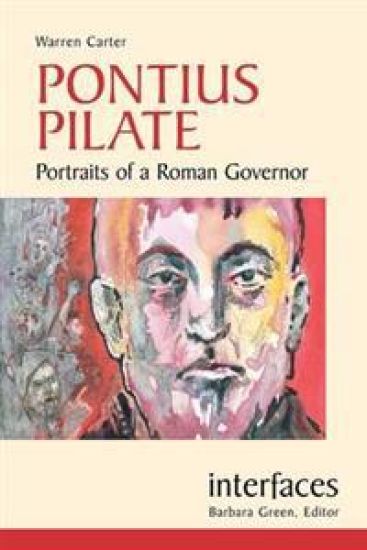
Pontius Pilate examines the portraits of this Roman governor found in the Gospels. Unlike some discussions of Pilate, this one takes Pilate's role as governor and representative of Roman imperial power seriously. It views Pilate predominantly as a strong, efficient, and astute governor, not as a weak and indecisive man, pressured into killing Jesus against Pilate's convictions. The conclusion considers some of the ethical and theological issues the scenes involving Pilate raise for contemporary readers. Chapters are "Would the Real Pilate Please Stand Up?" "Reading the Gospel Accounts of Pilate," "Governors and the Roman Imperial System," "Mark's Pilate," "Matthew's Pilate," "Luke's Pilate," and "John's Pilate." Warren Carter, Ph. D., is professor of New Testament at Saint Paul School of Theology, Kansas City, Missouri. He has published numerous scholarly and ecclesial publications.
Matthew and Empire

Matthew and Empire

Warren Carter

Continuum International Publishing Group - Trinity
2001
nidottu
Although New Testament scholars have examined Paul's writings and their relationship to the Roman empire and its imperial policies and writings, they have focused little attention on ways in which the Gospels were influenced by that imperialism. In Matthew and Empire, Warren Carter argues that Matthew's Gospel protests Roman imperialism by asserting that God's purposes and will are performed not by the empire and emperor but by Jesus and his community of disciples. Matthew and Empire makes the claim for reading Matthew in this way against the almost exclusive emphasis on the relationship with the synagogue that has long been a staple of Matthean criticism. Carter establishes Matthew's imperial context by examining Roman imperial ideology and material presence in Antioch, the traditional provenance for Matthew. He argues that Matthean Christology, which presents Jesus as God's agent, is shaped by claims and protests against those claims that the emperor and empire are agents of God. In successive chapters Carter pays particular attention to the Gospel's central irony, namely that in depicting God's ways and purposes, the Gospel employs the very imperial framework that it resists. Matthew and Empire challenges traditional readings of Matthew and Empire encourages fresh perspectives in Matthean scholarship. Warren Carter is Pherigo Professor of New Testament at Saint Paul School of Theology and author of Matthew and the Margins: A Socio-Political and Religious Reading.