Kirjojen hintavertailu – 12 859 828 kirjaa ja 27 kauppaa

Kirjailija

Warren Dean

Kirjat ja teokset yhdessä paikassa: 4 kirjaa, julkaisuja vuosilta 1969–1997, suosituimpiin kuuluu With Broadax and Firebrand. Vertaile teosten hintoja ja tarkista saatavuus suomalaisista kirjakaupoista.

4 kirjaa

Kirjojen julkaisuvuodet: 1969–1997.

With Broadax and Firebrand

With Broadax and Firebrand

Warren Dean; Stuart B. Schwartz

University of California Press
1997
pokkari
Warren Dean chronicles the chaotic path to what could be one of the greatest natural disasters of modern times: the disappearance of the Atlantic Forest. A quarter the size of the Amazon Forest, and the most densely populated region in Brazil, the Atlantic Forest is now the most endangered in the world. It contains a great diversity of life forms, some of them found nowhere else, as well as the country's largest cities, plantations, mines, and industries. Continual clearing is ravaging most of the forested remnants. Dean opens his story with the hunter-gatherers of twelve thousand years ago and takes it up to the 1990s--through the invasion of Europeans in the sixteenth century; the ensuing devastation wrought by such developments as gold and diamond mining, slash-and-burn farming, coffee planting, and industrialization; and the desperate battles between conservationists and developers in the late twentieth century. Based on a great range of documentary and scientific resources,With Broadax and Firebrand is an enormously ambitious book. More than a history of a tropical forest, or of the relationship between forest and humans, it is also a history of Brazil told from an environmental perspective. Dean writes passionately and movingly, in the fierce hope that the story of the Atlantic Forest will serve as a warning of the terrible costs of destroying its great neighbor to the west, the Amazon Forest.

Brazil and the Struggle for Rubber

Brazil and the Struggle for Rubber

Warren Dean

Cambridge University Press
1987
sidottu
Brazil once enjoyed a near monopoly in rubber when the commodity was gathered in the wild. By 1913, however, cultivated rubber in South-east Asia swept the Brazilian gathered product from the market. In this innovative study, Warren Dean demonstrates that environmental factors have played a key role in the many failed attempts to produce a significant rubber crop again in Brazil. In the Amazon attempts to shift to cultivated rubber failed repeatedly. Brazilian social and economic conditions have been blamed for these failures, in particular the failure of local capitalists and the refusal of the working class to accept wage labour. Dean shows in this study, however, that the difficulty was mainly ecological: the rubber tree in the wild lives in close association with a parasitic leaf fungus; when the tree was planted in close stands, the blight appeared in epidemic proportions.
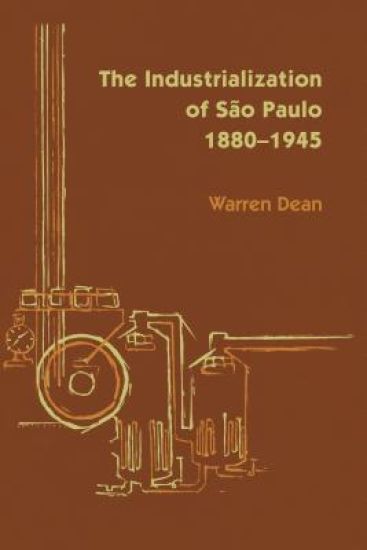
The Industrialization of São Paulo, 1800-1945

The Industrialization of São Paulo, 1800-1945

Warren Dean

University of Texas Press
1969
pokkari
SÃo Paulo is one of the few places in the underdeveloped world where an advanced industrial system has grown out of a tropical raw-material-exporting economy. By 1960 there were 830,000 industrial workers in the state, producing $3.3 billion worth of goods. It had become Latin America’s largest industrial center. This is a study of the early years of manufacturing in SÃo Paulo: how it was influenced by the growth and decline of the coffee trade; where it found its markets, its credit, and its labor force; and how it confronted the competition of imports. The principal focus, however, is on the manufacturers themselves, whose perceptions of their opportunities determined how industrialization was brought about. Warren Dean discusses their social origins, their connections with other sectors of the elite, their attitudes toward workers and consumers, and their view of the potentialities of economic development. He analyzes the political activities of the manufacturers, to discover both how they promoted their interests and how they confronted the larger challenge of social and political transformation. Paradoxically, the industrialization of SÃo Paulo is not a “success story” of private entrepreneurship. Until after World War II manufacturing grew quite slowly, and its hallmarks were always low productivity, technical backwardness, and consumer hostility. More than half of the state’s present large-scale factory production and nearly all of its heavy industry was built by foreign capital or state enterprise, not by privately owned firms. Dean shows that this outcome is partly a consequence of the historical experience of domestic manufacture. Throughout the book the author points out the “peculiar articulations” of the industrial system of SÃo Paulo-the significant social and political interests that determined what kinds of development were possible. The result is an exposition of an unusual case study in twentieth-century economic development.