Kirjojen hintavertailu – 12 903 725 kirjaa ja 27 kauppaa

Kirjailija

Warren Dixon

Kirjat ja teokset yhdessä paikassa: 4 kirjaa, julkaisuja vuosilta 2009–2019, suosituimpiin kuuluu Lyapunov-Based Control of Robotic Systems. Vertaile teosten hintoja ja tarkista saatavuus suomalaisista kirjakaupoista.

4 kirjaa

Kirjojen julkaisuvuodet: 2009–2019.

Lyapunov-Based Control of Robotic Systems

Lyapunov-Based Control of Robotic Systems

Aman Behal; Warren Dixon; Darren M. Dawson; Bin Xian

CRC Press
2019
nidottu
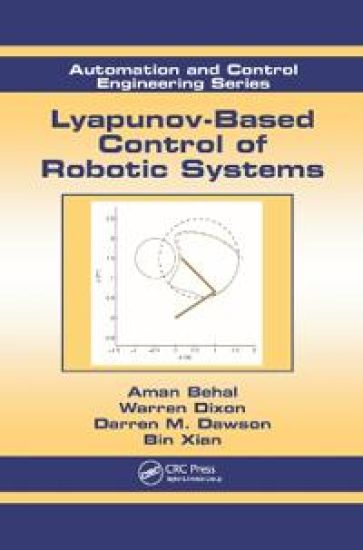
Lyapunov-Based Control of Robotic Systems describes nonlinear control design solutions for problems that arise from robots required to interact with and manipulate their environments. Since most practical scenarios require the design of nonlinear controllers to work around uncertainty and measurement-related issues, the authors use Lyapunov’s direct method as an effective tool to design and analyze controllers for robotic systems. After describing the evolution of real-time control design systems and the associated operating environments and hardware platforms, the book presents a host of standard control design tools for robotic systems using a common Lyapunov-based framework. It then discusses several problems in visual servoing control, including the design of homography-based visual servo control methods and the classic structure from motion problem. The book also deals with the issues of path planning and control for manipulator arms and wheeled mobile robots. With a focus on the emerging research area of human machine interaction, the final chapter illustrates the design of control schemes based on passivity such that the machine is a net energy sink. Including much of the authors’ own research work in controls and robotics, this book facilitates an understanding of the application of Lyapunov-based control design techniques to up-and-coming problems in robotics.
Lyapunov-Based Control of Robotic Systems

Lyapunov-Based Control of Robotic Systems

Aman Behal; Warren Dixon; Darren M. Dawson; Bin Xian

CRC Press Inc
2009
sidottu
Lyapunov-Based Control of Robotic Systems describes nonlinear control design solutions for problems that arise from robots required to interact with and manipulate their environments. Since most practical scenarios require the design of nonlinear controllers to work around uncertainty and measurement-related issues, the authors use Lyapunov’s direct method as an effective tool to design and analyze controllers for robotic systems. After describing the evolution of real-time control design systems and the associated operating environments and hardware platforms, the book presents a host of standard control design tools for robotic systems using a common Lyapunov-based framework. It then discusses several problems in visual servoing control, including the design of homography-based visual servo control methods and the classic structure from motion problem. The book also deals with the issues of path planning and control for manipulator arms and wheeled mobile robots. With a focus on the emerging research area of human machine interaction, the final chapter illustrates the design of control schemes based on passivity such that the machine is a net energy sink. Including much of the authors’ own research work in controls and robotics, this book facilitates an understanding of the application of Lyapunov-based control design techniques to up-and-coming problems in robotics.
Reinforcement Learning for Optimal Feedback Control

Reinforcement Learning for Optimal Feedback Control

Rushikesh Kamalapurkar; Patrick Walters; Joel Rosenfeld; Warren Dixon

Springer Nature Switzerland AG
2018
nidottu
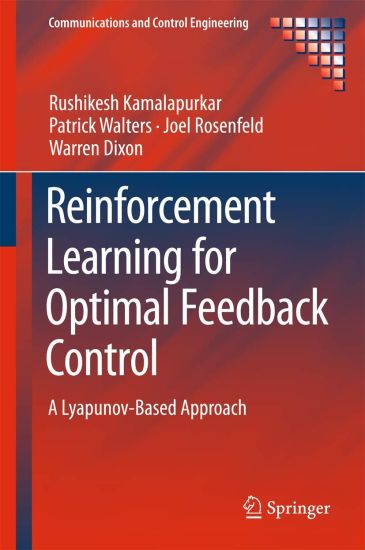
Reinforcement Learning for Optimal Feedback Control develops model-based and data-driven reinforcement learning methods for solving optimal control problems in nonlinear deterministic dynamical systems. In order to achieve learning under uncertainty, data-driven methods for identifying system models in real-time are also developed. The book illustrates the advantages gained from the use of a model and the use of previous experience in the form of recorded data through simulations and experiments. The book’s focus on deterministic systems allows for an in-depth Lyapunov-based analysis of the performance of the methods described during the learning phase and during execution. To yield an approximate optimal controller, the authors focus on theories and methods that fall under the umbrella of actor–critic methods for machine learning. They concentrate on establishing stability during the learning phase and the execution phase, and adaptive model-based and data-driven reinforcement learning, to assist readers in the learning process, which typically relies on instantaneous input-output measurements. This monograph provides academic researchers with backgrounds in diverse disciplines from aerospace engineering to computer science, who are interested in optimal reinforcement learning functional analysis and functional approximation theory, with a good introduction to the use of model-based methods. The thorough treatment of an advanced treatment to control will also interest practitioners working in the chemical-process and power-supply industry.
Reinforcement Learning for Optimal Feedback Control

Reinforcement Learning for Optimal Feedback Control

Rushikesh Kamalapurkar; Patrick Walters; Joel Rosenfeld; Warren Dixon

Springer International Publishing AG
2018
sidottu
Reinforcement Learning for Optimal Feedback Control develops model-based and data-driven reinforcement learning methods for solving optimal control problems in nonlinear deterministic dynamical systems. In order to achieve learning under uncertainty, data-driven methods for identifying system models in real-time are also developed. The book illustrates the advantages gained from the use of a model and the use of previous experience in the form of recorded data through simulations and experiments. The book’s focus on deterministic systems allows for an in-depth Lyapunov-based analysis of the performance of the methods described during the learning phase and during execution. To yield an approximate optimal controller, the authors focus on theories and methods that fall under the umbrella of actor–critic methods for machine learning. They concentrate on establishing stability during the learning phase and the execution phase, and adaptive model-based and data-driven reinforcement learning, to assist readers in the learning process, which typically relies on instantaneous input-output measurements. This monograph provides academic researchers with backgrounds in diverse disciplines from aerospace engineering to computer science, who are interested in optimal reinforcement learning functional analysis and functional approximation theory, with a good introduction to the use of model-based methods. The thorough treatment of an advanced treatment to control will also interest practitioners working in the chemical-process and power-supply industry.