Kirjojen hintavertailu – 12 903 725 kirjaa ja 27 kauppaa

Kirjailija

Warren S. Brown

Kirjat ja teokset yhdessä paikassa: 5 kirjaa, julkaisuja vuosilta 2007–2020, suosituimpiin kuuluu Did My Neurons Make Me Do It?. Vertaile teosten hintoja ja tarkista saatavuus suomalaisista kirjakaupoista.

5 kirjaa

Kirjojen julkaisuvuodet: 2007–2020.

Enhancing Christian Life – How Extended Cognition Augments Religious Community
2020 Foreword INDIES Book of the Year Finalist - Science and Technology No one is really Christian on their own. But often the religious life is seen as individual, private, and internal—resulting in a truncated, consumeristic faith. And what if that kind of individualistic Christianity is built on a fundamental misunderstanding of human nature? According to psychologists Brad Strawn and Warren Brown, it's time to rethink the Christian life in light of current research on the human mind, particularly with a deeper understanding of the process called "extended cognition." Using insights from neuroscience, psychology, and philosophy, they argue in Enhancing Christian Life that persons must be understood as not only embodied and embedded within particular contexts, but also extended beyond the body to encompass aspects of the physical and social world. Embracing a vision of the Christian life as extended into interactions with a local network of believers, they help us discover a fuller, more effective way to be Christian. After exploring the psychological dynamics of extended cognition, including how the mind is "supersized" by the incorporation of physical tools and social networks, Strawn and Brown consider implications for spiritual practices, congregational life, and religious language and traditions, which they describe as mental "wikis." The formation of robust Christian life, they show, is a process that takes place within a larger mesh of embodiment and mind—broader, deeper, and richer than we could ever be on our own.
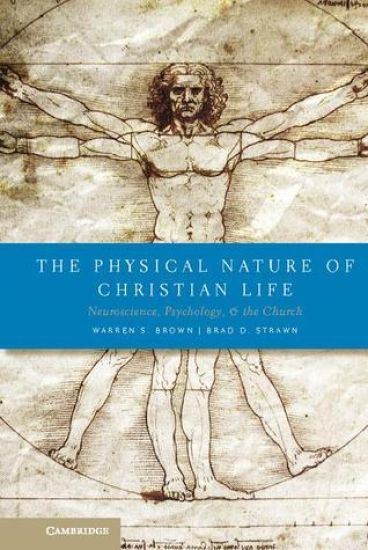
The Physical Nature of Christian Life

The Physical Nature of Christian Life

Warren S. Brown; Brad D. Strawn

Cambridge University Press
2012
sidottu
This book explores the implications of recent insights in modern neuroscience for the church's view of spiritual formation. Science suggests that functions of the brain and body in collaboration with social experience, rather than a disembodied soul, provide physical basis for the mental capacities, interpersonal relations, and religious experiences of human beings. The realization that human beings are wholly physical, but with unique mental, relational and spiritual capacities, challenges traditional views of Christian life as defined by the care of souls, a view that leads to inwardness and individuality. Psychology and neuroscience suggest the importance of developmental openness, attachment, imitation and stories as tools in spiritual formation. Accordingly, the idea that care of embodied persons should be fundamentally social and communal sets new priorities for encouraging spiritual growth and building congregations.
The Physical Nature of Christian Life

The Physical Nature of Christian Life

Warren S. Brown; Brad D. Strawn

Cambridge University Press
2012
pokkari
This book explores the implications of recent insights in modern neuroscience for the church's view of spiritual formation. Science suggests that functions of the brain and body in collaboration with social experience, rather than a disembodied soul, provide physical basis for the mental capacities, interpersonal relations, and religious experiences of human beings. The realization that human beings are wholly physical, but with unique mental, relational and spiritual capacities, challenges traditional views of Christian life as defined by the care of souls, a view that leads to inwardness and individuality. Psychology and neuroscience suggest the importance of developmental openness, attachment, imitation and stories as tools in spiritual formation. Accordingly, the idea that care of embodied persons should be fundamentally social and communal sets new priorities for encouraging spiritual growth and building congregations.
Did My Neurons Make Me Do It?

Did My Neurons Make Me Do It?

Nancey Murphy; Warren S. Brown

Oxford University Press
2009
nidottu
If humans are purely physical, and if it is the brain that does the work formerly assigned to the mind or soul, then how can it fail to be the case that all of our thoughts and actions are determined by the laws of neurobiology? If this is the case, then free will, moral responsibility, and, indeed, reason itself would appear to be in jeopardy. Nancey Murphy and Warren S. Brown here defend a non-reductive version of physicalism whereby humans are (sometimes) the authors of their own thoughts and actions. Did My Neurons Make Me Do It? brings together insights from both philosophy and the cognitive neurosciences to defeat neurobiological reductionism. One resource is a 'post-Cartesian' account of mind as essentially embodied and constituted by action-feedback-evaluation-action loops in the environment, and 'scaffolded' by cultural resources. Another is a non-mysterious account of downward (mental) causation explained in terms of a complex, higher-order system exercising constraints on lower-level causal processes. These resources are intrinsically related: the embeddedness of brain events in action-feedback loops is the key to their mentality, and those broader systems have causal effects on the brain itself. With these resources Murphy and Brown take on two problems in philosophy of mind: a response to the charges that physicalists cannot account for the meaningfulness of language nor the causal efficacy of the mental qua mental. Solutions to these problems are a prerequisite to addressing the central problem of the book: how can biological organisms be free and morally responsible? The authors argue that the free-will problem is badly framed if it is put in terms of neurobiological determinism; the real issue is neurobiological reductionism. If it is indeed possible to make sense of the notion of downward causation, then the relevant question is whether humans exert downward causation over some of their own parts and processes. If all organisms do this to some extent, what needs to be added to this animalian flexibility to constitute free and responsible action? The keys are sophisticated language and hierarchically ordered cognitive processes allowing (mature) humans to evaluate their own actions, motives, goals, and rational and moral principles.
Did My Neurons Make Me Do It?

Did My Neurons Make Me Do It?

Nancey Murphy; Warren S. Brown

Clarendon Press
2007
sidottu
If humans are purely physical, and if it is the brain that does the work formerly assigned to the mind or soul, then how can it fail to be the case that all of our thoughts and actions are determined by the laws of neurobiology? If this is the case, then free will, moral responsibility, and, indeed, reason itself would appear to be in jeopardy. Nancey Murphy and Warren S. Brown here defend a non-reductive version of physicalism whereby humans are (sometimes) the authors of their own thoughts and actions. Did My Neurons Make Me Do It? brings together insights from both philosophy and the cognitive neurosciences to defeat neurobiological reductionism. One resource is a 'post-Cartesian' account of mind as essentially embodied and constituted by action-feedback-evaluation-action loops in the environment, and 'scaffolded' by cultural resources. Another is a non-mysterious account of downward (mental) causation explained in terms of a complex, higher-order system exercising constraints on lower-level causal processes. These resources are intrinsically related: the embeddedness of brain events in action-feedback loops is the key to their mentality, and those broader systems have causal effects on the brain itself. With these resources Murphy and Brown take on two problems in philosophy of mind: a response to the charges that physicalists cannot account for the meaningfulness of language nor the causal efficacy of the mental qua mental. Solutions to these problems are a prerequisite to addressing the central problem of the book: how can biological organisms be free and morally responsible? The authors argue that the free-will problem is badly framed if it is put in terms of neurobiological determinism; the real issue is neurobiological reductionism. If it is indeed possible to make sense of the notion of downward causation, then the relevant question is whether humans exert downward causation over some of their own parts and processes. If all organisms do this to some extent, what needs to be added to this animalian flexibility to constitute free and responsible action? The keys are sophisticated language and hierarchically ordered cognitive processes allowing (mature) humans to evaluate their own actions, motives, goals, and rational and moral principles.