Kirjojen hintavertailu – 12 903 725 kirjaa ja 27 kauppaa

Kirjailija

Wei Emma Zhang

Kirjat ja teokset yhdessä paikassa: 6 kirjaa, julkaisuja vuosilta 2018–2026, suosituimpiin kuuluu NLP meets LLM. Vertaile teosten hintoja ja tarkista saatavuus suomalaisista kirjakaupoista.

6 kirjaa

Kirjojen julkaisuvuodet: 2018–2026.

NLP meets LLM

NLP meets LLM

Munazza Zaib; Quan Z. Sheng; Wei Emma Zhang; Adnan Mahmood

TAYLOR FRANCIS LTD
2026
sidottu
This book looks at conversational search in intelligent dialogue systems, as it investigates and addresses the challenges pertinent to effective context incorporation in conversational question answering (ConvQA). The authors explore the possibility of designing a scalable Conversational Question Answering Agent that can handle the challenges of incomplete/ambiguous questions, better able to relate to co-references to cope with the problems of effective weights and optimal threshold selection in vehicular networks. A fundamental emphasis is the understanding of ambiguous follow-up questions and the generation of contextual and question entities to fill in the missing information gaps. Key topics are studied, such as ‘hard history selection’ to filter out the context that is not relevant and performing a re-ranking of the selected turns based on their significance to answer the question as a part of the soft history selection process. This book aims to demonstrate that the history selection and modelling approaches proposed can effectively improve the performance of ConvQA models in different settings. The proposed models are compared with the state-of-the-art vis-à-vis different conversational datasets and provide new insights into conversational information retrieval. Through a systematic study of structured representations, entity-aware history selection, and open-domain passage retrieval using contrastive learning, this book presents a robust framework for advancing multi-turn QA systems. It is an essential resource for researchers, practitioners, and graduate students working at the intersection of NLP, dialogue systems, and intelligent information access.
Trust Management in the Internet of Vehicles

Trust Management in the Internet of Vehicles

Adnan Mahmood; Michael Sheng; Wei Emma Zhang; Sira Yongchareon

TAYLOR FRANCIS LTD
2025
nidottu
The Internet of Vehicles (IoV) is referred to as an efficient and inevitable convergence of the Internet of Things, intelligent transportation systems, edge / fog and cloud computing, and big data, all of which could be intelligently harvested for the cooperative vehicular safety and non-safety applications as well as cooperative mobility management. A secure and low-latency communication is, therefore, indispensable to meet the stringent performance requirements of the safety-critical vehicular applications. Whilst the challenges surrounding low latency are being addressed by the researchers in both academia and industry, it is the security of an IoV network which is of paramount importance, as a single malicious message is perfectly capable enough of jeopardizing the entire networking infrastructure and can prove fatal for the vehicular passengers and the vulnerable pedestrians. This book thus investigates the promising notion of trust in a bid to strengthen the resilience of the IoV networks. It not only introduces trust categorically in the context of an IoV network, i.e., in terms of its fundamentals and salient characteristics, but further envisages state-of-the-art trust models and intelligent trust threshold mechanisms for segregating both malicious and non-malicious vehicles. Furthermore, open research challenges and recommendations for addressing the same are discussed in the same too.
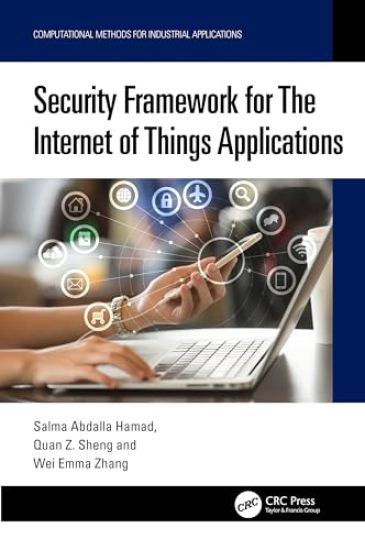
Security Framework for The Internet of Things Applications

Security Framework for The Internet of Things Applications

Salma Abdalla Hamad; Quan Z. Sheng; Wei Emma Zhang

TAYLOR FRANCIS LTD
2024
sidottu
The text highlights a comprehensive survey that focuses on all security aspects and challenges facing the Internet of Things systems, including outsourcing techniques for partial computations on edge or cloud while presenting case studies to map security challenges. It further covers three security aspects including Internet of Things device identification and authentication, network traffic intrusion detection, and executable malware files detection. This book:Presents a security framework model design named Behavioral Network Traffic Identification and Novelty Anomaly Detection for the IoT InfrastructuresHighlights recent advancements in machine learning, deep learning, and networking standards to boost Internet of Things securityBuilds a near real-time solution for identifying Internet of Things devices connecting to a network using their network traffic traces and providing them with sufficient access privilegesDevelops a robust framework for detecting IoT anomalous network trafficCovers an anti-malware solution for detecting malware targeting embedded devicesIt will serve as an ideal text for senior undergraduate and graduate students, and professionals in the fields of electrical engineering, electronics and communication engineering, computer engineering, and information technology.
Trust Management in the Internet of Vehicles

Trust Management in the Internet of Vehicles

Adnan Mahmood; Michael Sheng; Wei Emma Zhang; Sira Yongchareon

TAYLOR FRANCIS LTD
2023
sidottu
The Internet of Vehicles (IoV) is referred to as an efficient and inevitable convergence of the Internet of Things, intelligent transportation systems, edge / fog and cloud computing, and big data, all of which could be intelligently harvested for the cooperative vehicular safety and non-safety applications as well as cooperative mobility management. A secure and low-latency communication is, therefore, indispensable to meet the stringent performance requirements of the safety-critical vehicular applications. Whilst the challenges surrounding low latency are being addressed by the researchers in both academia and industry, it is the security of an IoV network which is of paramount importance, as a single malicious message is perfectly capable enough of jeopardizing the entire networking infrastructure and can prove fatal for the vehicular passengers and the vulnerable pedestrians. This book thus investigates the promising notion of trust in a bid to strengthen the resilience of the IoV networks. It not only introduces trust categorically in the context of an IoV network, i.e., in terms of its fundamentals and salient characteristics, but further envisages state-of-the-art trust models and intelligent trust threshold mechanisms for segregating both malicious and non-malicious vehicles. Furthermore, open research challenges and recommendations for addressing the same are discussed in the same too.
Managing Data From Knowledge Bases: Querying and Extraction

Managing Data From Knowledge Bases: Querying and Extraction

Wei Emma Zhang; Quan Z. Sheng

Springer Nature Switzerland AG
2019
nidottu
In this book, the authors first address the research issues by providing a motivating scenario, followed by the exploration of the principles and techniques of the challenging topics. Then they solve the raised research issues by developing a series of methodologies. More specifically, the authors study the query optimization and tackle the query performance prediction for knowledge retrieval. They also handle unstructured data processing, data clustering for knowledge extraction. To optimize the queries issued through interfaces against knowledge bases, the authors propose a cache-based optimization layer between consumers and the querying interface to facilitate the querying and solve the latency issue. The cache depends on a novel learning method that considers the querying patterns from individual’s historical queries without having knowledge of the backing systems of the knowledge base. To predict the query performance for appropriate query scheduling, the authors examine the queries’ structural and syntactical features and apply multiple widely adopted prediction models. Their feature modelling approach eschews the knowledge requirement on both the querying languages and system. To extract knowledge from unstructured Web sources, the authors examine two kinds of Web sources containing unstructured data: the source code from Web repositories and the posts in programming question-answering communities. They use natural language processing techniques to pre-process the source codes and obtain the natural language elements. Then they apply traditional knowledge extraction techniques to extract knowledge. For the data from programming question-answering communities, the authors make the attempt towards building programming knowledge base by starting with paraphrase identification problems and develop novel features to accurately identify duplicate posts. For domain specific knowledge extraction, the authors propose to use a clustering technique toseparate knowledge into different groups. They focus on developing a new clustering algorithm that uses manifold constraints in the optimization task and achieves fast and accurate performance. For each model and approach presented in this dissertation, the authors have conducted extensive experiments to evaluate it using either public dataset or synthetic data they generated.
Managing Data From Knowledge Bases: Querying and Extraction

Managing Data From Knowledge Bases: Querying and Extraction

Wei Emma Zhang; Quan Z. Sheng

Springer International Publishing AG
2018
sidottu
In this book, the authors first address the research issues by providing a motivating scenario, followed by the exploration of the principles and techniques of the challenging topics. Then they solve the raised research issues by developing a series of methodologies. More specifically, the authors study the query optimization and tackle the query performance prediction for knowledge retrieval. They also handle unstructured data processing, data clustering for knowledge extraction. To optimize the queries issued through interfaces against knowledge bases, the authors propose a cache-based optimization layer between consumers and the querying interface to facilitate the querying and solve the latency issue. The cache depends on a novel learning method that considers the querying patterns from individual’s historical queries without having knowledge of the backing systems of the knowledge base. To predict the query performance for appropriate query scheduling, the authors examine the queries’ structural and syntactical features and apply multiple widely adopted prediction models. Their feature modelling approach eschews the knowledge requirement on both the querying languages and system. To extract knowledge from unstructured Web sources, the authors examine two kinds of Web sources containing unstructured data: the source code from Web repositories and the posts in programming question-answering communities. They use natural language processing techniques to pre-process the source codes and obtain the natural language elements. Then they apply traditional knowledge extraction techniques to extract knowledge. For the data from programming question-answering communities, the authors make the attempt towards building programming knowledge base by starting with paraphrase identification problems and develop novel features to accurately identify duplicate posts. For domain specific knowledge extraction, the authors propose to use a clustering technique toseparate knowledge into different groups. They focus on developing a new clustering algorithm that uses manifold constraints in the optimization task and achieves fast and accurate performance. For each model and approach presented in this dissertation, the authors have conducted extensive experiments to evaluate it using either public dataset or synthetic data they generated.