Kirjojen hintavertailu – 12 859 828 kirjaa ja 27 kauppaa

Kirjailija

Wei Ni

Kirjat ja teokset yhdessä paikassa: 4 kirjaa, julkaisuja vuosilta 2025–2026, suosituimpiin kuuluu Artificial Intelligence for Unmanned Aerial Vehicles. Vertaile teosten hintoja ja tarkista saatavuus suomalaisista kirjakaupoista.

4 kirjaa

Kirjojen julkaisuvuodet: 2025–2026.

Artificial Intelligence for Unmanned Aerial Vehicles

Artificial Intelligence for Unmanned Aerial Vehicles

Shuyan Hu; Kai Li; Xin Yuan; Wei Ni; Xin Wang

JOHN WILEY SONS INC
2026
sidottu
In-depth exploration of machine learning techniques applied to UAV operations and communications, highlighting areas of potential growth and research gaps Artificial Intelligence for Unmanned Aerial Vehicles provides a comprehensive overview of machine learning (ML) techniques used in unmanned aerial vehicle (UAV) operations, communications, sensing, and computing. It emphasizes key components of UAV activity to which ML can significantly contribute including perception and feature extraction, feature interpretation and regeneration, trajectory and mission planning, and aerodynamic control and operation. The book considers the notion of security in the UAV network primarily in terms of its underlying rationale. This book also includes a detailed analysis of UAV behavior with respect to time and explores online machine learning-based solutions for UAV-assisted IoT networks. Additional topics include: Joint cruise control and data collection Resilience in an AI-aided UAV network against multiple attacks, introducing a flexible and adaptive threshold to alleviate malicious conduct Quantification of influencing attributes, quantification of weights affiliated with these attributes, and movement tracking of malicious UAVs Integration of contextual information, threshold definitions, and time-variant behavior analysis Artificial Intelligence for Unmanned Aerial Vehicles is an essential up-to-date reference on the subject for researchers, professors, graduate and senior undergraduate students, and industry professionals in the field.
Graph Learning Techniques

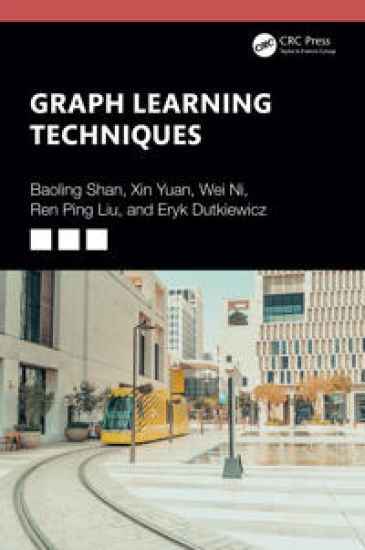
Graph Learning Techniques

Baoling Shan; Xin Yuan; Wei Ni; Ren Ping Liu; Eryk Dutkiewicz

TAYLOR FRANCIS LTD
2025
sidottu
This comprehensive guide addresses key challenges at the intersection of data science, graph learning, and privacy preservation. It begins with foundational graph theory, covering essential definitions, concepts, and various types of graphs. The book bridges the gap between theory and application, equipping readers with the skills to translate theoretical knowledge into actionable solutions for complex problems. It includes practical insights into brain network analysis and the dynamics of COVID-19 spread. The guide provides a solid understanding of graphs by exploring different graph representations and the latest advancements in graph learning techniques. It focuses on diverse graph signals and offers a detailed review of state-of-the-art methodologies for analyzing these signals. A major emphasis is placed on privacy preservation, with comprehensive discussions on safeguarding sensitive information within graph structures. The book also looks forward, offering insights into emerging trends, potential challenges, and the evolving landscape of privacy-preserving graph learning. This resource is a valuable reference for advance undergraduate and postgraduate students in courses related to Network Analysis, Privacy and Security in Data Analytics, and Graph Theory and Applications in Healthcare.
Graph Learning Techniques

Graph Learning Techniques

Baoling Shan; Xin Yuan; Wei Ni; Ren Ping Liu; Eryk Dutkiewicz

TAYLOR FRANCIS LTD
2025
nidottu
This comprehensive guide addresses key challenges at the intersection of data science, graph learning, and privacy preservation. It begins with foundational graph theory, covering essential definitions, concepts, and various types of graphs. The book bridges the gap between theory and application, equipping readers with the skills to translate theoretical knowledge into actionable solutions for complex problems. It includes practical insights into brain network analysis and the dynamics of COVID-19 spread. The guide provides a solid understanding of graphs by exploring different graph representations and the latest advancements in graph learning techniques. It focuses on diverse graph signals and offers a detailed review of state-of-the-art methodologies for analyzing these signals. A major emphasis is placed on privacy preservation, with comprehensive discussions on safeguarding sensitive information within graph structures. The book also looks forward, offering insights into emerging trends, potential challenges, and the evolving landscape of privacy-preserving graph learning. This resource is a valuable reference for advance undergraduate and postgraduate students in courses related to Network Analysis, Privacy and Security in Data Analytics, and Graph Theory and Applications in Healthcare.