Kirjojen hintavertailu – 12 859 829 kirjaa ja 27 kauppaa

Kirjailija

Wei Qi Yan

Kirjat ja teokset yhdessä paikassa: 7 kirjaa, julkaisuja vuosilta 2015–2026, suosituimpiin kuuluu Computational Methods for Deep Learning. Vertaile teosten hintoja ja tarkista saatavuus suomalaisista kirjakaupoista.

7 kirjaa

Kirjojen julkaisuvuodet: 2015–2026.

Computational Methods for Deep Learning

Computational Methods for Deep Learning

Wei Qi Yan

SPRINGER VERLAG, SINGAPORE
2023
sidottu
The first edition of this textbook was published in 2021. Over the past two years, we have invested in enhancing all aspects of deep learning methods to ensure the book is comprehensive and impeccable. Taking into account feedback from our readers and audience, the author has diligently updated this book. The second edition of this textbook presents control theory, transformer models, and graph neural networks (GNN) in deep learning. We have incorporated the latest algorithmic advances and large-scale deep learning models, such as GPTs, to align with the current research trends. Through the second edition, this book showcases how computational methods in deep learning serve as a dynamic driving force in this era of artificial intelligence (AI). This book is intended for research students, engineers, as well as computer scientists with interest in computational methods in deep learning. Furthermore, it is also well-suited for researchers exploring topics such as machine intelligence, robotic control, and related areas.

Computational Methods for Deep Learning

Computational Methods for Deep Learning

Wei Qi Yan

Springer Nature Switzerland AG
2021
nidottu
Integrating concepts from deep learning, machine learning, and artificial neural networks, this highly unique textbook presents content progressively from easy to more complex, orienting its content about knowledge transfer from the viewpoint of machine intelligence. It adopts the methodology from graphical theory, mathematical models, and algorithmic implementation, as well as covers datasets preparation, programming, results analysis and evaluations. Beginning with a grounding about artificial neural networks with neurons and the activation functions, the work then explains the mechanism of deep learning using advanced mathematics. In particular, it emphasizes how to use TensorFlow and the latest MATLAB deep-learning toolboxes for implementing deep learning algorithms. As a prerequisite, readers should have a solid understanding especially of mathematical analysis, linear algebra, numerical analysis, optimizations, differential geometry, manifold, and information theory, as well as basic algebra, functional analysis, and graphical models. This computational knowledge will assist in comprehending the subject matter not only of this text/reference, but also in relevant deep learning journal articles and conference papers. This textbook/guide is aimed at Computer Science research students and engineers, as well as scientists interested in deep learning for theoretic research and analysis. More generally, this book is also helpful for those researchers who are interested in machine intelligence, pattern analysis, natural language processing, and machine vision. Dr. Wei Qi Yan is an Associate Professor in the Department of Computer Science at Auckland University of Technology, New Zealand. His other publications include the Springer title, Visual Cryptography for Image Processing and Security.
Introduction to Intelligent Surveillance

Introduction to Intelligent Surveillance

Wei Qi Yan

Springer Nature Switzerland AG
2019
sidottu
This practically-oriented textbook introduces the fundamentals of designing digital surveillance systems powered by intelligent computing techniques. The text offers comprehensive coverage of each aspect of the system, from camera calibration and data capture, to the secure transmission of surveillance data, in addition to the detection and recognition of individual biometric features and objects. The coverage concludes with the development of a complete system for the automated observation of the full lifecycle of a surveillance event, enhanced by the use of artificial intelligence and supercomputing technology. This updated third edition presents an expanded focus on human behavior analysis and privacy preservation, as well as deep learning methods. Topics and features: contains review questions and exercises in every chapter, together with a glossary; describes the essentials of implementing an intelligent surveillance system and analyzing surveillance data, including a range of biometric characteristics; examines the importance of network security and digital forensics in the communication of surveillance data, as well as issues of issues of privacy and ethics; discusses the Viola-Jones object detection method, and the HOG algorithm for pedestrian and human behavior recognition; reviews the use of artificial intelligence for automated monitoring of surveillance events, and decision-making approaches to determine the need for human intervention; presents a case study on a system that triggers an alarm when a vehicle fails to stop at a red light, and identifies the vehicle’s license plate number; investigates the use of cutting-edge supercomputing technologies for digital surveillance, such as FPGA, GPU and parallel computing. This concise and accessible work serves as a classroom-tested textbook for graduate-level courses on intelligent surveillance. Researchers and engineersinterested in entering this area will also find the book suitable as a helpful self-study reference.
Introduction to Intelligent Surveillance

Introduction to Intelligent Surveillance

Wei Qi Yan

Springer International Publishing AG
2018
nidottu
This accessible textbook/reference reviews the fundamental concepts and practical issues involved in designing digital surveillance systems that fully exploit the power of intelligent computing techniques. The book presents comprehensive coverage of all aspects of such systems, from camera calibration and data capture, to the secure transmission of surveillance data. In addition to the detection and recognition of objects and biometric features, the text also examines the automated observation of surveillance events, and how this can be enhanced through the use of deep learning methods and supercomputing technology. This updated new edition features extended coverage on face detection, pedestrian detection and privacy preservation for intelligent surveillance. Topics and features: contains review questions and exercises in every chapter, together with a glossary; describes the essentials of implementing an intelligent surveillance system and analyzing surveillance data, includinga range of biometric characteristics; examines the importance of network security and digital forensics in the communication of surveillance data, as well as issues of issues of privacy and ethics; discusses the Viola-Jones object detection method, and the HOG algorithm for pedestrian and human behavior recognition; reviews the use of artificial intelligence for automated monitoring of surveillance events, and decision-making approaches to determine the need for human intervention; presents a case study on a system that triggers an alarm when a vehicle fails to stop at a red light, and identifies the vehicle’s license plate number; investigates the use of cutting-edge supercomputing technologies for digital surveillance, such as FPGA, GPU and parallel computing. This concise, classroom-tested textbook is ideal for undergraduate and postgraduate-level courses on intelligent surveillance. Researchers interested in entering this area will alsofind the book suitable as a helpful self-study reference.
Visual Cryptography for Image Processing and Security

Visual Cryptography for Image Processing and Security

Feng Liu; Wei Qi Yan

Springer International Publishing AG
2016
nidottu
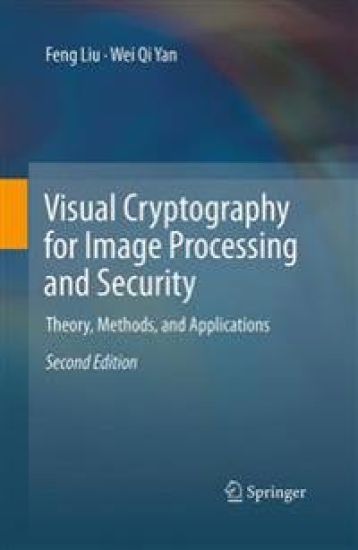
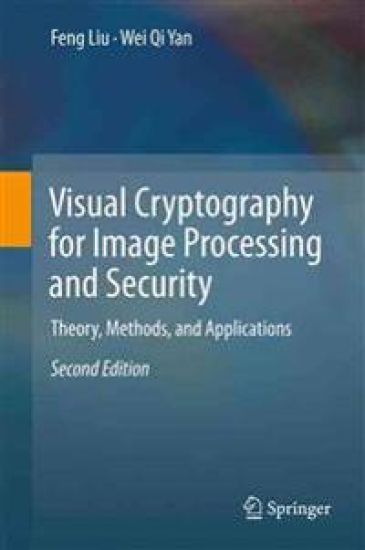
This book addresses the fundamental concepts in the theory and practice of visual cryptography. The design, construction, analysis, and application of visual cryptography schemes (VCSs) are discussed in detail. Original, cutting-edge research is presented on probabilistic, size invariant, threshold, concolorous, and cheating immune VCS. This updated second edition has also been expanded with new content on braille and 2D barcode authentication of visual cryptography shares. Features: contains review exercises at the end of each chapter, as well as a helpful glossary; examines various common problems in visual cryptography, including the alignment, flipping, cheating, distortion, and thin line problems; reviews a range of VCSs, including XOR-based visual cryptography and security enriched VCS; describes different methods for presenting color content using visual cryptographic techniques; covers such applications of visual cryptography as watermarking, resolution variant VCS, and multiple resolution VCS.
Visual Cryptography for Image Processing and Security

Visual Cryptography for Image Processing and Security

Feng Liu; Wei Qi Yan

Springer International Publishing AG
2015
sidottu
This book addresses the fundamental concepts in the theory and practice of visual cryptography. The design, construction, analysis, and application of visual cryptography schemes (VCSs) are discussed in detail. Original, cutting-edge research is presented on probabilistic, size invariant, threshold, concolorous, and cheating immune VCS. This updated second edition has also been expanded with new content on braille and 2D barcode authentication of visual cryptography shares. Features: contains review exercises at the end of each chapter, as well as a helpful glossary; examines various common problems in visual cryptography, including the alignment, flipping, cheating, distortion, and thin line problems; reviews a range of VCSs, including XOR-based visual cryptography and security enriched VCS; describes different methods for presenting color content using visual cryptographic techniques; covers such applications of visual cryptography as watermarking, resolution variant VCS, and multiple resolution VCS.