Kirjojen hintavertailu – 12 903 735 kirjaa ja 27 kauppaa

Kirjailija

Weimin Han

Kirjat ja teokset yhdessä paikassa: 12 kirjaa, julkaisuja vuosilta 2002–2024, suosituimpiin kuuluu A Posteriori Error Analysis Via Duality Theory. Vertaile teosten hintoja ja tarkista saatavuus suomalaisista kirjakaupoista.

12 kirjaa

Kirjojen julkaisuvuodet: 2002–2024.

An Introduction to Theory and Applications of Stationary Variational-Hemivariational Inequalities
This book offers a comprehensive and accessible introduction to the mathematical theory of stationary Variational-Hemivariational Inequalities (VHIs), a rapidly growing area of research with significant applications in science and engineering. Unlike traditional approaches that rely heavily on abstract inclusion results for pseudomonotone operators, this work presents a more user-friendly method grounded in basic Functional Analysis. VHIs include variational inequalities and hemivariational inequalities as special cases. The book systematically categorizes and names different VHIs, making it easier for readers to understand the specific problems being addressed. Designed for graduate students and researchers in mathematics, physical sciences, and engineering, this monograph not only provides a concise review of essential materials in Sobolev spaces, convex analysis, and nonsmooth analysis but also delves into applications in contact and fluid mechanics. Through detailed explanations and practical examples, the book bridges the gap between theory and practice, making the complex subject of VHIs more approachable. By focusing on the well-posedness of various forms of VHIs and extending the analysis to include mixed VHIs for the Stokes and Navier-Stokes equations, this book serves as an essential resource for anyone interested in the modeling, analysis, numerical solutions, and real-world applications of VHIs.
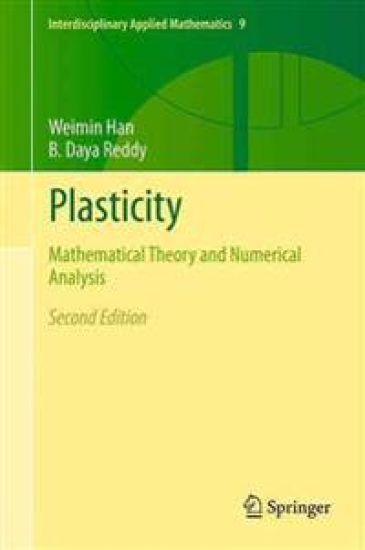
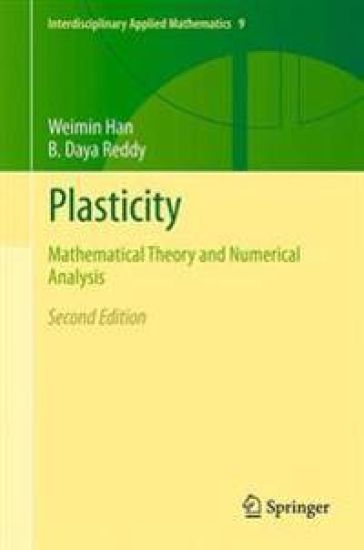
Plasticity

Plasticity

Weimin Han; B. Daya Reddy

Springer-Verlag New York Inc.
2014
nidottu
This book focuses on the theoretical aspects of small strain theory of elastoplasticity with hardening assumptions. It provides a comprehensive and unified treatment of the mathematical theory and numerical analysis. It is divided into three parts, with the first part providing a detailed introduction to plasticity, the second part covering the mathematical analysis of the elasticity problem, and the third part devoted to error analysis of various semi-discrete and fully discrete approximations for variational formulations of the elastoplasticity. This revised and expanded edition includes material on single-crystal and strain-gradient plasticity. In addition, the entire book has been revised to make it more accessible to readers who are actively involved in computations but less so in numerical analysis. Reviews of earlier edition: “The authors have written an excellent book which can be recommended for specialists in plasticity who wish to know more about the mathematical theory, as well as those with a background in the mathematical sciences who seek a self-contained account of the mechanics and mathematics of plasticity theory.” (ZAMM, 2002) “In summary, the book represents an impressive comprehensive overview of the mathematical approach to the theory and numerics of plasticity. Scientists as well as lecturers and graduate students will find the book very useful as a reference for research or for preparing courses in this field.” (Technische Mechanik) "The book is professionally written and will be a useful reference to researchers and students interested in mathematical and numerical problems of plasticity. It represents a major contribution in the area of continuum mechanics and numerical analysis." (Math Reviews)
Plasticity

Plasticity

Weimin Han; B. Daya Reddy

Springer-Verlag New York Inc.
2012
sidottu
This book focuses on the theoretical aspects of small strain theory of elastoplasticity with hardening assumptions. It provides a comprehensive and unified treatment of the mathematical theory and numerical analysis. It is divided into three parts, with the first part providing a detailed introduction to plasticity, the second part covering the mathematical analysis of the elasticity problem, and the third part devoted to error analysis of various semi-discrete and fully discrete approximations for variational formulations of the elastoplasticity. This revised and expanded edition includes material on single-crystal and strain-gradient plasticity. In addition, the entire book has been revised to make it more accessible to readers who are actively involved in computations but less so in numerical analysis. Reviews of earlier edition: “The authors have written an excellent book which can be recommended for specialists in plasticity who wish to know more about the mathematical theory, as well as those with a background in the mathematical sciences who seek a self-contained account of the mechanics and mathematics of plasticity theory.” (ZAMM, 2002) “In summary, the book represents an impressive comprehensive overview of the mathematical approach to the theory and numerics of plasticity. Scientists as well as lecturers and graduate students will find the book very useful as a reference for research or for preparing courses in this field.” (Technische Mechanik) "The book is professionally written and will be a useful reference to researchers and students interested in mathematical and numerical problems of plasticity. It represents a major contribution in the area of continuum mechanics and numerical analysis." (Math Reviews)
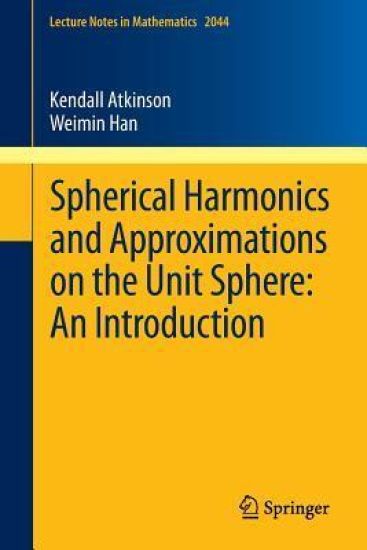
Spherical Harmonics and Approximations on the Unit Sphere: An Introduction

Spherical Harmonics and Approximations on the Unit Sphere: An Introduction

Kendall Atkinson; Weimin Han

Springer-Verlag Berlin and Heidelberg GmbH Co. K
2012
nidottu
These notes provide an introduction to the theory of spherical harmonics in an arbitrary dimension as well as an overview of classical and recent results on some aspects of the approximation of functions by spherical polynomials and numerical integration over the unit sphere. The notes are intended for graduate students in the mathematical sciences and researchers who are interested in solving problems involving partial differential and integral equations on the unit sphere, especially on the unit sphere in three-dimensional Euclidean space. Some related work for approximation on the unit disk in the plane is also briefly discussed, with results being generalizable to the unit ball in more dimensions.
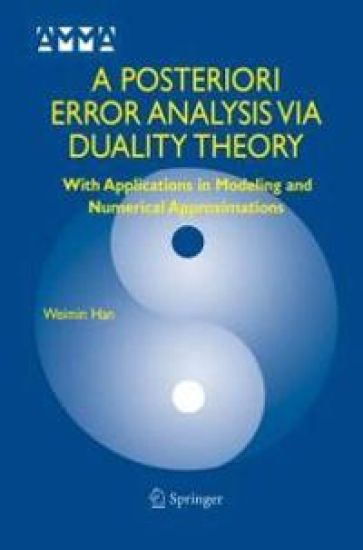
A Posteriori Error Analysis Via Duality Theory

A Posteriori Error Analysis Via Duality Theory

Weimin Han

Springer-Verlag New York Inc.
2010
nidottu
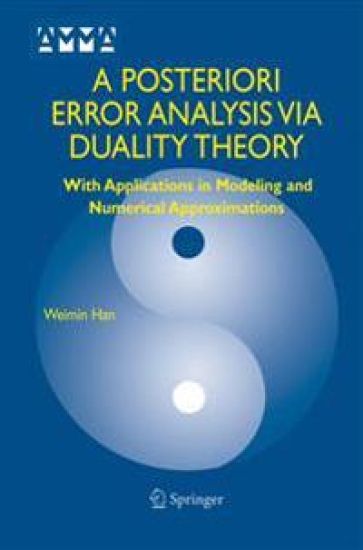
This work provides a posteriori error analysis for mathematical idealizations in modeling boundary value problems, especially those arising in mechanical applications, and for numerical approximations of numerous nonlinear var- tional problems. An error estimate is called a posteriori if the computed solution is used in assessing its accuracy. A posteriori error estimation is central to m- suring, controlling and minimizing errors in modeling and numerical appr- imations. In this book, the main mathematical tool for the developments of a posteriori error estimates is the duality theory of convex analysis, documented in the well-known book by Ekeland and Temam ([49]). The duality theory has been found useful in mathematical programming, mechanics, numerical analysis, etc. The book is divided into six chapters. The first chapter reviews some basic notions and results from functional analysis, boundary value problems, elliptic variational inequalities, and finite element approximations. The most relevant part of the duality theory and convex analysis is briefly reviewed in Chapter 2.
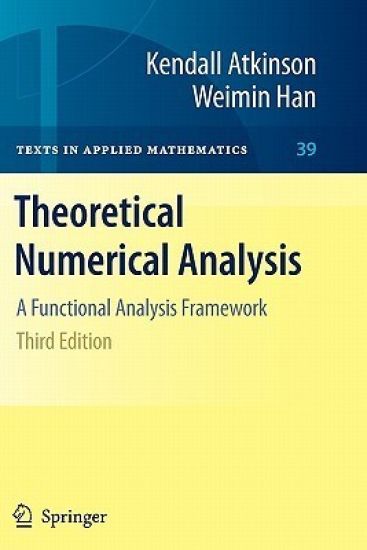
Theoretical Numerical Analysis

Theoretical Numerical Analysis

Kendall Atkinson; Weimin Han

Springer-Verlag New York Inc.
2010
nidottu
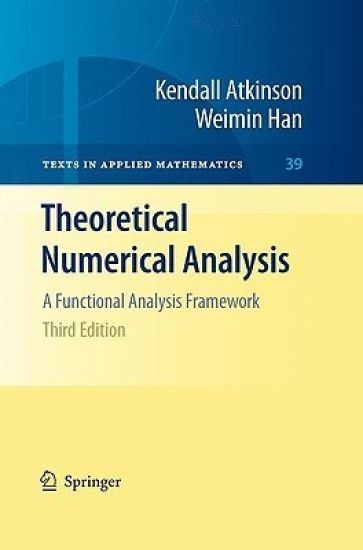
This textbook prepares graduate students for research in numerical analysis/computational mathematics by giving to them a mathematical framework embedded in functional analysis and focused on numerical analysis. This helps the student to move rapidly into a research program. The text covers basic results of functional analysis, approximation theory, Fourier analysis and wavelets, iteration methods for nonlinear equations, finite difference methods, Sobolev spaces and weak formulations of boundary value problems, finite element methods, elliptic variational inequalities and their numerical solution, numerical methods for solving integral equations of the second kind, and boundary integral equations for planar regions. The presentation of each topic is meant to be an introduction with certain degree of depth. Comprehensive references on a particular topic are listed at the end of each chapter for further reading and study. Because of the relevance in solving real world problems, multivariable polynomials are playing an ever more important role in research and applications. In this third editon, a new chapter on this topic has been included and some major changes are made on two chapters from the previous edition. In addition, there are numerous minor changes throughout the entire text and new exercises are added. Review of earlier edition: "...the book is clearly written, quite pleasant to read, and contains a lot of important material; and the authors have done an excellent job at balancing theoretical developments, interesting examples and exercises, numerical experiments, and bibliographical references." R. Glowinski, SIAM Review, 2003
Theoretical Numerical Analysis

Theoretical Numerical Analysis

Kendall Atkinson; Weimin Han

Springer-Verlag New York Inc.
2009
sidottu
This textbook prepares graduate students for research in numerical analysis/computational mathematics by giving to them a mathematical framework embedded in functional analysis and focused on numerical analysis. This helps the student to move rapidly into a research program. The text covers basic results of functional analysis, approximation theory, Fourier analysis and wavelets, iteration methods for nonlinear equations, finite difference methods, Sobolev spaces and weak formulations of boundary value problems, finite element methods, elliptic variational inequalities and their numerical solution, numerical methods for solving integral equations of the second kind, and boundary integral equations for planar regions. The presentation of each topic is meant to be an introduction with certain degree of depth. Comprehensive references on a particular topic are listed at the end of each chapter for further reading and study. Because of the relevance in solving real world problems, multivariable polynomials are playing an ever more important role in research and applications. In this third editon, a new chapter on this topic has been included and some major changes are made on two chapters from the previous edition. In addition, there are numerous minor changes throughout the entire text and new exercises are added. Review of earlier edition: "...the book is clearly written, quite pleasant to read, and contains a lot of important material; and the authors have done an excellent job at balancing theoretical developments, interesting examples and exercises, numerical experiments, and bibliographical references." R. Glowinski, SIAM Review, 2003
Numerical Solution of Ordinary Differential Equations

Numerical Solution of Ordinary Differential Equations

Kendall Atkinson; Weimin Han; David E. Stewart

John Wiley Sons Inc
2009
sidottu
A concise introduction to numerical methodsand the mathematical framework neededto understand their performance Numerical Solution of Ordinary Differential Equations presents a complete and easy-to-follow introduction to classical topics in the numerical solution of ordinary differential equations. The book's approach not only explains the presented mathematics, but also helps readers understand how these numerical methods are used to solve real-world problems. Unifying perspectives are provided throughout the text, bringing together and categorizing different types of problems in order to help readers comprehend the applications of ordinary differential equations. In addition, the authors' collective academic experience ensures a coherent and accessible discussion of key topics, including: Euler's method Taylor and Runge-Kutta methods General error analysis for multi-step methods Stiff differential equations Differential algebraic equations Two-point boundary value problems Volterra integral equations Each chapter features problem sets that enable readers to test and build their knowledge of the presented methods, and a related Web site features MATLAB® programs that facilitate the exploration of numerical methods in greater depth. Detailed references outline additional literature on both analytical and numerical aspects of ordinary differential equations for further exploration of individual topics. Numerical Solution of Ordinary Differential Equations is an excellent textbook for courses on the numerical solution of differential equations at the upper-undergraduate and beginning graduate levels. It also serves as a valuable reference for researchers in the fields of mathematics and engineering.
A Posteriori Error Analysis Via Duality Theory

A Posteriori Error Analysis Via Duality Theory

Weimin Han

Springer-Verlag New York Inc.
2004
sidottu
This work provides a posteriori error analysis for mathematical idealizations in modeling boundary value problems, especially those arising in mechanical applications, and for numerical approximations of numerous nonlinear var- tional problems. An error estimate is called a posteriori if the computed solution is used in assessing its accuracy. A posteriori error estimation is central to m- suring, controlling and minimizing errors in modeling and numerical appr- imations. In this book, the main mathematical tool for the developments of a posteriori error estimates is the duality theory of convex analysis, documented in the well-known book by Ekeland and Temam ([49]). The duality theory has been found useful in mathematical programming, mechanics, numerical analysis, etc. The book is divided into six chapters. The first chapter reviews some basic notions and results from functional analysis, boundary value problems, elliptic variational inequalities, and finite element approximations. The most relevant part of the duality theory and convex analysis is briefly reviewed in Chapter 2.
Elementary Numerical Analysis

Elementary Numerical Analysis

Kendall Atkinson; Weimin Han

John Wiley Sons Inc
2003
sidottu
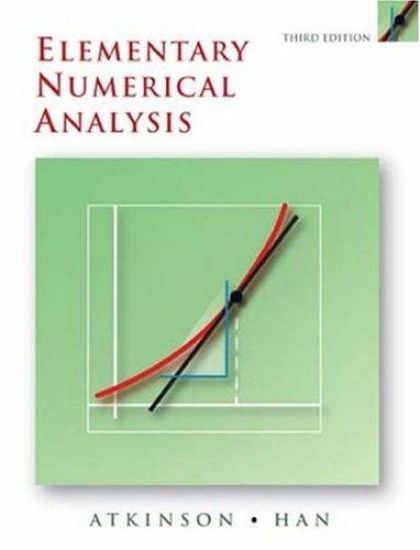
Offering a clear, precise, and accessible presentation, complete with MATLAB programs, this new Third Edition of Elementary Numerical Analysis gives students the support they need to master basic numerical analysis and scientific computing. Now updated and revised, this significant revision features reorganized and rewritten content, as well as some new additional examples and problems. The text introduces core areas of numerical analysis and scientific computing along with basic themes of numerical analysis such as the approximation of problems by simpler methods, the construction of algorithms, iteration methods, error analysis, stability, asymptotic error formulas, and the effects of machine arithmetic.
Analysis and Approximation of Contact Problems with Adhesion or Damage

Analysis and Approximation of Contact Problems with Adhesion or Damage

Mircea Sofonea; Weimin Han; Meir Shillor

Chapman Hall/CRC
2005
sidottu
Research into contact problems continues to produce a rapidly growing body of knowledge. Recognizing the need for a single, concise source of information on models and analysis of contact problems, accomplished experts Sofonea, Han, and Shillor carefully selected several models and thoroughly study them in Analysis and Approximation of Contact Problems with Adhesion or Damage. The book describes very recent models of contact processes with adhesion or damage along with their mathematical formulations, variational analysis, and numerical analysis. Following an introduction to modeling and functional and numerical analysis, the book devotes individual chapters to models involving adhesion and material damage, respectively, with each chapter exploring a particular model. For each model, the authors provide a variational formulation and establish the existence and uniqueness of a weak solution. They study a fully discrete approximation scheme that uses the finite element method to discretize the spatial domain and finite differences for the time derivatives. The final chapter summarizes the results, presents bibliographic comments, and considers future directions in the field. Employing recent results on elliptic and evolutionary variational inequalities, convex analysis, nonlinear equations with monotone operators, and fixed points of operators, Analysis and Approximation of Contact Problems with Adhesion or Damage places these important tools and results at your fingertips in a unified, accessible reference.
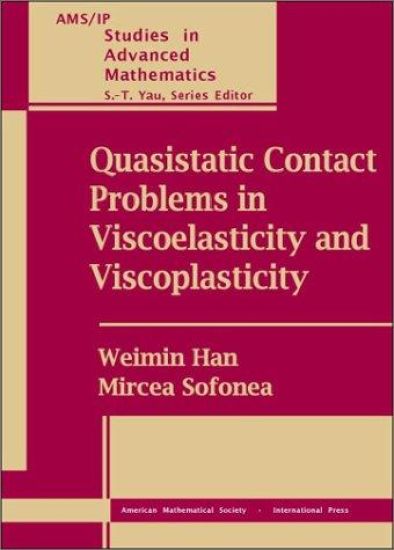
Quasistatic Contact Problems in Viscoelasticity and Viscoplasticity

Quasistatic Contact Problems in Viscoelasticity and Viscoplasticity

Weimin Han; Mircea Sofonea

Amer Mathematical Society
2002
sidottu
Phenomena of contact between deformable bodies or between deformable and rigid bodies abound in industry and in everyday life. A few simple examples are brake pads with wheels, tires on roads, and pistons with skirts. Common industrial processes such as metal forming and metal extrusion involve contact evolutions. Because of the importance of contact processes in structural and mechanical systems, considerable effort has been put into modeling and numerical simulations. This book introduces readers to a mathematical theory of contact problems involving deformable bodies. It covers mechanical modeling, mathematical formulations, variational analysis, and the numerical solution of the associated formulations. The authors give a complete treatment of some contact problems by presenting arguments and results in modeling, analysis, and numerical simulations. Variational analysis of the models includes existence and uniqueness results of weak solutions, as well as results of continuous dependence of the solution on the data and parameters. Also discussed are links between different mechanical models. In carrying out the variational analysis, the authors systematically use results on elliptic and evolutionary variational inequalities, convex analysis, nonlinear equations with monotone operators, and fixed points of operators. Prerequisites include basic functional analysis, variational formulations of partial differential equation problems, and numerical approximations. The text is suitable for graduate students and researchers in applied mathematics, computational mathematics, and computational mechanics.