Kirjojen hintavertailu – 12 859 826 kirjaa ja 27 kauppaa

Kirjailija

Weixing Hu

Kirjat ja teokset yhdessä paikassa: 6 kirjaa, julkaisuja vuosilta 2013–2026, suosituimpiin kuuluu Geography and International Conflict. Vertaile teosten hintoja ja tarkista saatavuus suomalaisista kirjakaupoista.

6 kirjaa

Kirjojen julkaisuvuodet: 2013–2026.

The Future of Pacific Asia

The Future of Pacific Asia

Steve Chan; Weixing Hu

TAYLOR FRANCIS LTD
2026
sidottu
This book examines the future of the Asia Pacific’s political economy and its security challenges for the next quarter century. Featuring pertinent discussions on topics such as the ongoing Sino-American power transition and hedging behavior by various states in this vital region, it explains that while some important legacies will endure (such as China’s centrality in the region and continuing U. S. military dominance), other ongoing changes (such as the obsolescence of the Yoshida Doctrine and China’s displacement of the U. S. as the main economic partner for practically all countries in this region) suggest a more turbulent and unpredictable future. The book also explores the profound changes occurring in Chinese, Japanese, and U. S. domestic politics and their cascading effects on the rest of the region. Highlighting how existing Western analytic categories are unable to fully capture the nuances of the Asia Pacific, this book will be a valuable resource to students and scholars of international relations and comparative politics interested in this region.
Geography and International Conflict

Geography and International Conflict

Steve Chan; Weixing Hu

TAYLOR FRANCIS LTD
2026
nidottu
This book analyzes the influence of geography— defined broadly to refer to physical size, location, terrain, accessibility, insularity, climate, regions, neighborhoods, natural endowment, strategic pathways, maritime and continental orientations and even imagined communities— on international relations. Drawing on evidence and insights from cross- national research the book highlights geography’s enduring importance in and relevance to the ongoing Russo-Ukrainian War, tension across the Taiwan Strait, construction of regional order such as Greater Eurasia and Indo-Pacific and important differences in the nature of the security environment facing China and the U. S., respectively. It successfully bridges the gap that often separates international relations scholarship, interested in the central tendencies characterizing how states interact in general, and more idiographic approaches of Sinology providing rich country-specific details but at the expense of often overlooking features that China shares with other countries. Offering an overview of propositions about how geography has shaped human development and institutions, alongside in- depth discussions of its role in influencing national security and interstate conflict, this book will appeal to students and scholars of international relations, political geography and comparative politics.
Geography and International Conflict

Geography and International Conflict

Steve Chan; Weixing Hu

TAYLOR FRANCIS LTD
2024
sidottu
This book analyzes the influence of geography— defined broadly to refer to physical size, location, terrain, accessibility, insularity, climate, regions, neighborhoods, natural endowment, strategic pathways, maritime and continental orientations and even imagined communities— on international relations. Drawing on evidence and insights from cross- national research the book highlights geography’s enduring importance in and relevance to the ongoing Russo-Ukrainian War, tension across the Taiwan Strait, construction of regional order such as Greater Eurasia and Indo-Pacific and important differences in the nature of the security environment facing China and the U. S., respectively. It successfully bridges the gap that often separates international relations scholarship, interested in the central tendencies characterizing how states interact in general, and more idiographic approaches of Sinology providing rich country-specific details but at the expense of often overlooking features that China shares with other countries. Offering an overview of propositions about how geography has shaped human development and institutions, alongside in- depth discussions of its role in influencing national security and interstate conflict, this book will appeal to students and scholars of international relations, political geography and comparative politics.
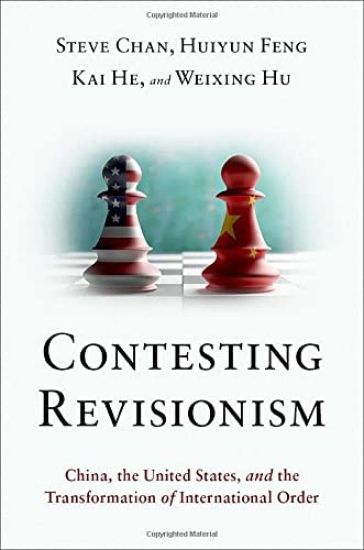
Contesting Revisionism

Contesting Revisionism

Steve Chan; Huiyun Feng; Kai He; Weixing Hu

Oxford University Press Inc
2021
nidottu
How can we know a country, such as the United States or China, is revisionist, that is, whether it intends to upset the international order? What motivates states to act the way they do? Contesting Revisionism focuses on a particular kind of motivation inclining a state to challenge the existing norms, rules, and institutions of international order: revisionism. The authors offer a critique of the existing discourse on revisionism and investigate the origin and evolution of the foreign policy orientations of revisionist states in the past. Furthermore, they introduce an ensemble of indicators to discern and compare the extent of revisionist tendencies on the part of contemporary China and the United States. Questioning the facile assumption that past episodes will repeat in the future, they argue that "hard" revisionism relying on war and conquest is less viable and likely in today's world. Instead, "soft" revisionism seeking to promote institutional change is more relevant and likely. Focusing on contemporary Sino-American relations, they conclude that much of the current discourse based on power transition theory is problematic. A dominant power is not inevitably committed to the defense of international order, nor does a rising power always have a revisionist agenda to challenge this order. The transformation of international order does not necessarily require a power transition between China and the US., nor does a possible power transition necessarily augur war. After developing the concept of revisionism both theoretically and empirically, they conclude with a series of policy recommendations for enhancing international stability and diminishing tension in Sino-American relations.
Contesting Revisionism

Contesting Revisionism

Steve Chan; Huiyun Feng; Kai He; Weixing Hu

Oxford University Press Inc
2021
sidottu
How can we know a country, such as the United States or China, is revisionist, that is, whether it intends to upset the international order? What motivates states to act the way they do? Contesting Revisionism focuses on a particular kind of motivation inclining a state to challenge the existing norms, rules, and institutions of international order: revisionism. The authors offer a critique of the existing discourse on revisionism and investigate the origin and evolution of the foreign policy orientations of revisionist states in the past. Furthermore, they introduce an ensemble of indicators to discern and compare the extent of revisionist tendencies on the part of contemporary China and the United States. Questioning the facile assumption that past episodes will repeat in the future, they argue that "hard" revisionism relying on war and conquest is less viable and likely in today's world. Instead, "soft" revisionism seeking to promote institutional change is more relevant and likely. Focusing on contemporary Sino-American relations, they conclude that much of the current discourse based on power transition theory is problematic. A dominant power is not inevitably committed to the defense of international order, nor does a rising power always have a revisionist agenda to challenge this order. The transformation of international order does not necessarily require a power transition between China and the US., nor does a possible power transition necessarily augur war. After developing the concept of revisionism both theoretically and empirically, they conclude with a series of policy recommendations for enhancing international stability and diminishing tension in Sino-American relations.
Building a Neighborly Community

Building a Neighborly Community

Daojiong Zha; Weixing Hu

Manchester University Press
2013
nidottu
Building a neighborly community, available for the first time in paperback, explores the political economy of post-cold war East Asian co-operation by examining the history of intra-regional co-operation, against the background of China’s rise and Japan’s relative decline, both real and perceived. The book in particular examines how East Asian states have dealt with the South China Sea as a region-wide security challenge and the imperative for self-help after the 1997 economic crisis. The book builds on the explanatory strength of analytical eclecticism, and ultimately concludes that China, South Korea, Japan, and ASEAN states have aimed for constructing a neighborly community. The fundamental differences between a neighborly community and the kind of community that has emerged in Europe and North America are that qualification for membership is not conditional, the process of routine interactions is itself one of reassurance, the aim of inter-state interactions is to foster acceptance of each other, and changes in a member’s foreign policy behaviour are accepted.