

Kirjailija
Werner Hamacher
Kirjat ja teokset yhdessä paikassa: 17 kirjaa, julkaisuja vuosilta 1995–2025, suosituimpiin kuuluu Keinmaleins: Texte Zu Celan. Vertaile teosten hintoja ja tarkista saatavuus suomalaisista kirjakaupoista.
17 kirjaa
Kirjojen julkaisuvuodet: 1995–2025.

Neu als Fachkraft für Arbeitssicherheit
Andreas Wittmann; Silvester Siegmann; Werner Hamacher
ecomed
2022
nidottu

As its title suggests, this collections of essays by one of the foremost theorists working today takes as its theme the edge or limit between language, time, history, and politics. These are essays that are all on the brink, about the edge, the very extreme at which one can no longer say where one is located, neither on the cliff, say, nor over the edge. To be on the brink, then, is to take up that extreme limit, the point of contamination or indetermination where language, time, history, and politics all converge upon one another. The book begins with a consideration of Kant’s treatment of time as representation, before moving toward more explicitly political themes as it engages political theology and messianism in Hegel and Hölderlin. The second section explores the questionof language in a variety of manifestations—from translation to complaint and greeting—and through a number of literary and cultural forms, from the work of Mallarmé to email. The volume concludes with an interview in which Hamacher offers a revealing overview of his work, beginning with an account of his early writings and moving up to his most recent essays.

As its title suggests, this collections of essays by one of the foremost theorists working today takes as its theme the edge or limit between language, time, history, and politics. These are essays that are all on the brink, about the edge, the very extreme at which one can no longer say where one is located, neither on the cliff, say, nor over the edge. To be on the brink, then, is to take up that extreme limit, the point of contamination or indetermination where language, time, history, and politics all converge upon one another. The book begins with a consideration of Kant’s treatment of time as representation, before moving toward more explicitly political themes as it engages political theology and messianism in Hegel and Hölderlin. The second section explores the questionof language in a variety of manifestations—from translation to complaint and greeting—and through a number of literary and cultural forms, from the work of Mallarmé to email. The volume concludes with an interview in which Hamacher offers a revealing overview of his work, beginning with an account of his early writings and moving up to his most recent essays.
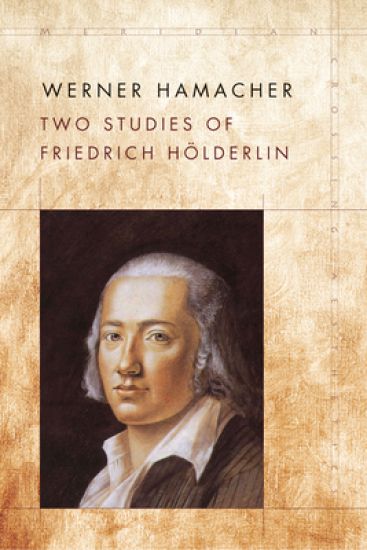
Two Studies of Friedrich Hölderlin shows how the poet enacts a radical theory of meaning that culminates in a unique and still groundbreaking concept of revolution, one that begins with a revolutionary understanding of language. The product of an intense engagement with both Walter Benjamin and Jacques Derrida, the book presents Werner Hamacher's major attempts at developing a critical practice commensurate with the immensity of Hölderlin's late writings. These essays offer an incisive and innovative combination of critical theory and deconstruction while also identifying where influential critics like Heidegger fail to do justice to the poet's astonishing radicality. Readers will not only come away with a new appreciation of Hölderlin's poetic and political-theoretical achievements but will also discover the motivating force behind Hamacher's own achievements as a literary scholar and political theorist. An introduction by Julia Ng and an afterword by Peter Fenves provide further information about these studies and the academic and theoretical context in which they were composed.
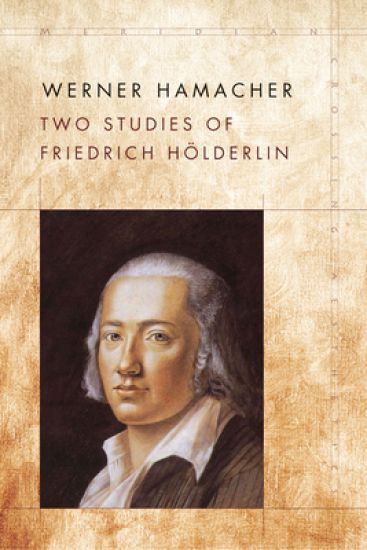
Two Studies of Friedrich Hölderlin shows how the poet enacts a radical theory of meaning that culminates in a unique and still groundbreaking concept of revolution, one that begins with a revolutionary understanding of language. The product of an intense engagement with both Walter Benjamin and Jacques Derrida, the book presents Werner Hamacher's major attempts at developing a critical practice commensurate with the immensity of Hölderlin's late writings. These essays offer an incisive and innovative combination of critical theory and deconstruction while also identifying where influential critics like Heidegger fail to do justice to the poet's astonishing radicality. Readers will not only come away with a new appreciation of Hölderlin's poetic and political-theoretical achievements but will also discover the motivating force behind Hamacher's own achievements as a literary scholar and political theorist. An introduction by Julia Ng and an afterword by Peter Fenves provide further information about these studies and the academic and theoretical context in which they were composed.
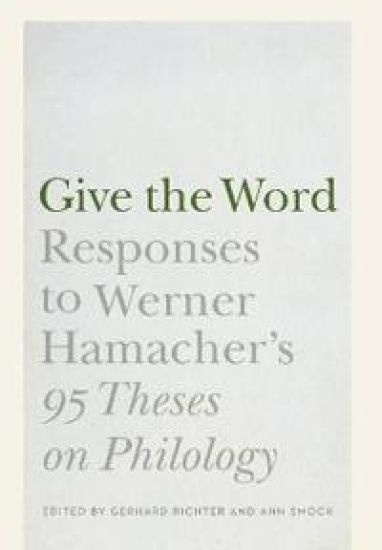
Werner Hamacher’s witty and elliptical 95 Theses on Philology challenges the humanities-and particularly academic philology-that assume language to be a given entity rather than an event. In Give the Word eleven scholars of literature and philosophy (Susan Bernstein, MichÈle Cohen-Halimi, Peter Fenves, Sean Gurd, Daniel Heller-Roazen, Jan Plug, Gerhard Richter, Avital Ronell, Thomas Schestag, Ann Smock, and Vincent van Gerven Oei) take up the challenge presented by Hamacher’s theses. At the close Hamacher responds to them in a spirited text that elaborates on the context of his 95 Theses and its rich theoretical and philosophical ramifications. The 95 Theses, included in this volume, makes this collection a rich resource for the study and practice of “radical philology.” Hamacher’s philology interrupts and transforms, parting with tradition precisely in order to remain faithful to its radical but increasingly occluded core. The contributors test Hamacher’s break with philology in a variety of ways, attempting a philological practice that does not take language as an object of knowledge, study, or even love. Thus, in responding to Hamacher’s Theses, the authors approach language that, because it can never be an object of any kind, awakens an unfamiliar desire. Taken together these essays problematize philological ontology in a movement toward radical reconceptualizations of labor, action, and historical time.
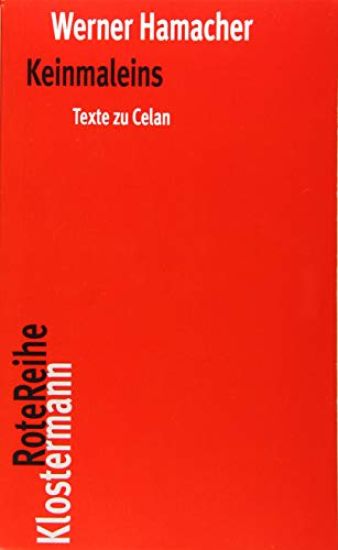
The late Werner Hamacher enjoys a legendary reputation beyond the narrower limits of his trade. By combining the most solid German philology with his erudite knowledge of German-French philosophy, his texts acquire a unique voice, internationally acknowledged for its unparalleled sophistication. Highly self-critical, Hamacher was notoriously reluctant to allow more than a handful of his texts to be published during his lifetime. "Keinmaleins" finally makes available Hamacher's essays on the poetry of Paul Celan, whose work Hamacher kept interpreting with astonishing intensity throughout his life. The volume also contains a preface by French philosopher Jean-Luc Nancy.
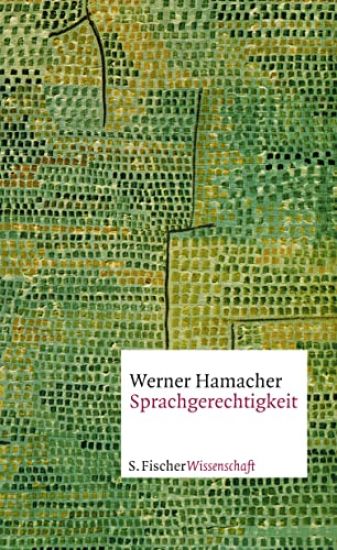
Minima Philologica brings together two essays by Werner Hamacher that are meant to revitalize philology as a practice beyond its restriction to the restoration of linguistic data and their meanings. In these two texts, "95 Theses on Philology" and "For—Philology," Hamacher propounds a notion of generalized philology that is equivalent to the real production of linguistic utterances, and indeed utterances not limited to predicative or even discursive statements. Philology, in speaking for language where no clear and distinct language is given, exhibits and exposes the structure of language in general. The first text, "95 Theses on Philology," challenges academic philology as well as other disciplines across the humanities and sciences that "use" language, assuming it to be a given entity and not an event. The theses develop what Hamacher calls the "idea of philology" by describing the constitution of its objects, its relation to knowledge, its suspension of consciousness, and its freedom for what remains always still to be said. In "For—Philology," both speaking and writing, Hamacher argues, follow, discursively and non-discursively, the desire for language. Desire—philía—is the insatiable affect that drives the movement between utterances toward the next and the one after that. Desiring language—logos—means to respond to an alien utterance that precedes you, ignorant about where the path will lead, accepting loss and uncertainty, thinking in and through language and the lack of it, exceeding, returning, responding to others, cutting into and off what is to be said. In arguing this, Hamacher responds, directly or obliquely, to other philological thinkers such as Plato and Schlegel, Nietzsche, Benjamin, and Heidegger, as well as to poets such as Rene Char, Francis Ponge, Paul Celan, and Friedrich Holderlin. Taken together, the essays of Minima Philologica constitute a manifesto for a new understanding of linguistic existence that breaks new ways of attending to language and those who live by it.
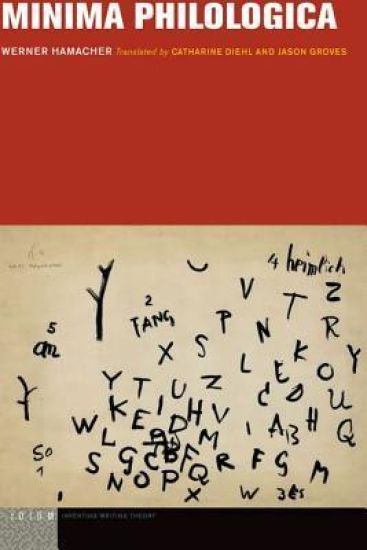
Minima Philologica brings together two essays by Werner Hamacher that are meant to revitalize philology as a practice beyond its restriction to the restoration of linguistic data and their meanings. In these two texts, “95 Theses on Philology” and “For—Philology,” Hamacher propounds a notion of generalized philology that is equivalent to the real production of linguistic utterances, and indeed utterances not limited to predicative or even discursive statements. Philology, in speaking for language where no clear and distinct language is given, exhibits and exposes the structure of language in general. The first text, “95 Theses on Philology,” challenges academic philology as well as other disciplines across the humanities and sciences that “use” language, assuming it to be a given entity and not an event. The theses develop what Hamacher calls the “idea of philology” by describing the constitution of its objects, its relation to knowledge, its suspension of consciousness, and its freedom for what remains always still to be said. In “For—Philology,” both speaking and writing, Hamacher argues, follow, discursively and non-discursively, the desire for language. Desire—philía—is the insatiable affect that drives the movement between utterances toward the next and the one after that. Desiring language—logos—means to respond to an alien utterance that precedes you, ignorant about where the path will lead, accepting loss and uncertainty, thinking in and through language and the lack of it, exceeding, returning, responding to others, cutting into and off what is to be said. In arguing this, Hamacher responds, directly or obliquely, to other philological thinkers such as Plato and Schlegel, Nietzsche, Benjamin, and Heidegger, as well as to poets such as Rene Char, Francis Ponge, Paul Celan, and Friedrich Holderlin. Taken together, the essays of Minima Philologica constitute a manifesto for a new understanding of linguistic existence that breaks new ways of attending to language and those who live by it.
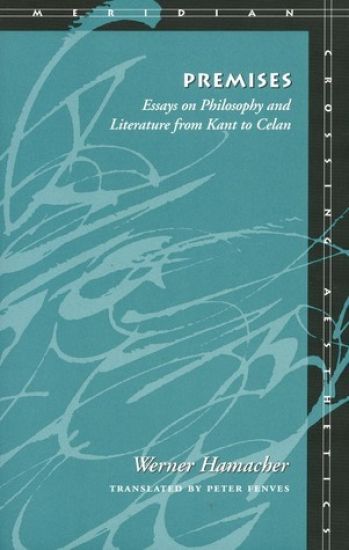
"Poetry does not impose, it exposes itself," wrote Paul Celan. Werner Hamacher's investigations into crucial texts of philosophical and literary modernity show that Celan's apothegm is also valid for the structure of understanding and for language in general. In Premises Hamacher demonstrates that the promise of a subject position is not only unavoidable—and thus operates as a structural imperative—but is also unattainable and therefore by necessity open to possibilities other than that defined as "position," to redefinitions and unexpected transformations of the merely thetical act. Proceeding along the lines of both philosophical argument and critical reading, Hamacher presents the fullest account of the vast disruption in the theories and ethics of positional and propositional acts—a disruption first exposed by Kant's analysis of the minimal requirements for linguistic and practical action. Focusing on the double trait of every premise—that it is promised but never attained—Hamacher analyzes nine decisive themes, topics, and texts of modernity: the hermeneutic circle in Schleiermacher and Heidegger, the structure of ethical commands in Kant, Nietzsche's genealogy of moral terms and his exploration of the aporias of singularity, the irony of reading in de Man, the parabasis of positing acts in Fichte and Schlegel, Kleist's disruption of narrative representation, the gesture of naming in Benjamin and Kafka, and the incisive caesura that Paul Celan inserts into temporal and linguistic reversals. There is no book that so fully brings the issues of both critical philosophy and critical literature into reach. Reviews "Werner Hamacher's Premises is the heir and successor to the most important theoretical and critical work done in American departments of comparative literature from the 1960s through the 1980s. Yet, Premises is no more a work of literary scholarship than one of philosophical submission to philosophy. With the gesture that is genuinely called post-structural, which is the suspicion and suspension of every code, the book's act of freedom is freedom to read and write language tout court." —Timothy Bahti, University of Michigan "Hamacher's project can be described as the retracing of the epistemological ground upon which the modern conception of the literary was erected. It is quite clear to me that there is nothing presently available to rival this book." —Wlad Godzich, University of Geneva
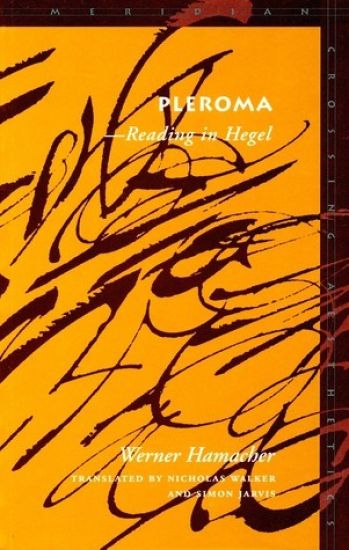
Since Hegel, philosophy cannot stop thinking its end. The violent transformations which Hegel's philosophy has uncovered and caused in the structure of philosophical terms and in the terms under which philosophy is possible is Hamacher's topic. Starting from Hegel's commentaries on biblical scripture, Hamacher traces the genealogy and unfolding of Hegel's thought into his mature works—the Phenomenology of Spirit, the Encyclopedia, the Philosophy of History—focusing throughout on the limits and borders, the limitations and extremities of its conceptual and textual movements. Because the concept for Hegel is the end of the thing—the point where it peaks—because it occurs by severance from its representational content, the trace of this splitting appears imprinted into its discursive articulation. The Hegelian text is punctuated by a series of terms and topics that operate according to the logic of the turning point: one function activating its opposite, they serve as pores between mutually exclusive experiences and establish their unity. This dialectical procedure falters, its unity dissolves, the pores turn into aporias, wherever conceptual exigencies surpass the reality they have instilled. Hamacher shows that dialectics, proceeding by way of aporias, remains unable to account for its own movement. Hegel's system must be read from the point where its rupture fails to converge with its end. Analyzing both the historical and the systematic aspects of Hegel's philosophy, addressing Kant and religious fetishism, Nietzsche and the impossible repetition of the same, Marx and the aroma of religion, Freud and the hysterical body, Hamacher's argument is directed toward what in Hegel's philosophy of spirit resists spiritualization and defeats philosophy. Aspiring to be the last philosophy, speculative idealism has to incorporate all previous systems and spiritualize its incorporation. Its logic of ingestion must, however, reject with repulsion and nausea (Ekel) everything that resists appropriation. Emphasizing Hegel's claim to present the political theology of modern society, Hamacher shows that the mechanism of nausea meant to keep the system intact is in fact itself a mechanism foreign to its body; it averts the promised incorporation, defeats idealization, leaves the body politic disintegrated, and voids the claim of the most powerful ontology of modern society to mark the end, the completion and plenitude—the pleroma—of philosophy and history. What remains—the indigestible, the unreadable, the nondiscursive—demands yet another kind of discourse and another practical gesture: toward a pleroma other than Hegel's.
Since Hegel, philosophy cannot stop thinking its end. The violent transformations which Hegel's philosophy has uncovered and caused in the structure of philosophical terms and in the terms under which philosophy is possible is Hamacher's topic. Starting from Hegel's commentaries on biblical scripture, Hamacher traces the genealogy and unfolding of Hegel's thought into his mature works—the Phenomenology of Spirit, the Encyclopedia, the Philosophy of History—focusing throughout on the limits and borders, the limitations and extremities of its conceptual and textual movements. Because the concept for Hegel is the end of the thing—the point where it peaks—because it occurs by severance from its representational content, the trace of this splitting appears imprinted into its discursive articulation. The Hegelian text is punctuated by a series of terms and topics that operate according to the logic of the turning point: one function activating its opposite, they serve as pores between mutually exclusive experiences and establish their unity. This dialectical procedure falters, its unity dissolves, the pores turn into aporias, wherever conceptual exigencies surpass the reality they have instilled. Hamacher shows that dialectics, proceeding by way of aporias, remains unable to account for its own movement. Hegel's system must be read from the point where its rupture fails to converge with its end. Analyzing both the historical and the systematic aspects of Hegel's philosophy, addressing Kant and religious fetishism, Nietzsche and the impossible repetition of the same, Marx and the aroma of religion, Freud and the hysterical body, Hamacher's argument is directed toward what in Hegel's philosophy of spirit resists spiritualization and defeats philosophy. Aspiring to be the last philosophy, speculative idealism has to incorporate all previous systems and spiritualize its incorporation. Its logic of ingestion must, however, reject with repulsion and nausea (Ekel) everything that resists appropriation. Emphasizing Hegel's claim to present the political theology of modern society, Hamacher shows that the mechanism of nausea meant to keep the system intact is in fact itself a mechanism foreign to its body; it averts the promised incorporation, defeats idealization, leaves the body politic disintegrated, and voids the claim of the most powerful ontology of modern society to mark the end, the completion and plenitude—the pleroma—of philosophy and history. What remains—the indigestible, the unreadable, the nondiscursive—demands yet another kind of discourse and another practical gesture: toward a pleroma other than Hegel's.
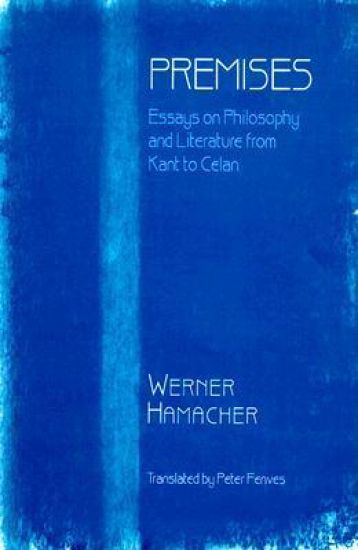
"Poetry does not impose, it exposes itself," wrote Paul Celan. Werner Hamacher's investigations into crucial texts of philosophical and literary modernity show that Celan's apothegm is also valid for the structure of understanding and for language in general. "Subject position" is widely invoked today, yet Hamacher is the first to thoroughly investigate the premises for this invocation. He demonstrates that the promise of a subject position is not only unavoidable--and thus produces more and more fundamentalisms--but is also unattainable and therefore always open to innovation, revision, and unexpected transformation. In a book that is both philosophical and literary, Hamacher gives us the fullest account of the vast disruption in the very nature of our understanding that was first unleashed by Kant's critique of human subjectivity. In light of the double nature of every premise--that it is promised but never attainable--Hamacher gives us nine decisive themes, topics, and texts of modernity: the hermeneutic circle in Schleiermacher and Heidegger, the structure of ethical commands in Kant, Nietzsche's genealogy of moral terms and his exploration of the aporias of singularity, the irony of reading in de Man, the parabasis of language in Schlegel, Kleist's disruption of narrative representation, the gesture of naming in Benjamin and Kafka, and the incisive caesura that Paul Celan inserts into temporal and linguistic reversals. There is no book that so fully brings the issues of both critical philosophy and critical literature into reach.

Fabrikinnovation ALS Technisch-Organisatorische Gesamtloesung
Werner Hamacher; Johannes Hungerhoff;
Peter Lang AG
1995
nidottu
Aufgrund des Wandels der Umwelt und der Markte geraten Unternehmen mehr und mehr unter Modernisierungsdruck. An einem Praxisbeispiel aus der mittelstandischen Industrie wird der schwierige Prozess der Reorganisation der Fertigung und seine Auswirkungen auf das gesamte Unternehmen in der Umbruchsituation vom Taylorismus zum -Lean-Management- dargestellt. Das Beispiel zeigt, dass Modernisierung dann erfolgreich ist, wenn eine technisch-organisatorische Gesamtlosung sowohl nach zukunftsgerichteten betriebswirtschaftlichen Kriterien als auch nach Leitlinien der menschengerechten Arbeitsgestaltung erfolgt. Die Gesamtlosung ist charakterisiert durch die aufeinander bezogene Gestaltung von Technik, Organisation und Qualifikation."