

Kirjailija
Werner Sombart
Kirjat ja teokset yhdessä paikassa: 85 kirjaa, julkaisuja vuosilta 1927–2025, suosituimpiin kuuluu Der moderne Kapitalismus.. Vertaile teosten hintoja ja tarkista saatavuus suomalaisista kirjakaupoista.
85 kirjaa
Kirjojen julkaisuvuodet: 1927–2025.


Die deutsche Volkswirtschaft im neunzehnten Jahrhundert und im Anfang des 20. Jahrhunderts
Werner Sombart
Outlook
2014
sidottu

Die deutsche Volkswirtschaft im neunzehnten Jahrhundert und im Anfang des 20. Jahrhunderts
Werner Sombart
Salzwasser-Verlag Gmbh
2013
pokkari


Warum gibt es in den Vereinigten Staaten keinen Sozialismus?
Werner Sombart
Salzwasser-Verlag Gmbh
2011
pokkari




Socialism and the Social Movement in the Nineteenth Century
Werner Sombart; Anson P. (TRN) Atterbury; John B. (CON) Clark
Kessinger Pub
2008
sidottu

Socialism and the Social Movement in the Nineteenth Century
Werner Sombart; Anson P. (TRN) Atterbury; John B. (CON) Clark
Kessinger Pub
2008
pokkari

Die Ordnung des Wirtschaftslebens
Werner Sombart
Springer-Verlag Berlin and Heidelberg GmbH Co. KG
2007
sidottu
Reprint der Erstauflage von 1927: "Systematisierung", "Organisierung" und "Regulierung" des Wirtschaftslebens von W. Sombart. Er gibt einen guten Überblick über die Organisationsformen wirtschaftlicher Tätigkeit. Dabei betrachtet er die volks- und betriebswirtschaftliche Ebene. Eine aufschlussreiche Sammlung zur Diskussion über Wirtschaftssysteme, Betriebsorganisation und wirtschaftspolitische Standpunkte im ersten Drittel des 20. Jahrhunderts.


Die Drei Nationalokonomien: Geschichte Und System Der Lehre Von Der Wirtschaft
Werner Sombart
Duncker Humblot
2003
nidottu
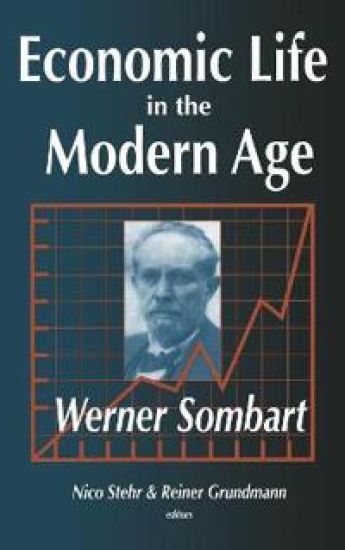
Werner Sombart (1863-1941) may well have been the most famous and controversial social scientist in Germany during the early twentieth century. Highly influential, his work and reputation have been indelibly tainted by his embrace of National Socialism in the last decade of his life. Although Sombart left an enormous opus spanning disciplinary boundaries, intellectual reaction to his work inside and outside of Germany is divided and ambivalent. Sombart consistently responded to the social and political developments that have shaped the twentieth century. Economic Life in the Modern Age provides a representative sampling of those portions of Sombart's work that have stood the test of time. The volume opens with a substantial introduction reviewing Sombart's life and career, the evolution of his major intellectual concerns, his relation to Marx and Weber, and his political affiliation with the Nazis. The editors' selection of texts emphasizes areas of Sombart's economic and cultural thought that remain relevant, particularly to those intellectual trends that seek a more broadly based, cross-disciplinary approach to culture and economics. Sombart's writings on capitalism are represented by essays on the nature and origin of the market system and the diversity of motives among the bourgeoisie and the proletariat. Also included is an excerpt from Sombart's controversial The Jews and Modern Capitalism, exploring the widely perceived relation between economic life and Judaism as a religion. In essays on the economics of cultural processes, Sombart's comprehensive and expansive idea of cultural science yields prophetic insights into the nature of urbanism, luxury consumption, fashion, and the cultural secularization of love. The volume's final section consists of Sombart's reflections on the social influences of technology, the economic life of the future, and on socialism, including the influential essay "Why is there no Socialism in the United States." Encapsulating the most valuable aspects of his work, Economic Life in the Modern Age provides clear demonstration of Sombart's sense for fine cultural distinctions and broad cultural developments and the predictive power of his analyses. It will be of interest to sociologists, economists, political scientists, and specialists in cultural studies. Nico Stehr is professor at the Max Planck-Instit³t f³r Meteorologie in Hamburg. Reiner Grundmann is professor at the Aston Business School of Aston University in Birmingham, U. K.

Since its first appearance in Germany in 1911, Jews and Modern Capitalism has provoked vehement criticism. As Samuel Z. Klausner emphasizes, the lasting value of Sombart's work rests not in his results-most of which have long since been disproved-but in his point of departure. Openly acknowledging his debt to Max Weber, Sombart set out to prove the double thesis of the Jewish foundation of capitalism and the capitalist foundation of Judaism. Klausner, placing Sombart's work in its historical and societal context, examines the weaknesses and strengths of Jews and Modern Capitalism.

Why is the United States the only advanced capitalist country with no labor party? This question is one of the great enduring puzzles of American political development, and it lies at the heart of a fundamental debate about the nature of American society. Tackling this debate head-on, Robin Archer puts forward a new explanation for why there is no American labor party-an explanation that suggests that much of the conventional wisdom about "American exceptionalism" is untenable. Conventional explanations rely on comparison with Europe. Archer challenges these explanations by comparing the United States with its most similar New World counterpart-Australia. This comparison is particularly revealing, not only because the United States and Australia share many fundamental historical, political, and social characteristics, but also because Australian unions established a labor party in the late nineteenth century, just when American unions, against a common backdrop of industrial defeat and depression, came closest to doing something similar. Archer examines each of the factors that could help explain the American outcome, and his systematic comparison yields unexpected conclusions. He argues that prosperity, democracy, liberalism, and racial hostility often promoted the very changes they are said to have obstructed. And he shows that it was not these characteristics that left the United States without a labor party, but, rather, the powerful impact of repression, religion, and political sectarianism.