Kirjojen hintavertailu – 12 859 829 kirjaa ja 27 kauppaa

Kirjailija

Whitney K. Taylor

Kirjat ja teokset yhdessä paikassa: 6 kirjaa, julkaisuja vuosilta 2023–2025, suosituimpiin kuuluu The Social Constitution. Vertaile teosten hintoja ja tarkista saatavuus suomalaisista kirjakaupoista.

6 kirjaa

Kirjojen julkaisuvuodet: 2023–2025.

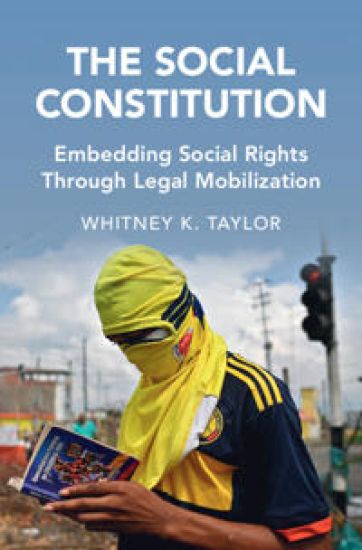
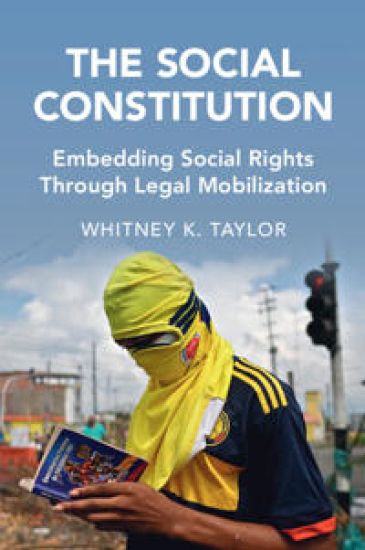
The Social Constitution

The Social Constitution

Whitney K. Taylor

Cambridge University Press
2025
pokkari
In The Social Constitution, Whitney Taylor examines the conditions under which new constitutional rights become meaningful and institutionalized. Taylor introduces the concept of 'embedding' constitutional law to clarify how particular visions of law come to take root both socially and legally. Constitutional embedding can occur through legal mobilization, as citizens understand the law in their own way and make legal claims - or choose not to - on the basis of that understanding, and as judges decide whether and how to respond to legal claims. These interactions ultimately construct the content and strength of the constitutional order. Taylor draws on more than a year of fieldwork across Colombia and multiple sources of data, including semi-structured interviews, original surveys, legal documents, and participation observation. This title is part of the Flip it Open Programme and may also be available Open Access. Check our website Cambridge Core for details.
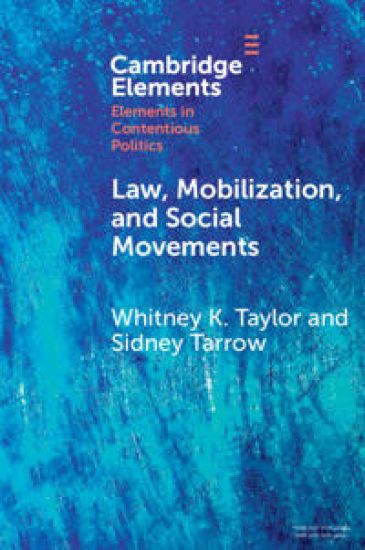
Law, Mobilization, and Social Movements

Law, Mobilization, and Social Movements

Whitney K. Taylor; Sidney Tarrow

Cambridge University Press
2024
sidottu
Legal and social movement scholars have long puzzled over the role of movements in moving, being moved by, and changing the meanings of the law. But for decades, these two strands of scholarship only dovetailed at their edges, in the work of a few far-seeing scholars. The fields began to more productively merge before and after the turn of the century. In this Element, the authors take an interactive approach to this problem and sketch four mechanisms that seem promising in effecting a true fusion: legal mobilization, legal-political opportunity structure, social construction, and movement-countermovement interaction. The Element also illustrates the workings and interactions of these four mechanisms from two examples of the authors' work: the campaign for same-sex marriage in the United States and social constitutionalism in South Africa.
Law, Mobilization, and Social Movements

Law, Mobilization, and Social Movements

Whitney K. Taylor; Sidney Tarrow

Cambridge University Press
2024
pokkari
Legal and social movement scholars have long puzzled over the role of movements in moving, being moved by, and changing the meanings of the law. But for decades, these two strands of scholarship only dovetailed at their edges, in the work of a few far-seeing scholars. The fields began to more productively merge before and after the turn of the century. In this Element, the authors take an interactive approach to this problem and sketch four mechanisms that seem promising in effecting a true fusion: legal mobilization, legal-political opportunity structure, social construction, and movement-countermovement interaction. The Element also illustrates the workings and interactions of these four mechanisms from two examples of the authors' work: the campaign for same-sex marriage in the United States and social constitutionalism in South Africa.
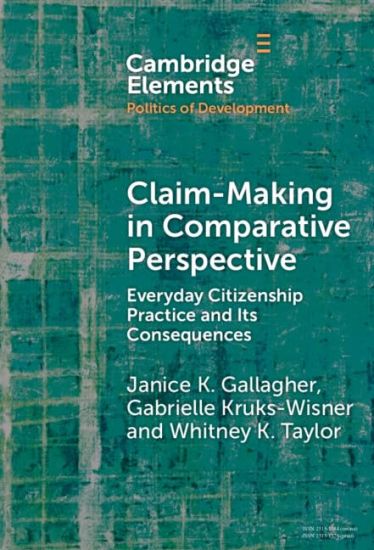
Claim-Making in Comparative Perspective

Claim-Making in Comparative Perspective

Janice K. Gallagher; Gabrielle Kruks-Wisner; Whitney K. Taylor

Cambridge University Press
2024
sidottu
Claim-making – the everyday strategies through which citizens pursue rights fulfilment – is often overlooked in studies of political behavior, which tend to focus on highly visible, pivotal moments: elections, mass protests, high court decisions, legislative decisions. But what of the politics of the everyday? This Element takes up this question, drawing together research from Colombia, South Africa, India, and Mexico. The authors argue that claim-making is a distinct form of citizenship practice characterized by its everyday nature, which is neither fully programmatic nor clientelistic; and which is prevalent in settings marked by gaps between the state's de jure commitments to rights and their de facto realization. Under these conditions, claim making is both meaningful (there are rights to be secured) and necessary (fulfillment is far from guaranteed). Claim-making of this kind is of critical consequence, both materially and politically, with the potential to shape how citizens engage (or disengage) the state.
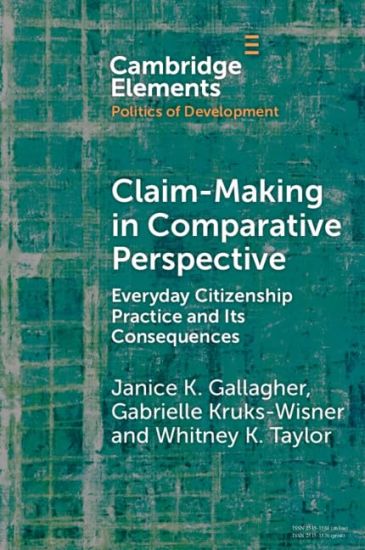
Claim-Making in Comparative Perspective

Claim-Making in Comparative Perspective

Janice K. Gallagher; Gabrielle Kruks-Wisner; Whitney K. Taylor

Cambridge University Press
2024
pokkari
Claim-making – the everyday strategies through which citizens pursue rights fulfilment – is often overlooked in studies of political behavior, which tend to focus on highly visible, pivotal moments: elections, mass protests, high court decisions, legislative decisions. But what of the politics of the everyday? This Element takes up this question, drawing together research from Colombia, South Africa, India, and Mexico. The authors argue that claim-making is a distinct form of citizenship practice characterized by its everyday nature, which is neither fully programmatic nor clientelistic; and which is prevalent in settings marked by gaps between the state's de jure commitments to rights and their de facto realization. Under these conditions, claim making is both meaningful (there are rights to be secured) and necessary (fulfillment is far from guaranteed). Claim-making of this kind is of critical consequence, both materially and politically, with the potential to shape how citizens engage (or disengage) the state.
The Social Constitution

The Social Constitution

Whitney K. Taylor

Cambridge University Press
2023
sidottu
In The Social Constitution, Whitney Taylor examines the conditions under which new constitutional rights become meaningful and institutionalized. Taylor introduces the concept of 'embedding' constitutional law to clarify how particular visions of law come to take root both socially and legally. Constitutional embedding can occur through legal mobilization, as citizens understand the law in their own way and make legal claims - or choose not to - on the basis of that understanding, and as judges decide whether and how to respond to legal claims. These interactions ultimately construct the content and strength of the constitutional order. Taylor draws on more than a year of fieldwork across Colombia and multiple sources of data, including semi-structured interviews, original surveys, legal documents, and participation observation. This title is part of the Flip it Open Programme and may also be available Open Access. Check our website Cambridge Core for details.