Kirjojen hintavertailu – 12 903 724 kirjaa ja 27 kauppaa

Kirjailija

Wilhelm Von Humboldt

Kirjat ja teokset yhdessä paikassa: 113 kirjaa, julkaisuja vuosilta 1843–2025, suosituimpiin kuuluu Selected Basque Writings. Vertaile teosten hintoja ja tarkista saatavuus suomalaisista kirjakaupoista.

113 kirjaa

Kirjojen julkaisuvuodet: 1843–2025.

Über die Verschiedenheit des menschlichen Sprachbaues und ihren Einflu§ auf die geistige Entwickelung des Menschengeschlechts
Wilhelm von Humboldt's classic study of human language was first published posthumously in 1836 and influenced generations of scholars of language including Boas, Sapir and Chomsky. In the later twentieth century, Humboldt's pioneering philosophical and linguistic works began once again to attract scholarly attention in their own right, and in the context of Humboldt's lively communication with other leading scholars of his day. This book, now reissued, summarises the author's theoretical views of language, its universal structures and its relation to mind, education and culture. It ranges far beyond the Indo-European languages and explores the ways in which the grammatical structures of languages make them more or less suitable as instruments of thought and cultural development. Humboldt also addresses the relationship between written and spoken language. To this day, this landmark publication remains one of the most significant attempts to draw philosophical conclusions from comparative linguistics.
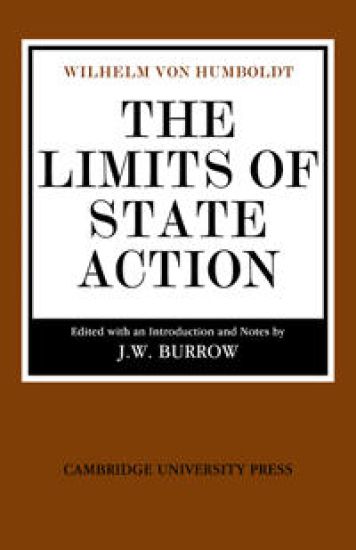
The Limits of State Action

The Limits of State Action

Wilhelm von Humboldt

Cambridge University Press
2008
pokkari
This text is important both as one of the most interesting contributions to the liberalism of the German Enlightenment, and as the most significant source for the ideas which John Stuart Mill popularized in his essay On Liberty. Humboldt's concern is to define the criteria by which the permissible limits of the state's activities may be determined. His basic principle, like that of Mill, is that the only justification for government interference is the prevention of harm to others. He discusses in detail the role and limits of the state's responsibility for the welfare, security and morals of its citizens. Humboldt's special achievement in this work is to enlarge our sense of what a liberal political theory might be by his particularly sensitive grasp of the complexity of our attitudes to and our need of other people. Dr Burrow has based his translation on Coulthard's version of 1854. In an important introduction, he provides a most perceptive as well as scholarly guide to Humboldt's political thought.
Humboldt: 'On Language'

Humboldt: 'On Language'

Wilhelm von Humboldt

Cambridge University Press
1999
sidottu
Wilhelm von Humboldt’s classic study of human language was first published in 1836, as a general introduction to his three-volume treatise on the Kawi language of Java. It is the final statement of his lifelong study of the nature of language, exploring its universal structures and its relation to mind and culture. Empirically wide-ranging - Humboldt goes far beyond the Indo-European family of languages - it remains one of the most interesting and important attempts to draw philosophical conclusions from comparative linguistics. This volume presents a translation by Peter Heath, together with an introduction by Michael Losonsky that places Humboldt’s work in its historical context and discusses its relevance to contemporary work in philosophy, linguistics, cognitive science, and psychology.
Limits of State Action

Limits of State Action

Wilhelm Von Humboldt

Liberty Fund Inc
1993
nidottu
The Limits of State Action, by "Germany's greatest philosopher of freedom," as F. A. Hayek called him, has an exuberance and attention to principle that make it a valuable introduction to classical liberal political thought. It is also crucial for an understanding of liberalism as it developed in Europe at the turn of the nineteenth century. Humboldt explores the role that liberty plays in individual development, discusses criteria for permitting the state to limit individual actions, and suggests ways of confining the state to its proper bounds. In so doing, he uniquely combines the ancient concern for human excellence and the modern concern for what has come to be known as negative liberty.