Kirjojen hintavertailu – 12 903 725 kirjaa ja 27 kauppaa

Kirjailija

Willard Van Orman Quine

Kirjat ja teokset yhdessä paikassa: 25 kirjaa, julkaisuja vuosilta 1934–2020, suosituimpiin kuuluu Quine in Dialogue. Vertaile teosten hintoja ja tarkista saatavuus suomalaisista kirjakaupoista.

25 kirjaa

Kirjojen julkaisuvuodet: 1934–2020.

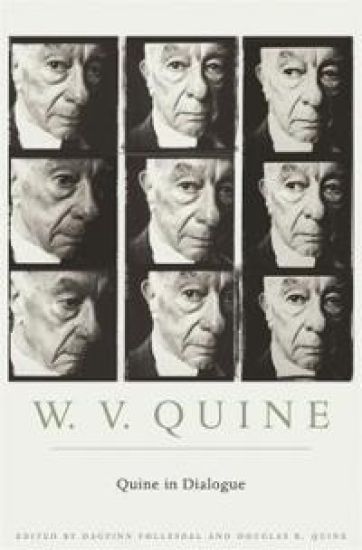
Quine in Dialogue

Quine in Dialogue

Willard Van Orman Quine

Harvard University Press
2008
sidottu
Over the course of his life, W. V. Quine, one of the twentieth century’s great philosophers, engaged and inspired, interviewed and critiqued countless scholars, critics, and students. The qualities that distinguished him in any discussion are on clear display in this volume, which features him in dialogue with his predecessors and peers, his critics and students. The volume begins with a number of interviews Quine gave about his perspectives on twentieth-century logic, science and philosophy, the ideas of others, and philosophy generally. Also included are his most important articles, reviews, and comments on other philosophers, from Rudolf Carnap to P. F. Strawson. The book, which contains many previously unpublished manuscripts, concludes with a selection of small pieces, written for a broader public, that give a glimpse of the philosopher’s wide interests, his sense of humor, and his warm relations to friends. The result is a wide-ranging, in-depth, and finely nuanced portrait of the humanity underlying this great twentieth-century thinker’s philosophy.
The Significance of the New Logic

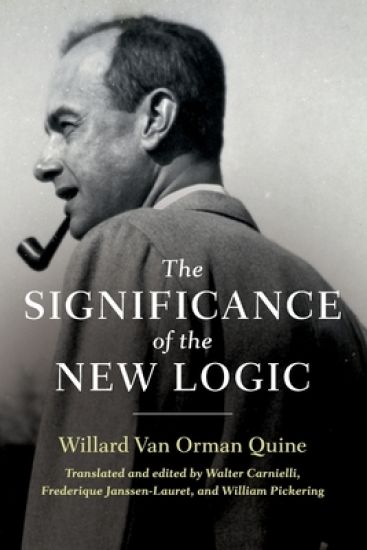
The Significance of the New Logic

Willard Van Orman Quine

Cambridge University Press
2020
pokkari
W. V. Quine was one of the most influential figures of twentieth-century American analytic philosophy. Although he wrote predominantly in English, in Brazil in 1942 he gave a series of lectures on logic and its philosophy in Portuguese, subsequently published as the book O Sentido da Nova Lógica. The book has never before been fully translated into English, and this volume is the first to make its content accessible to Anglophone philosophers. Quine would go on to develop revolutionary ideas about semantic holism and ontology, and this book provides a snapshot of his views on logic and language at a pivotal stage of his intellectual development. The volume also includes an essay on logic which Quine also published in Portuguese, together with an extensive historical-philosophical essay by Frederique Janssen-Lauret. The valuable and previously neglected works first translated in this volume will be essential for scholars of twentieth-century philosophy.
The Significance of the New Logic

The Significance of the New Logic

Willard Van Orman Quine

Cambridge University Press
2018
sidottu
W. V. Quine was one of the most influential figures of twentieth-century American analytic philosophy. Although he wrote predominantly in English, in Brazil in 1942 he gave a series of lectures on logic and its philosophy in Portuguese, subsequently published as the book O Sentido da Nova Lógica. The book has never before been fully translated into English, and this volume is the first to make its content accessible to Anglophone philosophers. Quine would go on to develop revolutionary ideas about semantic holism and ontology, and this book provides a snapshot of his views on logic and language at a pivotal stage of his intellectual development. The volume also includes an essay on logic which Quine also published in Portuguese, together with an extensive historical-philosophical essay by Frederique Janssen-Lauret. The valuable and previously neglected works first translated in this volume will be essential for scholars of twentieth-century philosophy.
Word and Object

Word and Object

Willard Van Orman Quine; Patricia S. Churchland

MIT Press
2013
pokkari

Halvin toimitettuna 65,10 €

A new edition of Quine's most important work. Willard Van Orman Quine begins this influential work by declaring, "Language is a social art. In acquiring it we have to depend entirely on intersubjectively available cues as to what to say and when." As Patricia Smith Churchland notes in her foreword to this new edition, with Word and Object Quine challenged the tradition of conceptual analysis as a way of advancing knowledge. The book signaled twentieth-century philosophy's turn away from metaphysics and what Churchland calls the "phony precision" of conceptual analysis. In the course of his discussion of meaning and the linguistic mechanisms of objective reference, Quine considers the indeterminacy of translation, brings to light the anomalies and conflicts implicit in our language's referential apparatus, clarifies semantic problems connected with the imputation of existence, and marshals reasons for admitting or repudiating each of various categories of supposed objects. In addition to Churchland's foreword, this edition offers a new preface by Quine's student and colleague Dagfinn Follesdal that describes the never-realized plans for a second edition of Word and Object, in which Quine would offer a more unified treatment of the public nature of meaning, modalities, and propositional attitudes.
Mathematical Logic

Mathematical Logic

Willard Van Orman Quine

Literary Licensing, LLC
2011
sidottu
Mathematical Logic by Willard Van Orman Quine is a comprehensive introduction to the study of mathematical logic. The book covers a wide range of topics in logic, including propositional logic, predicate logic, set theory, and the foundations of mathematics. Quine's approach to logic is highly formal and mathematical, emphasizing the use of symbols and the manipulation of formal systems. The book begins with an overview of propositional logic, including truth tables and the laws of logic. From there, Quine moves on to predicate logic, introducing quantifiers and the concept of logical equivalence. He then covers set theory, discussing the axioms of set theory and the paradoxes that arise from them. Throughout the book, Quine emphasizes the importance of formal systems and the use of symbols in logical reasoning. He also discusses the philosophical implications of mathematical logic, including the relationship between logic and language, and the role of logic in the foundations of mathematics. Overall, Mathematical Logic is a rigorous and thorough introduction to the study of logic, suitable for advanced undergraduate and graduate students in mathematics, philosophy, and computer science. This scarce antiquarian book is a facsimile reprint of the old original and may contain some imperfections such as library marks and notations. Because we believe this work is culturally important, we have made it available as part of our commitment for protecting, preserving, and promoting the world's literature in affordable, high quality, modern editions, that are true to their original work.
Confessions of a Confirmed Extensionalist and Other Essays

Confessions of a Confirmed Extensionalist and Other Essays

Willard Van Orman Quine

Harvard University Press
2008
sidottu
W. V. Quine created a new way of looking at the eternal questions of philosophy and their interconnections. His investigations into semantics and epistemology, ontology and causality, natural kinds, time, space, and individuation transformed the philosophical landscape for generations to come. In the twenty years between his last collection of essays and his death in 2000, Quine continued his work, producing a number of impressive essays in which he deepened, elaborated, and occasionally modified his position on central philosophical issues. The last of these essays, which gives this collection its name, appeared in 2002. This volume collects the main essays from this last, productive period of Quine’s prodigious career. It also includes some notable earlier essays that were not included in the previous collections although they contain illuminating discussions and are quite often referred to by other philosophers and also by Quine himself in his later writings. These essays, along with several manuscripts published here for the first time, offer a more complete and highly defined picture than ever before of one of the twentieth century’s greatest thinkers working at the height of his powers.
Quintessence

Quintessence

Willard Van Orman Quine

The Belknap Press
2008
nidottu
Through the first half of the twentieth century, analytic philosophy was dominated by Russell, Wittgenstein, and Carnap. Influenced by Russell and especially by Carnap, another towering figure, Willard Van Orman Quine (1908–2000) emerged as the most important proponent of analytic philosophy during the second half of the century. Yet with twenty-three books and countless articles to his credit—including, most famously, Word and Object and "Two Dogmas of Empiricism"—Quine remained a philosopher's philosopher, largely unknown to the general public. Quintessence for the first time collects Quine's classic essays (such as "Two Dogmas" and "On What There Is") in one volume—and thus offers readers a much-needed introduction to his general philosophy. Divided into six parts, the thirty-five selections take up analyticity and reductionism; the indeterminacy of translation of theoretical sentences and the inscrutability of reference; ontology; naturalized epistemology; philosophy of mind; and extensionalism. Representative of Quine at his best, these readings are fundamental not only to an appreciation of the philosopher and his work, but also to an understanding of the philosophical tradition that he so materially advanced.
From Stimulus to Science

From Stimulus to Science

Willard Van Orman Quine

Harvard University Press
1998
nidottu
W. V. Quine is one of the most eminent philosophers alive today. Now in his mid-eighties he has produced a sharp, sprightly book that encapsulates the whole of his philosophical enterprise, including his thinking on all the key components of his epistemological stance--especially the value of logic and mathematics. New readers of Quine may have to go slowly, fathoming for themselves the richness that past readers already know lies between these elegant lines. For the faithful there is much to ponder. In this short book, based on lectures delivered in Spain in 1990, Quine begins by locating his work historically. He provides a lightning tour of the history of philosophy (particularly the history of epistemology), beginning with Plato and culminating in an appreciative sketch of Carnap's philosophical ambitions and achievements. This leads, in the second chapter, to an introduction to Quine's attempt to naturalize epistemology, which emphasizes his continuities with Carnap rather than the differences between them. The next chapters develop the naturalistic story of the development of science to take account of how our conceptual apparatus is enhanced so that we can view the world as containing re-identifiable objects. Having explained the role of observation sentences in providing a checkpoint for assessing scientific theories, and having despaired of constructing an empirical criterion to determine which sentences are meaningful, Quine in the remaining chapters takes up a variety of important issues about knowledge. He concludes with an extended treatment of his views about reference and meaning and his attitudes toward psychological and modal notions. The presentation is distinctive, and the many small refinements of detail and formulation will fascinate all who know Quine's philosophy.
Selected Logic Papers

Selected Logic Papers

Willard Van Orman Quine

Harvard University Press
1995
nidottu
For more than two generations, W. V. Quine has contributed fundamentally to the substance, the pedagogy, and the philosophy of mathematical logic. Selected Logic Papers, long out of print and now reissued with eight additional essays, includes much of the author’s important work on mathematical logic and the philosophy of mathematics from the past sixty years.
Pursuit of Truth

Pursuit of Truth

Willard Van Orman Quine

Harvard University Press
1992
nidottu
A revised edition of Quine's concise presentation of major topics in the epistemological area of philosophy. He discusses evidence, reference, meaning, intension and truth, with the aim of avoiding common intellectual confusion over efforts to forge links between observation, theory and the world.
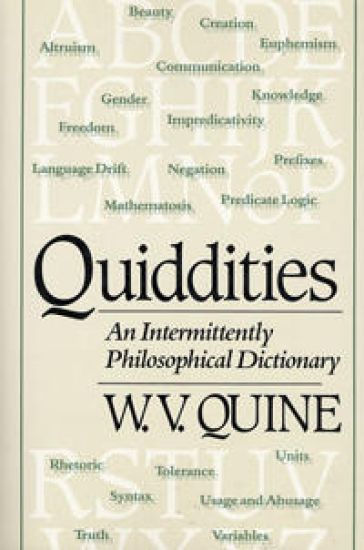
Quiddities

Quiddities

Willard Van Orman Quine

The Belknap Press
1989
nidottu
The appellation “polymath” is often lightly bestowed, but it can be applied with confidence to the celebrated philosopher Willard Van Orman Quine. Quine’s areas of interest are panoramic, as this lively book amply demonstrates. Moving from A (alphabet) to Z (zero), Quiddities roams through more than eighty topics, each providing a full measure of piquant thought, wordplay, and wisdom, couched in easy and elegant prose—“Quine at his unbuttoned best,” in Donald Davidson’s words. Philosophy, language, and mathematics are the subjects most fully represented; tides of entries include belief, communication, free will, idiotisms, longitude and latitude, marks, prizes, Latin pronunciation, tolerance, trinity. Even the more technical entries are larded with homely lore, anecdote, and whimsical humor. Quiddities will be a treat for admirers of Quine and for others who like to think, who care about language, and who enjoy the free play of intellect on topics large and small. For this select audience, it is an ideal book for browsing.
Philosophy of Logic

Philosophy of Logic

Willard Van Orman Quine

Harvard University Press
1986
nidottu

Halvin toimitettuna 36,40 €

With his customary incisiveness, W. V. Quine presents logic as the product of two factors, truth and grammar—but argues against the doctrine that the logical truths are true because of grammar or language. Rather, in presenting a general theory of grammar and discussing the boundaries and possible extensions of logic, Quine argues that logic is not a mere matter of words.
Theories and Things

Theories and Things

Willard Van Orman Quine

The Belknap Press
1986
nidottu
Here are the most recent writings, some of them unpublished, of the preeminent philosopher of our time. Philosophical reflections on language are brought to bear upon metaphysical and epistemological questions such as these: What does it mean to assume objects, concrete and abstract? How do such assumptions serve science? What is the empirical content of a scientific theory? Further essays deal with meaning, moral values, analytical philosophy and its history, metaphor, the nature of mathematics; several are concerned with logic; and there are essays on individual philosophers. The volume concludes with some general reflections on the contemporary scene and two playful pieces on the Times Atlas and H. L. Mencken. W. V. Quine is always, whatever his subject, an elegant writer, witty, precise, and forceful. Admirers of his earlier books will welcome this new volume.
Methods of Logic

Methods of Logic

Willard Van Orman Quine

Harvard University Press
1982
nidottu
This widely used textbook of modern formal logic now offers a number of new features. Incorporating updated notations, selective answers to exercises, expanded treatment of natural deduction, and new discussions of predicate-functor logic and the affinities between higher set theory and the elementary logic of terms, W. V. Quine’s new edition will serve admirably for both classroom and independent use.
Mathematical Logic

Mathematical Logic

Willard Van Orman Quine

Harvard University Press
1982
nidottu
W. V. Quine’s systematic development of mathematical logic has been widely praised for the new material presented and for the clarity of its exposition. This revised edition, in which the minor inconsistencies observed since its first publication have been eliminated, will be welcomed by all students and teachers in mathematics and philosophy who are seriously concerned with modern logic. Max Black, in Mind, has said of this book, “It will serve the purpose of inculcating, by precept and example, standards of clarity and precision which are, even in formal logic, more often pursued than achieved.”
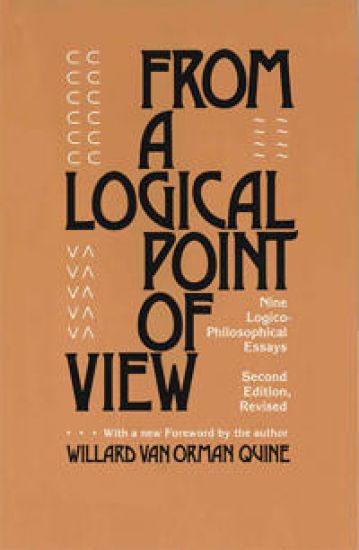
From a Logical Point of View

From a Logical Point of View

Willard Van Orman Quine

Harvard University Press
1980
nidottu
These nine essays are largely concerned with the theory of meaning and references—semantics. At the same time adjacent portions of philosophy and logic are discussed. To the existence of what objects may a given scientific theory be said to be committed? And what considerations may suitably guide us in accepting or revising such ontological commitments? These are among the questions dealt with in this book, particular attention being devoted to the role of abstract entities in mathematics. There is speculation on the mechanism whereby objects of one sort or another come to be posited, a process in which the notion of identity plays an important part.