Kirjojen hintavertailu – 12 903 725 kirjaa ja 27 kauppaa

Kirjailija

Willi Braun

Kirjat ja teokset yhdessä paikassa: 9 kirjaa, julkaisuja vuosilta 1995–2020, suosituimpiin kuuluu Jesus and Addiction to Origins. Vertaile teosten hintoja ja tarkista saatavuus suomalaisista kirjakaupoista.

9 kirjaa

Kirjojen julkaisuvuodet: 1995–2020.

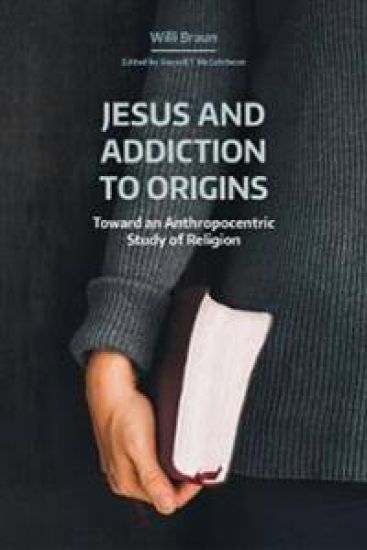
Jesus and Addiction to Origins

Jesus and Addiction to Origins

Willi Braun

Equinox Publishing Ltd
2020
sidottu
This collection of essays constitute an extended argument for an anthropocentric, human-focused, study of religious practices. The basic premise of the argument, offered in the opening section, is that there is nothing special or extraordinary about human behaviors and constructs that are claimed to have uniquely religious status and authority. Instead, they are fundamentally human and so the scholar of religion is engaged in nothing more or less than studying humans across time and place and all their complex existence-that includes creating more-than-human beings and realities. As an extended and detailed example of such an approach, the second part of the book contains essays that address practices, rhetoric and other data in early Christianities within Greco-Roman cultures and religions. The underlying aim is to insert studies of the New Testament and non-canonical texts, most often presented as "biblical studies," into the anthropocentric study of religion proposed in the opening section. For a general reading of modern biblical scholarship makes clear the assumption that the Christian bible is a "sacred text" whose principal raison d'etre is to stand, fetish-like, as the foundational and highest authority in matters moral, ritual or theological; how might we instead approach the study of these texts if they are nothing more or less than human documents deriving from situations that were themselves all too human? Braun's Jesus and Addiction to Origins seeks to answer just that question-doing so in a way that readers working outside Christian origins will undoubtedly find useful applications for the people, places, and historical periods that they study.
Jesus and Addiction to Origins

Jesus and Addiction to Origins

Willi Braun

Equinox Publishing Ltd
2020
pokkari
This collection of essays constitute an extended argument for an anthropocentric, human-focused, study of religious practices. The basic premise of the argument, offered in the opening section, is that there is nothing special or extraordinary about human behaviors and constructs that are claimed to have uniquely religious status and authority. Instead, they are fundamentally human and so the scholar of religion is engaged in nothing more or less than studying humans across time and place and all their complex existence-that includes creating more-than-human beings and realities. As an extended and detailed example of such an approach, the second part of the book contains essays that address practices, rhetoric and other data in early Christianities within Greco-Roman cultures and religions. The underlying aim is to insert studies of the New Testament and non-canonical texts, most often presented as "biblical studies," into the anthropocentric study of religion proposed in the opening section. For a general reading of modern biblical scholarship makes clear the assumption that the Christian bible is a "sacred text" whose principal raison d'etre is to stand, fetish-like, as the foundational and highest authority in matters moral, ritual or theological; how might we instead approach the study of these texts if they are nothing more or less than human documents deriving from situations that were themselves all too human? Braun's Jesus and Addiction to Origins seeks to answer just that question-doing so in a way that readers working outside Christian origins will undoubtedly find useful applications for the people, places, and historical periods that they study.

Failure and Nerve in the Academic Study of Religion

Failure and Nerve in the Academic Study of Religion

William E. Arnal; Willi Braun; Russell T. McCutcheon

Routledge
2017
nidottu
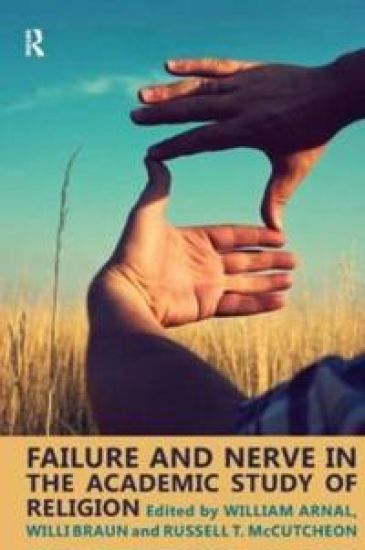
Failure and Nerve in the Academic Study of Religion presents a provocative critique of the unwillingness of modern scholars to publically distinguish research into comparative religion from confessional studies written within denominationally-affiliated institutions. The book offers the 19th Century founders of the study of religion as a bracing corrective to contemporary timidity. The issue was analysed and documented by Wiebe a quarter of a century ago. Here, marking Wiebe's work, a wide range of contributors reassess the methodology and ambition of contemporary religious research. The book argues that conceptualizing religion as part of the world of human action and experience is the first requirement of the study of religion.
Failure and Nerve in the Academic Study of Religion

Failure and Nerve in the Academic Study of Religion

William E. Arnal; Willi Braun; Russell T. McCutcheon

Equinox Publishing Ltd
2012
sidottu
Failure and Nerve in the Academic Study of Religion presents a provocative critique of the unwillingness of modern scholars to publically distinguish research into comparative religion from confessional studies written within denominationally-affiliated institutions. The book offers the 19th Century founders of the study of religion as a bracing corrective to contemporary timidity. The issue was analysed and documented by Wiebe a quarter of a century ago. Here, marking Wiebe's work, a wide range of contributors reassess the methodology and ambition of contemporary religious research. The book argues that conceptualizing religion as part of the world of human action and experience is the first requirement of the study of religion.
Introducing Religion

Introducing Religion

Willi Braun; Russell T. McCutcheon

Equinox Publishing Ltd
2008
sidottu
The study of religion encompasses ordinary human social practice and is not limited to the extraordinary or divine. 'Introducing Religion' brings together leading international scholars in the field of religious studies to examine religion as integral to everyday social practice. The book establishes a theoretical framework for the study of religion to analyse prayer, ritual, science, morality and politics in relation to the world's major religions. It will be of interest to students of theory and method in religious studies seeking a clear introduction to the multifaceted nature of religion.
Introducing Religion

Introducing Religion

Willi Braun; Russell T. McCutcheon

Equinox Publishing Ltd
2008
nidottu
The study of religion encompasses ordinary human social practice and is not limited to the extraordinary or divine. 'Introducing Religion' brings together leading international scholars in the field of religious studies to examine religion as integral to everyday social practice. The book establishes a theoretical framework for the study of religion to analyse prayer, ritual, science, morality and politics in relation to the world's major religions. It will be of interest to students of theory and method in religious studies seeking a clear introduction to the multifaceted nature of religion.
The Commerce of the Sacred

The Commerce of the Sacred

Jack Lightstone; Willi Braun

Columbia University Press
2006
sidottu
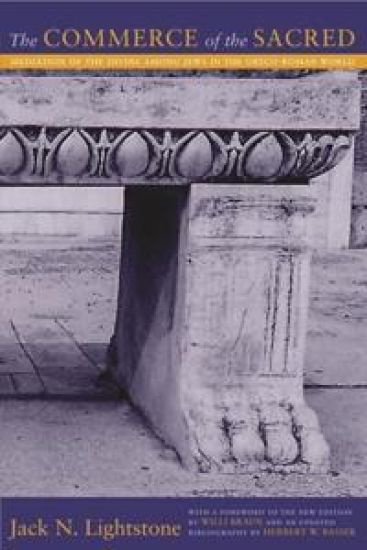
Jack Lightstone's "Commerce of the Sacred" remains an original and influential contribution to Judaic studies. Lightstone offers critical perspectives on the practices and beliefs of Greco-Roman Jews who lived outside of Palestine and beyond rabbinic control or influence. He investigates their influence on early Christians and examines how the two communities defined themselves in relation to each another. He challenges the view of Judaism as a single set of practices and beliefs and argues that Jews of the Greco-Roman Diaspora did not retain a shared, biblical 'perception of the world' centered on the Jerusalem temple. Rather, they believed multiple points of contact between God and man could be made through particular rites: prayer in the presence of the sacred scrolls, pleas for help at the tombs of dead saints and martyrs, and the interventions of holy men with alleged supernatural powers, to name a few. Many early Christians also participated in this Judaic 'commerce of the sacred', blurring the social and religious boundaries that distinguished Jews and Christians. Lightstone innovatively combines approaches from the history of religions and social anthropology to provide a different picture of Judaism during this period. Featuring a new foreword and an updated bibliography, "Commerce of the Sacred" resituates the Jews in the Greco-Roman world.
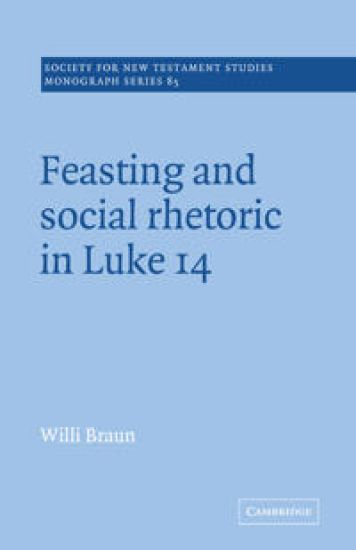
Feasting and Social Rhetoric in Luke 14

Feasting and Social Rhetoric in Luke 14

Willi Braun

Cambridge University Press
2005
pokkari
The writer of the Gospel of Luke is a Hellenistic writer who uses conventional modes of narration, characterisation and argumentation to present Jesus in the manner of the familiar figure of the dinner sage. In this original and thought-provoking 1995 study, Willi Braun draws both on social and literary evidence regarding the Greco-Roman élite banquet scene and on ancient prescribed methods of rhetorical composition. He argues that the Pharisaic dinner episode in Luke 14 is a skilfully crafted rhetorical unit in which Jesus presents an argument for Luke's vision of a Christian society. His contention that the point of the episode is directed primarily at the wealthy urban élite, who stand in most need of a transformation of character and values to fit them for membership of this society, points up the way in which gospel writers manipulated the inherited Jesus traditions for the purposes of ideological and social formation of Christian communities.
Feasting and Social Rhetoric in Luke 14

Feasting and Social Rhetoric in Luke 14

Willi Braun

Cambridge University Press
1995
sidottu
The writer of the Gospel of Luke is a Hellenistic writer who uses conventional modes of narration, characterisation and argumentation to present Jesus in the manner of the familiar figure of the dinner sage. In this original and thought-provoking study, Willi Braun draws both on social and literary evidence regarding the Greco-Roman élite banquet scene and on ancient prescribed methods of rhetorical composition. He argues that the Pharisaic dinner episode in Luke 14 is a skilfully crafted rhetorical unit in which Jesus presents an argument for Luke’s vision of a Christian society. His contention that the point of the episode is directed primarily at the wealthy urban élite, who stand in most need of a transformation of character and values to fit them for membership of this society, points up the way in which gospel writers manipulated the inherited Jesus traditions for the purposes of ideological and social formation of Christian communities.