

Kirjojen hintavertailu – 12 859 827 kirjaa ja 27 kauppaa

Kirjailija

William A. Dembski

Kirjat ja teokset yhdessä paikassa: 22 kirjaa, julkaisuja vuosilta 1998–2026, suosituimpiin kuuluu For a Greater Purpose. Vertaile teosten hintoja ja tarkista saatavuus suomalaisista kirjakaupoista.

Nimi esiintyy myös muodoissa: William A Dembski

22 kirjaa

Kirjojen julkaisuvuodet: 1998–2026.

No Free Lunch

No Free Lunch

William A. Dembski

Rowman Littlefield Publishers
2001
sidottu
Darwin's greatest accomplishment was to show how life might be explained as the result of natural selection. But does Darwin's theory mean that life was unintended? William A. Dembski argues that it does not. In this book Dembski extends his theory of intelligent design. Building on his earlier work in The Design Inference (Cambridge, 1998), he defends that life must be the product of intelligent design. Critics of Dembski's work have argued that evolutionary algorithms show that life can be explained apart from intelligence. But by employing powerful recent results from the No Free Lunch Theory, Dembski addresses and decisively refutes such claims. As the leading proponent of intelligent design, Dembski reveals a designer capable of originating the complexity and specificity found throughout the cosmos. Scientists and theologians alike will find this book of interest as it brings the question of creation firmly into the realm of scientific debate.
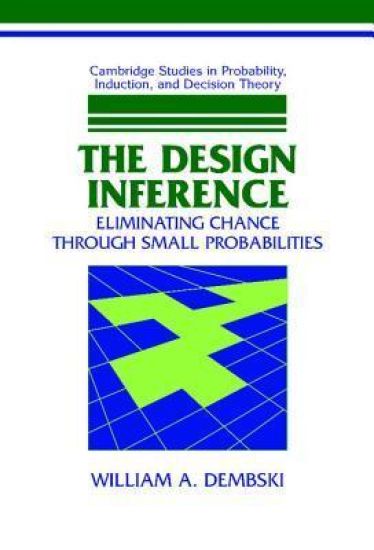
The Design Inference

The Design Inference

William A. Dembski

Cambridge University Press
1998
sidottu
The design inference uncovers intelligent causes by isolating their key trademark: specified events of small probability. Just about anything that happens is highly improbable, but when a highly improbable event is also specified (i.e. conforms to an independently given pattern) undirected natural causes lose their explanatory power. Design inferences can be found in a range of scientific pursuits from forensic science to research into the origins of life to the search for extraterrestrial intelligence. This challenging and provocative 1998 book shows how incomplete undirected causes are for science and breathes new life into classical design arguments. It will be read with particular interest by philosophers of science and religion, other philosophers concerned with epistemology and logic, probability and complexity theorists, and statisticians.