
Kirjailija
William A Keleher
Kirjat ja teokset yhdessä paikassa: 7 kirjaa, julkaisuja vuosilta 2007–2008, suosituimpiin kuuluu Maxwell Land Grant. Vertaile teosten hintoja ja tarkista saatavuus suomalaisista kirjakaupoista.
7 kirjaa
Kirjojen julkaisuvuodet: 2007–2008.
Recapturing the atmosphere of Territorial days, this 1962 extensively annotated edition of a Southwestern classic focuses on southeastern New Mexico, where "murder was a common offense" and stagecoach robberies were "nothing to get excited about." The delineation of this last, lively frontier begins in 1846 and ends in 1912 with New Mexico statehood. Here are the deeds, lives and legends of the colorful men who figure in New Mexico history. The lucky ones: John J. Baxter who struck it rich at White Oaks, Tom Wilson and Uncle Jack Winters of the Homestake claim, Jack Martin who brought water to the Jornada del Muerto and started the desperate struggle among stockmen culminating in the Lincoln County War, and the cattle king John S. Chisum. The land grabbers: Charles B. Eddy, accused of acquiring a county through coercion; the Denman gang dedicated to frightening settlers from their hereditary holdings; and Tom Catron, political boss and land-office man who owned more than a county. Writing men: Washington Matthews, Territorial army surgeon who told about the Navajo; Hubert Bancroft, prolific historian; Adolph Bandelier, pioneer anthropologist; Charles Lummis, the journalist who publicized life in the Territory through travel books; and Lew Wallace, Territorial governor who wrote "Ben Hur." The frontier newsmen: "Ash" Upson, chronicler of Billy the Kid; Major Bill Caffrey of White Oaks' "Lincoln County Leader"; Emerson Hough who mined his Western experiences for many a yarn; and Eugene Manlove Rhodes, beloved cowboy of the big circulation magazines. New appraisal is given Albert B. Fall, who with Doheny, another old timer, figured in the Teapot Dome affair. Not neglected are such celebrated frontiersmen as Patrick Garrett, nemesis of Billy the Kid, and Albert J. Fountain, who, with his little son, a buckboard and high-stepping team, disappeared from the face of the earth. All these and many more live again in accurate eye-witness accounts that make this a prime source book on the old West.
When the United States acquired New Mexico by invasion and conquest on August 15, 1846, it inherited a land grant problem of considerable magnitude. This problem continued for decades until 1870 when the United States Congress suddenly declined to act at all on any New Mexico grant claim. Among the grants that had been confirmed, however, was the Miranda and Beaubien, or Maxwell Land Grant, and that is the dominant theme of this book. Originally made in 1841 to Guadalupe Miranda and Charles Beaubien under Mexican rule, the Maxwell Land Grant was determined to embrace almost two million acres of land--2,460 square miles. Politicians, Indians, courts, ministers of the gospel, early day settlers, and soldiers, all had their place in the story of the Grant. Governor Manuel Armijo, the last chief executive under Mexican rule, Padre Martinez of Taos, Lucien B. Maxwell, Kit Carson, Charles Ben, Dick Wootton and many another old timer live again in these pages that read like fiction but are, in fact, totally true accounts.
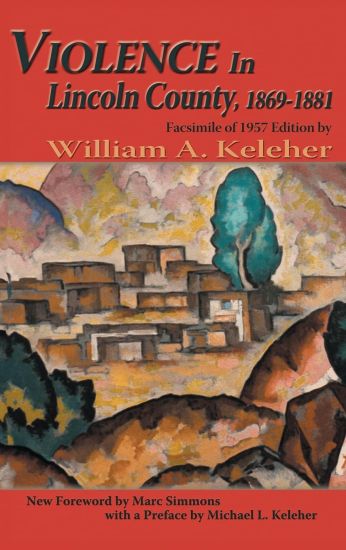
Lincoln County, New Mexico was once one of the largest counties in the United States and was the setting for a famous feud which lit up the horizon of history. Here between 1869 and 1881 were all the explosive ingredients for violence. On one side of the county was the Mescalero Apache reservation. A day away was an Army fort to keep the Indians "subdued." Along the Pecos River were hundreds of thousands of acres of public land, much of it claimed by settlers with deeds of "Squatters' Rights." Conflicts over land, politics, cattle and money, sparked by the tempers of young men fueled with six-shooters and cheap whiskey, set fire to the whole tinderbox. What became known as The Lincoln County War began over a dispute for the insurance money of Emil Fritz. It flared when the killing of John H. Tunstall became an international incident and started a chain reaction of murders. The Battle of Blazer's Mill presaged the four sultry days in July when Colonel N. A. M. Dudley marched U. S. troops into Lincoln and sided with the Dolan-Riley contingent against the McSween faction. This, along with the crack of Pat Garrett's pistol which ended the life of Billy the Kid, signaled the end of the outlaw heyday. Lew Wallace, governor of New Mexico (and author of Ben Hur), then wrote to Washington: "It gives me pleasure to report New Mexico in a state of quiet," thus bringing to a close a conflagration without parallel in the American West. Long out of print, the book is available once again with a new foreword by Marc Simmons and preface by Michael L. Keleher, William A. Keleher's son.
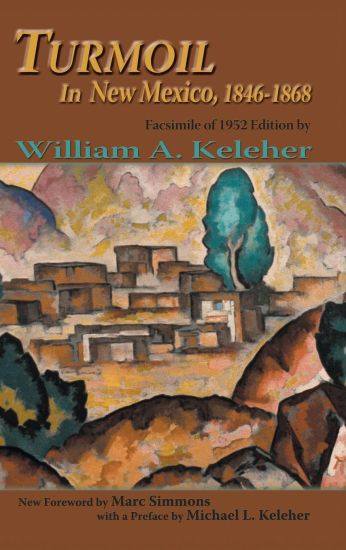
The vital history of New Mexico and Arizona during the formative years between the American Occupation and the coming of the railroad has been compressed by the author into one volume with hundreds of footnotes and many profiles that make this book of vital importance to teachers, students, and researchers. The book is broken into four parts: "General Kearny Comes to Santa Fe," "The Confederates Invade New Mexico," "Carleton's California Column," and "The Long Walk." Many famous men walk and talk through these pages, including Kearny, Doniphan, Baylor, Canby, Carleton, Sibley, and a host of others. In addition, the story of the impact of the Civil War in New Mexico on the Indians, and the tragic results, is told here in detail for the first time. Long out of print, the book is available once again with a new foreword by Marc Simmons and preface by Michael L. Keleher, William A. Keleher's son. It also includes brief biographies of Ernest L. Blumenschein and Oscar E. Berninghaus who provided the original illustrations.