Kirjojen hintavertailu – 12 859 829 kirjaa ja 27 kauppaa

Kirjailija

William Bonner

Kirjat ja teokset yhdessä paikassa: 8 kirjaa, julkaisuja vuosilta 2004–2024, suosituimpiin kuuluu Le Nouvel Empire Des Dettes: Grandeur Et Decadence d'Une Bulle Financiere Epique. Vertaile teosten hintoja ja tarkista saatavuus suomalaisista kirjakaupoista.

8 kirjaa

Kirjojen julkaisuvuodet: 2004–2024.

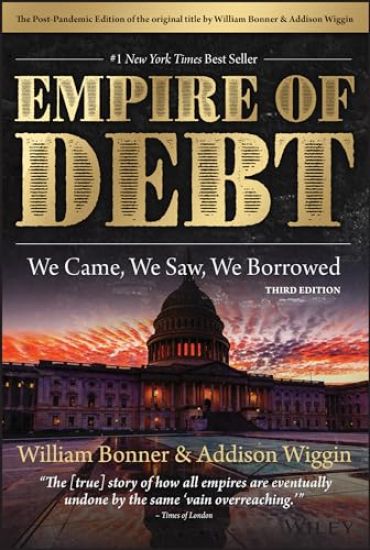
The Empire of Debt

The Empire of Debt

William Bonner; Addison Wiggin

JOHN WILEY SONS INC
2024
sidottu
Protect your investments with a deep dive into the past and future of finance Building on the uncannily accurate predictions in previous editions, this latest edition of The Empire of Debt: We Came, We Saw, We Borrowed, written by New York Times bestselling authors Addison Wiggin and Bill Bonner, explores the economic, political, and financial events between 2008-09 and 2023, placing them in historical context and explaining what's likely to happen for the remaining years of the 2020s. The book imparts practical advice on how to protect wealth in the face of ongoing and rapidly intensifying crises, as well as suggestions on how these trends can be played to put investors' own money to work. In this book, readers will learn about: Political development of US hegemony in the 20th century, from the founding of the Federal Reserve in 1913 through to the presentPast and current conflicts in Iraq, Afghanistan, Ukraine, and Russia and their effects on financeThe response to the Financial Panic of '08, including a decade of Zero Interest Rate Policy (ZIRP) With investors more eager than ever to protect their investments, The Empire of Debt is an essential guide to the future of finance, harnessing history to accurately plot where we are and where we're going.
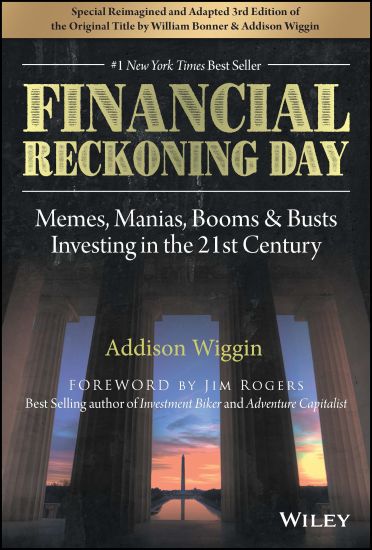
Financial Reckoning Day

Financial Reckoning Day

Addison Wiggin; William Bonner

JOHN WILEY SONS INC
2023
sidottu
An engaging and practical romp through contemporary financial and economic history—and what it means for your financial future Economic booms and busts are happening with more frequency. Since the turn of the new millennium, fortunes have been made and lost at a blistering pace. Each boom is like the tension building up before an earthquake. Seismologists can detect the build-up, but they can't necessarily explain why—or when—the next quake will hit. Economic busts can be equally devastating…and followed by numerous aftershocks. In this entertaining romp through recent economic and financial history, best-selling author, Addison Wiggin, traces the primary trends that have led up to rapid economic growth and innovation while keeping an eye on the inevitable downturn. The author practices "literary economics," telling stories about the characters behind the scenes and their motives, making this wide-ranging book easy-to-read. The current edition has been revised, adapted, and re-imagined, enlightening readers about what's happening behind today's top headlines: The rise of new financial innovations over the past decade, including cryptocurrencies, mobile trading platforms, and the democratization of financial marketsHow the policies of the Federal Reserve following the Panic of '08 led an entire generation to become unwitting speculators in stocks, bonds, real estate, and rare commoditiesWhat impact new political trends—environmental, social, governance (ESG) and diversity equity and inclusion (DEI)—have had on managing your own money Ultimately, the book helps place current events in the context of identifiable historical trends. The book proposes that when you understand what the primary trends are and follow them to their logical conclusion, it makes planning for your financial future much easier. What will be the role of the US economy in the future as policy makers try to grapple with new competition, economic and political, from Brazil, Russia, India, China - the so-called BRICs? The author follows the facts, the trends, and the stories that make up history and parlays them into forecasts for what he sees coming next. Ultimately, you'll get a review of previous trades and a new Trade of the Decade.
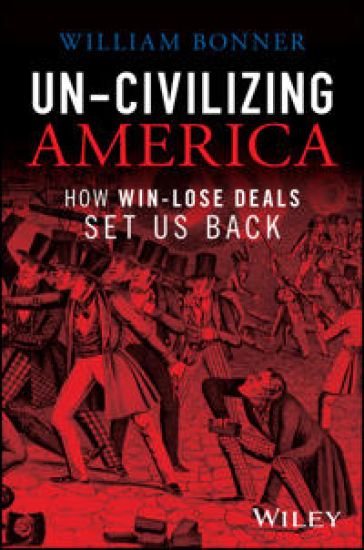
Un-Civilizing America

Un-Civilizing America

William Bonner

JOHN WILEY SONS INC
2023
sidottu
Discover what sets a fair and just economy apart from the rest In Un-Civilizing America – How Win-Win Deals Made Us Rich, bestselling author William Bonner delivers an incisive and engrossing account of the American economy, the four simple steps to earning money the honest way, and why many choose the dishonest way instead. He also discusses the shadow groups that influence America behind the scenes and how their power grew so large they lost the need to remain hidden, and what really drives the government’s phony wars—including the War on Drugs and the US-China trade war. In the book, you’ll learn why the best kinds of economies run on “win-win” deals and how companies and individuals use market-set prices to maximize their utility. You’ll also discover: Why the “Sermon on the Mount” was the best economic and social advice ever givenHow civilization developed and the one thing that sets it apart from barbarityHow “win-lose” deals inevitably force one side or the other to accept the terms of the “agreement”Why allowing only one side to profit in an arrangement is a recipe for disaster in the long runWhy capitalism favors “win-win” deals while socialism prefers the “win-lose” varietyA can’t-miss resource for anyone interested in American or global economics and finance, Un-Civilizing America will also earn a place on the bookshelves of business leaders, entrepreneurs, policy and lawmakers, and regulators.
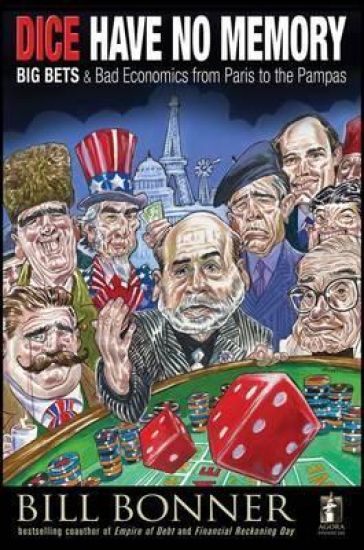
Dice Have No Memory

Dice Have No Memory

William Bonner

John Wiley Sons Inc
2011
sidottu
Right now, Congress, the Fed, and the Treasury are all gambling with your future and your money. And it's contagious. Economies around the globe are suffering from the biggest multitrillion-dollar bets ever wagered on big governments and miraculous financial interventions in pretend "free markets." One man saw it all coming and told his readers well in advance of today's crisis. Bill Bonner reports on the true health and well-being of the world's largest economy to over half a million readers each day in The Daily Reckoning. His newsletter is to the mainstream financial press what the Gnostic Gospels are to the King James Bible. Back in 2000, Bill Bonner sounded like a prophet crying in the wilderness. While everyone scrambled to purchase shares of the latest and hottest dot-com, Bill announced his Trade of the Decade: Sell dollars, buy gold. Back in 2000, you could get an ounce for around $264. Today, you could pay as much as $1,400 for that same ounce. Finally, some of Bonner's best pronouncements, predictions, and profitable analysis are collected in one place. Dice Have No Memory gather's Bonner's richest insights from August 1999 through November 2010 to form a chronological narrative of economics in America. Here's a fraction of what you'll find inside: Gold says "I Told You So"Three out of Four Economists Are WrongImperial Overstretch MarksWhy Debt Does MatterEconomic Zombies Shuffle Towards Bankruptcy Bonner's Dice Have No Memory offers elegies for economists, tips for investors, tirades against wasteful warfare past and present, and practical guides to modern finance with graceful prose, well-earned intelligence, and riotous irreverence. Bill Bonner's common sense genius rips the window dressing off modern finance - a world normally populated by misguided do-gooders, corrupt politicians, and big bankers empowered by dubious "mathematical" truths. The investing game is rigged, just like Monte Carlo. Instead of giving you magic formulas, this archcontrarian teaches you how to think clearly. And Dice Have No Memory gives today's investor the next moves he should make ... before it's too late.
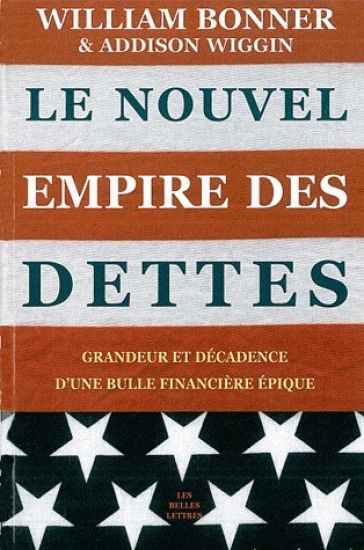
Le Nouvel Empire Des Dettes: Grandeur Et Decadence d'Une Bulle Financiere Epique
Historien et moraliste, William Bonner montre comment la modeste Republique des peres fondateurs s'est peu a peu, depuis la Premiere Guerre mondiale, transformee en Empire, dont, pour la premiere fois dans l'Histoire, l'hegemonie s'etend sur toute la terre. Il montre aussi comment cette transformation s'est accompagnee d'une evolution profonde des mentalites du peuple americain, dans tous les domaines, et particulierement le domaine financier, faisant d'un peuple d'epargnants un peuple d'emprunteurs frenetiques. Individuellement, les Americains vivent a credit, empruntant sans cesse pour rembourser leurs anciens prets, gages sur d'illusoires speculations le gouvernement, lui, finance son deficit, dont le montant, toujours croissant, est si eleve que le cerveau humain ne peut meme plus se le representer, par des emprunts exterieurs, qu'il rembourse tres partiellement en fabriquant des dollars. Paralleles historiques, anecdotes contemporaines, analyse financiere? William Bonner utilise toutes les informations pertinentes pour nous faire vivre, avec parfois fureur et plus souvent humour, l'ascension, et demain la chute, de l'Empire americain. La premiere edition, parue aux Etats-Unis en novembre 2005, et en France en 2006 aux Belles Lettres, sous le titre L'Empire des dettes, a aussitot figure dans la liste des dix best-sellers du New York Times et du Wall Street Journal. Cette nouvelle edition a paru aux Etats-Unis en aout 2009. Dans cette nouvelle edition, les auteurs poursuivent leur demonstration en tenant compte des evenements recents et exposent pourquoi la tourmente financiere qui a touche les US porte en germe la fin de ce qui fut un grand empire.
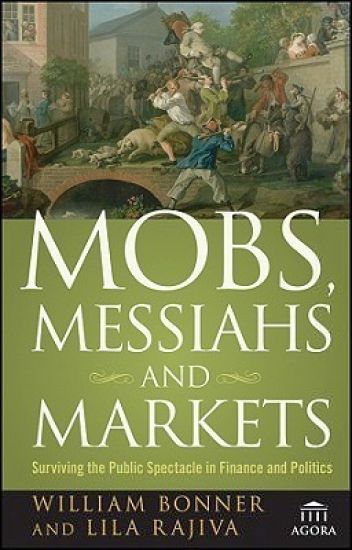
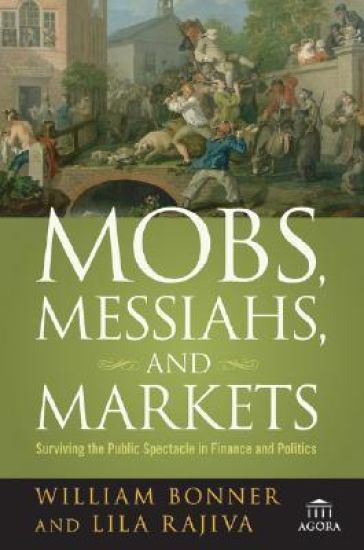
Mobs, Messiahs, and Markets

Mobs, Messiahs, and Markets

William Bonner; Lila Rajiva

John Wiley Sons Inc
2009
nidottu
An insightful look at how to succeed by going against the crowd Collectively, people think and act in ways that are different from how they think and act as individuals. Understanding these differences, says William (Bill) Bonner-a longtime maverick observer of the financial world and the vagaries of the investing public-is vital to preserving your wealth and personal dignity. From the witch-hunts of the early modern world to the war on terror, from dot-com mania to the real estate bubble, people have always been caught up in frauds, conceits, and wild guesses-often with devastating results. In Mobs, Messiahs, and Markets, Bonner and coauthor Lila Rajiva show groupthink at work in an improbable array of instances throughout history and reveal why swimming against the current pays. Shares the deeper secrets of investing and pushes you to question what this means for your financial well-beingExplains why people so often abandon good sense and good behavior to "follow the crowd"Offers concrete advice on how you can avoid the "public spectacle" of modern finance The authors' cautionary tale of bubble economies reveals how the gush of credit let loose by Alan Greenspan has wreaked havoc on our lives-but their thoughtful and always entertaining approach also offers some sound investing principles for avoiding the pitfalls of the public spectacle, thinking for yourself, and protecting your money, your sanity, and your soul.
Mobs, Messiahs, and Markets

Mobs, Messiahs, and Markets

William Bonner; Lila Rajiva

John Wiley Sons Inc
2007
sidottu
An insightful look at how to succeed by going against the crowd Collectively, people think and act in ways that are different from how they think and act as individuals. Understanding these differences, says William (Bill) Bonner-a longtime maverick observer of the financial world and the vagaries of the investing public-is vital to preserving your wealth and personal dignity. From the witch-hunts of the early modern world to the war on terror, from dot-com mania to the real estate bubble, people have always been caught up in frauds, conceits, and wild guesses-often with devastating results. In Mobs, Messiahs, and Markets, Bonner and coauthor Lila Rajiva show groupthink at work in an improbable array of instances throughout history and reveal why swimming against the current pays. Shares the deeper secrets of investing and pushes you to question what this means for your financial well-beingExplains why people so often abandon good sense and good behavior to "follow the crowd"Offers concrete advice on how you can avoid the "public spectacle" of modern finance The authors' cautionary tale of bubble economies reveals how the gush of credit let loose by Alan Greenspan has wreaked havoc on our lives-but their thoughtful and always entertaining approach also offers some sound investing principles for avoiding the pitfalls of the public spectacle, thinking for yourself, and protecting your money, your sanity, and your soul.
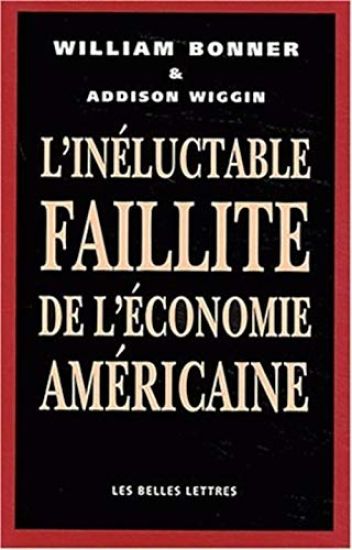
L'Ineluctable Faillite de l'Economie Americaine

L'Ineluctable Faillite de l'Economie Americaine

William Bonner; Addison Wiggin

Les Belles Lettres
2004
nidottu
L'economie americaine devient-elle japonaise? Suit-elle le chemin qui a conduit le Japon dans cette " depression douce " ou il reste englue depuis dix ans? Et va-t-elle vers un ineluctable effondrement? Pour repondre a cette question, William Bonner analyse sous l'angle de l'histoire et de la philosophie morale, mais sans negliger l'aspect economique, plusieurs etapes cruciales du developpement du monde industriel et explique notamment: Pourquoi a eclate la bulle boursiere de " l'age de l'information ", en examinant la realite d'entreprises telles qu'Amazon.com, Cisco systems ou Global crossings Pourquoi la consommation galopante des menages americains, fondee sur le credit et non sur l'epargne, a " surchauffe " l'economie US, en l'amenant au bord de l'explosion Pourquoi le " miracle economique " japonais s'est soudain ecroule, et ne s'est pas releve malgre une politique monetaire censee y remedier Pourquoi la Guerre de Secession - comme toute guerre en general - a conduit a la creation d'un systeme de banque centrale Pourquoi les aventures financieres de John Law, au XVIIIe siecle, annoncaient la speculation autour des " dot com " a la fin du XXe siecle Pourquoi le vieillissement de l'Occident menace plus notre economie que les politiques gouvernementales. Tirant les lecons trop negligees des evenements passes, William Bonner propose en conclusion des solutions originales et argumentees pour permettre au lecteur de survivre financierement face a la crise qui vient.