Kirjojen hintavertailu – 12 903 724 kirjaa ja 27 kauppaa

Kirjailija

William C. Baer

Kirjat ja teokset yhdessä paikassa: 3 kirjaa, julkaisuja vuosilta 1984–2024, suosituimpiin kuuluu A History of Homebuilders from Early Modern to Modern Times. Vertaile teosten hintoja ja tarkista saatavuus suomalaisista kirjakaupoista.

3 kirjaa

Kirjojen julkaisuvuodet: 1984–2024.

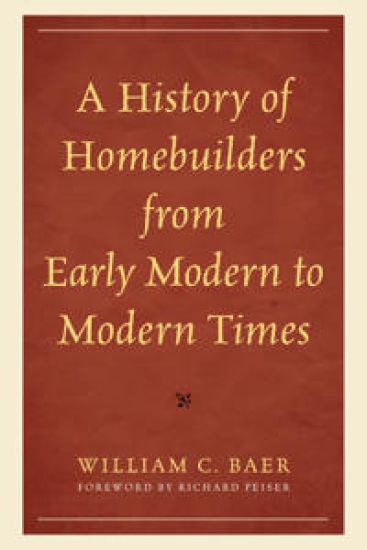
A History of Homebuilders from Early Modern to Modern Times

A History of Homebuilders from Early Modern to Modern Times

William C. Baer; Richard Peiser

BLOOMSBURY PUBLISHING PLC
2024
sidottu
A History of Homebuilders from Early Modern to Modern Times provides a diachronic account of homebuilders’ more than 500 years history in the Anglosphere nations of the U. S., Britain, Canada, and Australia. The comparative absence of individual homebuilders’ histories in the literature, despite builders’ importance in providing our dwellings and over 70% of our entire urban built environments, is surprising. Part One introduces homebuilders from several perspectives. These are useful for evaluating the homebuilders’ whose histories are presented in Part Two, and in providing a balanced understanding of homebuilders and the societal value of what they do. The actual, albeit brief, histories of mainly large homebuilders for more than 500 years in Part II, supply historians with some particulars of homebuilder attitudes, practices, ingenuity, and resourcefulness in how they operated over the centuries, with a modest trending to community building rather than just housebuilding. Part Three specifically focuses on the following evolutionary changes in homebuilding practices: 1) increasing standardization of dwelling components, 2) increasingly institutionalized sources of financial assistance, and 3) changes in production scale. Three technical appendices on dates of homebuilder ‘firsts’ in practices; in conceptualizing housing markets; and some government regulations, follow, with a fourth appendix on homebuilders’ organizational changes over the centuries.

Beyond the Neighborhood Unit

Beyond the Neighborhood Unit

Tridib Banerjee; William C. Baer

Springer-Verlag New York Inc.
2013
nidottu
Much of the research on which this book is based was funded almost a decade ago by separate grants from two different agencies of the U. S. Public Health Service, of the then still consolidated Department of Health, Education, and Welfare. The first grant was from the Bureau of Community Environmental Management (Public Health Service Research Grant J-RO J EM 0049-02), and the second from the Center for Studies of Metropolitan Problems of the National Institute of Mental Health (Public Health Service Grant ROJ MH 24904-02). These separate grants were necessary because of budget cuts that truncated our original effort. We were fortunate to receive subsequent assistance from NIMH to conclude the research, as it is doubtful that a project of the scope and intent of our effort--even as completed in abbreviated form-will be funded in the 1980s. The original intent of this project, as formulated by our colleagues Ira Robinson and Alan Kreditor, and as conceptualized earlier by their predeces­ sors-members of an advisory committee of planners and social scientists ap­ pointed by the American Public Health Association (APHA)-was to rewrite Planning the Neighborhood, APHA's recommended standards for residential design. In particular, it was proposed that the new study take the point of view of the user in terms of residential standards. Hitherto, the private sector had domi­ nated these considerations (i. e. , the designer's predilections, the requirements of builders and material suppliers, and lenders' needs for mortgage security).
Beyond the Neighborhood Unit

Beyond the Neighborhood Unit

Tridib Banerjee; William C. Baer

Kluwer Academic/Plenum Publishers
1984
sidottu
Much of the research on which this book is based was funded almost a decade ago by separate grants from two different agencies of the U. S. Public Health Service, of the then still consolidated Department of Health, Education, and Welfare. The first grant was from the Bureau of Community Environmental Management (Public Health Service Research Grant J-RO J EM 0049-02), and the second from the Center for Studies of Metropolitan Problems of the National Institute of Mental Health (Public Health Service Grant ROJ MH 24904-02). These separate grants were necessary because of budget cuts that truncated our original effort. We were fortunate to receive subsequent assistance from NIMH to conclude the research, as it is doubtful that a project of the scope and intent of our effort--even as completed in abbreviated form-will be funded in the 1980s. The original intent of this project, as formulated by our colleagues Ira Robinson and Alan Kreditor, and as conceptualized earlier by their predeces­ sors-members of an advisory committee of planners and social scientists ap­ pointed by the American Public Health Association (APHA)-was to rewrite Planning the Neighborhood, APHA's recommended standards for residential design. In particular, it was proposed that the new study take the point of view of the user in terms of residential standards. Hitherto, the private sector had domi­ nated these considerations (i. e. , the designer's predilections, the requirements of builders and material suppliers, and lenders' needs for mortgage security).