Kirjojen hintavertailu – 12 859 828 kirjaa ja 27 kauppaa

Kirjailija

William C. Dowling

Kirjat ja teokset yhdessä paikassa: 13 kirjaa, julkaisuja vuosilta 2000–2022, suosituimpiin kuuluu Professor's Song. Vertaile teosten hintoja ja tarkista saatavuus suomalaisista kirjakaupoista.

Nimi esiintyy myös muodoissa: William C Dowling

13 kirjaa

Kirjojen julkaisuvuodet: 2000–2022.

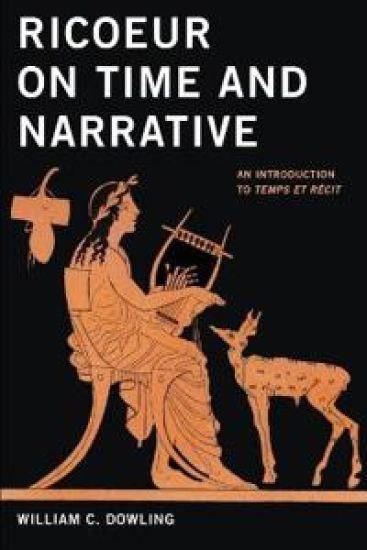
Ricoeur on Time and Narrative

Ricoeur on Time and Narrative

William C. Dowling

UNIVERSITY OF NOTRE DAME PRESS
2022
sidottu
"The object of this book," writes William C. Dowling in his preface, "is to make the key concepts of Paul Ricoeur's Time and Narrative available to readers who might have felt bewildered by the twists and turns of its argument." The sources of puzzlement are, he notes, many. For some, it is Ricoeur's famously indirect style of presentation, in which the polarities of argument and exegesis seem so often and so suddenly to have reversed themselves. For others, it is the extraordinary intellectual range of Ricoeur's argument, drawing on traditions as distant from each other as Heideggerian existentialism, French structuralism, and Anglo-American analytic philosophy. Yet beneath the labyrinthian surface of Ricoeur's Temps et récit, Dowling reveals a single extended argument that, though developed unsystematically, is meant to be understood in systematic terms. Ricoeur on Time and Narrative presents that argument in clear and concise terms, in a way that will be enlightening both to readers new to Ricoeur and those who may have felt themselves adrift in the complexities of Temps et récit, Ricoeur's last major philosophical work. Dowling divides his discussion into six chapters, all closely involved with specific arguments in Temps et récit: on mimesis, time, narrativity, semantics of action, poetics of history, and poetics of fiction. Additionally, Dowling provides a preface that lays out the French intellectual context of Ricoeur's philosophical method. An appendix presents his English translation of a personal interview in which Ricoeur, having completed Time and Narrative, looks back over his long career as an internationally renowned philosopher. Ricoeur on Time and Narrative communicates to readers the intellectual excitement of following Ricoeur's dismantling of established theories and arguments—Aristotle and Augustine and Husserl on time, Frye and Greimas on narrative structure, Arthur Danto and Louis O. Mink on the nature of historical explanation—while coming to see how, under the pressure of Ricoeur's analysis, these ideas are reconstituted and revealed in a new set of relations to one another.
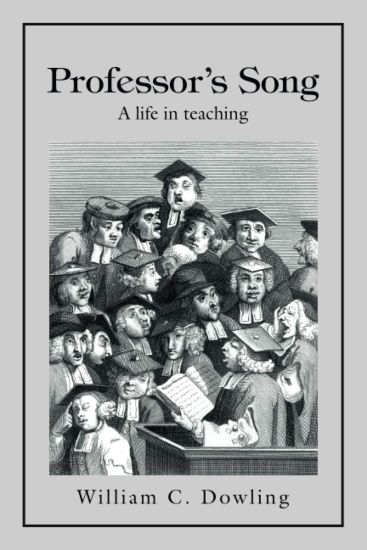
Professor's Song

Professor's Song

William C Dowling

Xlibris Us
2021
sidottu
William C. Dowling is University Distinguished Professor of English and American Literature emeritus at Rutgers University. His previous publications include The Epistolary Moment: A Poetics of the Eighteenth-Century Verse Epistle, Poetry and Ideology in Revolutionary Connecticut Literary Federalism in the Age of Jefferson, Jameson/Althusser/Marx, The Senses of the Text: Intensional Semantics and Literary History, Ricoeur on Time and Narrative, and Confessions of a Spoilsport, an account of the struggle against commercialized college athletics at Rutgers and other Div IA schools. ln 20l2 he received the Drake Group's Robert Maynard Hutchins Award for his advocacy of a return to participatory athletics in American higher education. A Reader's Companion to Infinite Jest, co-authored with Robert H. Bell of Williams College, was published by Xlibris in 2005.
Professor's Song

Professor's Song

William C Dowling

Xlibris Us
2021
pokkari
William C. Dowling is University Distinguished Professor of English and American Literature emeritus at Rutgers University. His previous publications include The Epistolary Moment: A Poetics of the Eighteenth-Century Verse Epistle, Poetry and Ideology in Revolutionary Connecticut Literary Federalism in the Age of Jefferson, Jameson/Althusser/Marx, The Senses of the Text: Intensional Semantics and Literary History, Ricoeur on Time and Narrative, and Confessions of a Spoilsport, an account of the struggle against commercialized college athletics at Rutgers and other Div IA schools. ln 20l2 he received the Drake Group's Robert Maynard Hutchins Award for his advocacy of a return to participatory athletics in American higher education. A Reader's Companion to Infinite Jest, co-authored with Robert H. Bell of Williams College, was published by Xlibris in 2005.
Language and Logos in Boswell's Life of Johnson

Language and Logos in Boswell's Life of Johnson

William C. Dowling

Princeton University Press
2016
sidottu
In this deconstructionist interpretation of a major eighteenth-century work, William Dowling analyzes Boswell's Life of Johnson as a paradigm of antithetical structure in narrative, and develops a grammar of discontinuity" for interpreting other texts as well. Originally published in 1981. The Princeton Legacy Library uses the latest print-on-demand technology to again make available previously out-of-print books from the distinguished backlist of Princeton University Press. These editions preserve the original texts of these important books while presenting them in durable paperback and hardcover editions. The goal of the Princeton Legacy Library is to vastly increase access to the rich scholarly heritage found in the thousands of books published by Princeton University Press since its founding in 1905.
The Epistolary Moment

The Epistolary Moment

William C. Dowling

Princeton University Press
2016
sidottu
The eighteenth-century verse epistle, argues William Dowling, was an attempt to solve in literary terms the dilemma of solipsism as raised by Locke and Hume. The focus of The Epistolary Moment is on internal audience in poetry--the audience "inside" the poem, created by its discourse and belonging to its world--as this divides in epistolary poetry into a double or simultaneous register of address: the audience directly addressed by the letter-writer, and an epistolary audience listening in on the exchange from a point external to the discourse of the speaker but internal to the discourse of the poem. Epistolary audience lies, contends The Epistolary Moment, at the heart of an Augustan theory of poetry as ideological intervention, poems as symbolic acts with enormous consequences in the domain of the real. The emergence of the verse epistle as the dominant form in eighteenth-century poetry thus takes as its ultimate context the origins of eighteenth-century solipsism in a degraded modernity symbolized by Sir Robert Walpole and his Robinocracy, the demonic representatives of a new money or market society arising from the ruins of organic or traditional community. Originally published in 1991. The Princeton Legacy Library uses the latest print-on-demand technology to again make available previously out-of-print books from the distinguished backlist of Princeton University Press. These editions preserve the original texts of these important books while presenting them in durable paperback and hardcover editions. The goal of the Princeton Legacy Library is to vastly increase access to the rich scholarly heritage found in the thousands of books published by Princeton University Press since its founding in 1905.
Language and Logos in Boswell's Life of Johnson

Language and Logos in Boswell's Life of Johnson

William C. Dowling

Princeton University Press
2014
pokkari
In this deconstructionist interpretation of a major eighteenth-century work, William Dowling analyzes Boswell's Life of Johnson as a paradigm of antithetical structure in narrative, and develops a grammar of discontinuity" for interpreting other texts as well. Originally published in 1981. The Princeton Legacy Library uses the latest print-on-demand technology to again make available previously out-of-print books from the distinguished backlist of Princeton University Press. These editions preserve the original texts of these important books while presenting them in durable paperback and hardcover editions. The goal of the Princeton Legacy Library is to vastly increase access to the rich scholarly heritage found in the thousands of books published by Princeton University Press since its founding in 1905.
The Epistolary Moment

The Epistolary Moment

William C. Dowling

Princeton University Press
2014
pokkari
The eighteenth-century verse epistle, argues William Dowling, was an attempt to solve in literary terms the dilemma of solipsism as raised by Locke and Hume. The focus of The Epistolary Moment is on internal audience in poetry--the audience "inside" the poem, created by its discourse and belonging to its world--as this divides in epistolary poetry into a double or simultaneous register of address: the audience directly addressed by the letter-writer, and an epistolary audience listening in on the exchange from a point external to the discourse of the speaker but internal to the discourse of the poem. Epistolary audience lies, contends The Epistolary Moment, at the heart of an Augustan theory of poetry as ideological intervention, poems as symbolic acts with enormous consequences in the domain of the real. The emergence of the verse epistle as the dominant form in eighteenth-century poetry thus takes as its ultimate context the origins of eighteenth-century solipsism in a degraded modernity symbolized by Sir Robert Walpole and his Robinocracy, the demonic representatives of a new money or market society arising from the ruins of organic or traditional community. Originally published in 1991. The Princeton Legacy Library uses the latest print-on-demand technology to again make available previously out-of-print books from the distinguished backlist of Princeton University Press. These editions preserve the original texts of these important books while presenting them in durable paperback and hardcover editions. The goal of the Princeton Legacy Library is to vastly increase access to the rich scholarly heritage found in the thousands of books published by Princeton University Press since its founding in 1905.
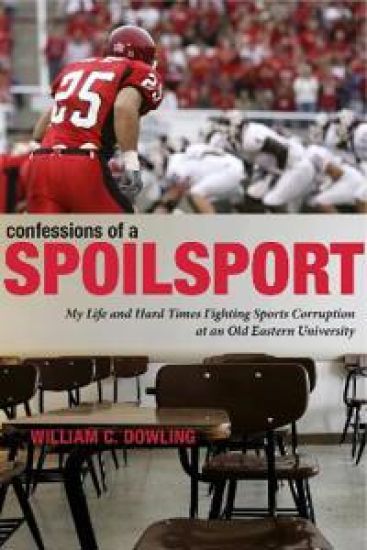
Confessions of a Spoilsport

Confessions of a Spoilsport

William C. Dowling

Pennsylvania State University Press
2013
pokkari
In 1998, Milton Friedman’s statement drew national attention to Rutgers 1000, a campaign in which students, faculty, and alumni were resisting the takeover of their university by commercialized Division I-A athletics. Subsequently, the movement received extensive coverage in the New York Times, the Wall Street Journal, the Chronicle of Higher Education, Sports Illustrated, and other publications. Today, “big-time” college athletics remains a hotly debated issue at Rutgers. Why did an old eastern university that had long competed against such institutions as Colgate, Columbia, Lafayette, and Princeton, choose, by joining the Big East conference in 1994, to plunge into the world of such TV-revenue-driven extravaganzas as “March Madness” and the Tostitos Fiesta Bowl? What is the moral for universities where big-time college sports have already become the primary source of institutional identity? Confessions of a Spoilsport is the story of an English professor who, having seen the University of New Mexico sink academically in the period of a major basketball scandal, was galvanized into action when Rutgers joined the Big East. It is also the story of the Rutgers 1000 students and alumni who set out against enormous odds to resist the decline of their university—eviscerated academic programs, cancellation of minor sports, loss of the “best and brightest” in-state students to the nearby College of New Jersey—while tens of millions of dollars were being lavished on Division I-A athletics. Ultimately, however, the story of Rutgers 1000 is what the New York Times called it when Milton Friedman issued his ringing statement: a struggle for the soul of a major university.
Ricoeur on Time and Narrative

Ricoeur on Time and Narrative

William C. Dowling

University of Notre Dame Press
2011
nidottu

Halvin toimitettuna 29,80 €

"The object of this book," writes William C. Dowling in his preface, "is to make the key concepts of Paul Ricoeur's Time and Narrative available to readers who might have felt bewildered by the twists and turns of its argument." The sources of puzzlement are, he notes, many. For some, it is Ricoeur's famously indirect style of presentation, in which the polarities of argument and exegesis seem so often and so suddenly to have reversed themselves. For others, it is the extraordinary intellectual range of Ricoeur's argument, drawing on traditions as distant from each other as Heideggerian existentialism, French structuralism, and Anglo-American analytic philosophy. Yet beneath the labyrinthian surface of Ricoeur's Temps et récit, Dowling reveals a single extended argument that, though developed unsystematically, is meant to be understood in systematic terms. Ricoeur on Time and Narrative presents that argument in clear and concise terms, in a way that will be enlightening both to readers new to Ricoeur and those who may have felt themselves adrift in the complexities of Temps et récit, Ricoeur's last major philosophical work. Dowling divides his discussion into six chapters, all closely involved with specific arguments in Temps et récit: on mimesis, time, narrativity, semantics of action, poetics of history, and poetics of fiction. Additionally, Dowling provides a preface that lays out the French intellectual context of Ricoeur's philosophical method. An appendix presents his English translation of a personal interview in which Ricoeur, having completed Time and Narrative, looks back over his long career as an internationally renowned philosopher. Ricoeur on Time and Narrative communicates to readers the intellectual excitement of following Ricoeur's dismantling of established theories and arguments—Aristotle and Augustine and Husserl on time, Frye and Greimas on narrative structure, Arthur Danto and Louis O. Mink on the nature of historical explanation—while coming to see how, under the pressure of Ricoeur's analysis, these ideas are reconstituted and revealed in a new set of relations to one another.
The Boswellian Hero

The Boswellian Hero

William C. Dowling

University of Georgia Press
2008
pokkari
Boswell's Life of Johnson, Tour of the Hebrides, and Tour to Corsica are controlled, argues William Dowling, by "a single conception of the heroic character, one that reaches beyond the particular narrative situation to a final vision of man's dilemma in the modern world." Samuel Johnson and Pascal Paoli, the great protagonists of the three major narratives Boswell published during his lifetime, are heroic spirits who manage to survive in an age of spiritual disintegration only by dwelling within imperiled private worlds of coherence and belief. The Boswellian Hero, the first comprehensive thematic study of Boswellian narrative, is also a work with strong theoretical implications for students of biography as a genre. Biography exists as literature, according to Dowling, only in relation to formal or objective interpretations of its meaning--to read the Life of Johnson as a literary work is to dissociate its biographical hero from any "real" or "historical" Samuel Johnson in the same way one dissociates Shakespeare's Richard III from Richard III of England. Although The Boswellian Hero promises to establish its importance in Boswell studies immediately, it will also be of significant interest to readers concerned with the hero in literature, with biography as a narrative form, and with the complex theoretical problem of "factual" or "historical" literature.
Confessions of a Spoilsport

Confessions of a Spoilsport

William C. Dowling

Pennsylvania State University Press
2007
sidottu
In 1998, Milton Friedman’s statement drew national attention to Rutgers 1000, a campaign in which students, faculty, and alumni were resisting the takeover of their university by commercialized Division I-A athletics. Subsequently, the movement received extensive coverage in the New York Times, the Wall Street Journal, the Chronicle of Higher Education, Sports Illustrated, and other publications. Today, “big-time” college athletics remains a hotly debated issue at Rutgers. Why did an old eastern university that had long competed against such institutions as Colgate, Columbia, Lafayette, and Princeton, choose, by joining the Big East conference in 1994, to plunge into the world of such TV-revenue-driven extravaganzas as “March Madness” and the Tostitos Fiesta Bowl? What is the moral for universities where big-time college sports have already become the primary source of institutional identity? Confessions of a Spoilsport is the story of an English professor who, having seen the University of New Mexico sink academically in the period of a major basketball scandal, was galvanized into action when Rutgers joined the Big East. It is also the story of the Rutgers 1000 students and alumni who set out against enormous odds to resist the decline of their university—eviscerated academic programs, cancellation of minor sports, loss of the “best and brightest” in-state students to the nearby College of New Jersey—while tens of millions of dollars were being lavished on Division I-A athletics. Ultimately, however, the story of Rutgers 1000 is what the New York Times called it when Milton Friedman issued his ringing statement: a struggle for the soul of a major university.
Essay on the Life of the Honourable Major-General Israel Putnam

Essay on the Life of the Honourable Major-General Israel Putnam

David Humphreys; William C Dowling

Liberty Fund Inc
2000
sidottu
General Israel Putnam is remembered in history and legend as exclaiming to the American soldiers at the Battle of Bunker Hill, "Don't fire 'til you see the whites of their eyes!" As Dowling notes, "All the episodes are retold -- Bunker Hill, the Battle of White Plains, the crossing of the Delaware, the Battle of Princeton -- but from the perspective of one who was there throughout, and who always permits us to see Putnam as the sort of character by whom history is, in the last analysis, made."
Essay on the Life of the Honourable Major-General Israel Putnam

Essay on the Life of the Honourable Major-General Israel Putnam

David Humphreys; William C Dowling

Liberty Fund Inc
2000
nidottu
General Israel Putnam is remembered in history and legend as exclaiming to the American soldiers at the Battle of Bunker Hill, "Don't fire 'til you see the whites of their eyes!" As Dowling notes, "All the episodes are retold -- Bunker Hill, the Battle of White Plains, the crossing of the Delaware, the Battle of Princeton -- but from the perspective of one who was there throughout, and who always permits us to see Putnam as the sort of character by whom history is, in the last analysis, made."