Kirjojen hintavertailu – 12 903 725 kirjaa ja 27 kauppaa

Kirjailija

William E. Leuchtenburg

Kirjat ja teokset yhdessä paikassa: 12 kirjaa, julkaisuja vuosilta 1953–2024, suosituimpiin kuuluu Patriot Presidents. Vertaile teosten hintoja ja tarkista saatavuus suomalaisista kirjakaupoista.

Nimi esiintyy myös muodoissa: William E Leuchtenburg

12 kirjaa

Kirjojen julkaisuvuodet: 1953–2024.

Patriot Presidents

Patriot Presidents

William E. Leuchtenburg

OXFORD UNIVERSITY PRESS INC
2024
sidottu
A nuanced account of the early leaders who shaped the American presidency The founding fathers of the United States created a unique institution, the presidency, as they were determined to authorize an effective chief executive but wary of monarchy. They endowed this office with broad prerogatives and power but hedged it in with limitations. The presidency that developed over the next generation, however, was fashioned less by the clauses in the Constitution than by the way that the first presidents responded to challenges such as sectional enmity and the vexing Napoleonic warfare that jeopardized maritime rights. Patriot Presidents explores how the presidency took shape from the medley of clauses handed down to George Washington, who said, "I walk on untrodden ground," for virtually everything he did created a precedent. It then follows the overwhelming challenges faced by his successors, from the austere John Adams who spoke passionately in favor of a strong executive, to Thomas Jefferson, a zealous advocate of American liberties, to James Madison, the creator of the first political party, and James Monroe, whose Monroe Doctrine protected the sovereignty of the Western Hemisphere. It concludes with John Quincy Adams, who could be called the prophet of the expansive twentieth-century state of the Square Deal, the New Deal, the Fair Deal, and the Great Society. The esteemed American historian William E. Leuchtenburg invites readers to revisit the years after the birth of the republic, when Americans could take pride in leaders of ideals, high competence, and integrity who headed their government--chief executives who, though not unflawed, had an abiding commitment to the success of the vulnerable government that had emerged from the revolutionary cause to which they had devoted themselves.
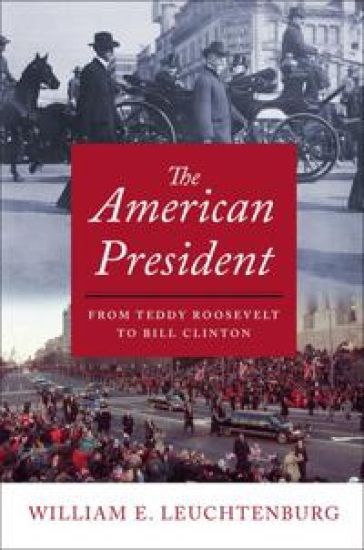
The American President

The American President

William E. Leuchtenburg

Oxford University Press Inc
2019
nidottu
The American President is an enthralling account of American presidential actions from the assassination of William McKinley in 1901 to Bill Clinton's last night in office in January 2001. William Leuchtenburg, one of the great presidential historians of the century, portrays each of the presidents in a chronicle sparkling with anecdote and wit. Leuchtenburg offers a nuanced assessment of their conduct in office, preoccupations, and temperament. His book presents countless moments of high drama: FDR hurling defiance at the "economic royalists" who exploited the poor; ratcheting tension for JFK as Soviet vessels approach an American naval blockade; a grievously wounded Reagan joking with nurses while fighting for his life. This book charts the enormous growth of presidential power from its lowly state in the late nineteenth century to the imperial presidency of the twentieth. That striking change was manifested both at home in periods of progressive reform and abroad, notably in two world wars, Vietnam, and the war on terror. Leuchtenburg sheds light on presidents battling with contradictory forces. Caught between maintaining their reputation and executing their goals, many practiced deceits that shape their image today. But he also reveals how the country's leaders pulled off magnificent achievements worthy of the nation's pride. Now with a preface new to this edition,The American President provides a timely reflection on the office that has shaped and continues to shape the destiny of the United States and its people.
The American President

The American President

William E. Leuchtenburg

Oxford University Press Inc
2016
sidottu
The American President is a riveting account of the actions of American presidents in the twentieth century from the assassination of William McKinley in 1901 to Bill Clinton's last night in office in January 2001. William Leuchtenburg, a prize-winning historian who has been a political analyst for major television networks, portrays each of the presidents in a chronicle sparked by anecdote and salted with wit. In this lively narrative, Leuchtenburg highlights countless moments of high drama: Woodrow Wilson sailing home from Paris with the Covenant of the League of Nations that the United States Senate will reject, breaking his heart; FDR hurling defiance at the "economic royalists " who exploited the poor; John F. Kennedy coping with white-knuckle anxiety as Soviet vessels approach an American naval blockade in the Atlantic; Richard Nixon conspiring to suppress evidence of the Watergate break-in; grievously wounded Ronald Reagan quipping with nurses while fighting for his life; Bill Clinton seeking to survive his affair with Monica Lewinsky as his pursuers close in. American President shows the enormous growth of presidential power from its lowly state in the late nineteenth century to the imperial presidency of the twentieth century. That striking change, Leuchtenburg maintains, was manifested both at home-in periods of progressive reform from Theodore Roosevelt's Square Deal, Woodrow Wilson's New Freedom, and Franklin Delano Roosevelt's New Deal to Harry Truman's Fair Deal, John F. Kennedy's New Frontier, and Lyndon B. Johnson's Great Society-and abroad, notably in World Wars I and II, the Korean conflict, Vietnam, and the war on terror. 4L American President exposes numerous instances when even the best of presidents practiced deceit, puncturing the inflated reputations of the overrated. But it also demonstrates brilliantly that there were times when the country's leaders were magnificent figures, worthy of the nation's pride.
In the Shadow of FDR

In the Shadow of FDR

William E. Leuchtenburg

Cornell University Press
2010
pokkari
A ghost has inhabited the Oval Office since 1945—the ghost of Franklin Delano Roosevelt. FDR's formidable presence has cast a large shadow on the occupants of that office in the years since his death, and an appreciation of his continuing influence remains essential to understanding the contemporary presidency. This new edition of In the Shadow of FDR has been updated to examine the presidency of George W. Bush and the first 100 days of the presidency of Barack Obama. The Obama presidency is evidence not just of the continuing relevance of FDR for assessing executive power but also of the salience of FDR's name in party politics and policy formulation.
In the Shadow of FDR

In the Shadow of FDR

William E. Leuchtenburg

Cornell University Press
2010
sidottu
A ghost has inhabited the Oval Office since 1945—the ghost of Franklin Delano Roosevelt. FDR's formidable presence has cast a large shadow on the occupants of that office in the years since his death, and an appreciation of his continuing influence remains essential to understanding the contemporary presidency. This new edition of In the Shadow of FDR has been updated to examine the presidency of George W. Bush and the first 100 days of the presidency of Barack Obama. The Obama presidency is evidence not just of the continuing relevance of FDR for assessing executive power but also of the salience of FDR's name in party politics and policy formulation.
Herbert Hoover

Herbert Hoover

William E. Leuchtenburg

Times Books
2009
sidottu
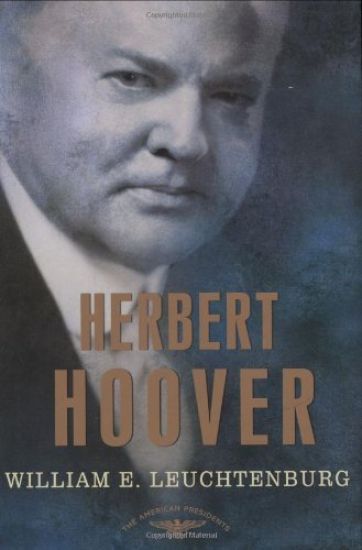
Catapulted into national politics by his heroic campaigns to feed Europe during and after World War I, Herbert Hoover - an engineer by training - exemplified the economic optimism of the 1920s. As president, however, Hoover was sorely tested by America's first crisis of the twentieth century: the Great Depression. Renowned New Deal historian William E. Leuchtenburg demonstrates how Hoover was blinkered by his distrust of government and his belief that volunteer ism would solve all social ills. As Leuchtenburg shows, Hoover's attempts to enlist the aid of private sector leaders did little to mitigate the Depression, and he was routed from office by Franklin D. Roosevelt in 1932. From his retirement at Stanford University, Hoover remained a vocal critic of the New Deal and big government until the end of his long life. Leuchtenburg offers a frank, thoughtful portrait of this lifelong public servant, and shrewdly assesses Hoover's policies and legacy in the face of one of the darkest periods of American history.
The White House Looks South

The White House Looks South

William E. Leuchtenburg

Louisiana State University Press
2007
nidottu
Perhaps not southerners in the usual sense, Franklin D. Roosevelt, Harry S. Truman, and Lyndon B. Johnson each demonstrated a political style and philosophy that helped them influence the South and unite the country in ways that few other presidents have. Combining vivid biography and political insight, William E. Leuchtenburg offers an engaging account of relations between these three presidents and the South while also tracing how the region came to embrace a national perspective without losing its distinctive sense of place. According to Leuchtenburg, each man ""had one foot below the Mason-Dixon Line, one foot above."" Roosevelt, a New Yorker, spent much of the last twenty-five years of his life in Warm Springs, Georgia, where he built a ""Little White House."" Truman, a Missourian, grew up in a pro-Confederate town but one that also looked West because of its history as the entrepôt for the Oregon Trail. Johnson, who hailed from the former Confederate state of Texas, was a westerner as much as a southerner. Their intimate associations with the South gave these three presidents an empathy toward and acceptance in the region. In urging southerners to jettison outworn folkways, Roosevelt could speak as a neighbor and adopted son, Truman as a borderstater who had been taught to revere the Lost Cause, and Johnson as a native who had been scorned by Yankees. Leuchtenburg explores in fascinating detail how their unique attachment to ""place"" helped them to adopt shifting identities, which proved useful in healing rifts between North and South, in altering behavior in regard to race, and in fostering southern economic growth. The White House Looks South is the monumental work of a master historian. At a time when race, class, and gender dominate historical writing, Leuchtenburg argues that place is no less significant. In a period when America is said to be homogenized, he shows that sectional distinctions persist. And in an era when political history is devalued, he demonstrates that government can profoundly affect people's lives and that presidents can be change-makers.
That Man

That Man

William E. Leuchtenburg

Oxford University Press Inc
2004
nidottu
Robert H. Jackson was one of the giants of the Roosevelt era: an Attorney General, a still revered Supreme Court Justice and, not least important, one of Franklin Delano Roosevelt's close friends and advisers. His intimate memoir of FDR, written in the early 1950s before Jackson's untimely death, has remained unpublished for fifty years. Here is that newly discovered memoir. Written with skill and grace, this is truly a unique account of the personality, conduct, greatness of character, and common humanity of "that man in the White House," as outraged conservatives called FDR. Jackson simply but eloquently provides an insider's view of Roosevelt's presidency, including such crucial events as FDR's Court-packing plan, his battles with corporate America, his decision to seek a third term, and his bold move to aid Britain in 1940 with American destroyers. He also offers an intimate personal portrait of Roosevelt--on fishing trips, in late-night poker games, or approving legislation while eating breakfast in bed, where he routinely began his workday. We meet a president who is far-sighted but nimble in attacking the problems at hand; principled but flexible; charismatic and popular but unafraid to pick fights, take stands, and when necessary, make enemies. That Man is not simply a valuable historical document, but an engaging and insightful look at one of the most remarkable men in American history. In reading this memoir, we gain not only a new appreciation for Roosevelt, but also admiration for Jackson, who emerges as both a public servant of great integrity and skill and a wry, shrewd, and fair-minded observer of politics at the highest level.
The Perils of Prosperity, 1914-1932

The Perils of Prosperity, 1914-1932

William E. Leuchtenburg

University of Chicago Press
1993
nidottu
Beginning with Woodrow Wilson and U. S. entry into World War I and closing with the Great Depression, The Perils of Prosperity traces the transformation of America from an agrarian, moralistic, isolationist nation into a liberal, industrialized power involved in foreign affairs in spite of itself. William E. Leuchtenburg's lively yet balanced account of this hotly debated era in American history has been a standard text for many years. This substantial revision gives greater weight to the roles of women and minorities in the great changes of the era and adds new insights into literature, the arts, and technology in daily life. He has also updated the lists of important dates and resources for further reading. "This book gives us a rare opportunity to enjoy the matured interpretation of an American Historian who has returned to the story and seen how recent decades have added meaning and vividness to this epoch of our history."--Daniel J. Boorstin, from the Preface William E. Leuchtenburg is William Rand Kenan Professor at the University of North Carolina, Chapel Hill and recent past president of the American Historical Association. He has published numerous books on twentieth-century American history.
Franklin D. Roosevelt and the New Deal

Franklin D. Roosevelt and the New Deal

William E Leuchtenburg

Harper Perennial
2013
pokkari
When the stability of American life was threatened by the Great Depression, the decisive and visionary policy contained in FDR's New Deal offered America a way forward. In this groundbreaking work, William E. Leuchtenburg traces the evolution of what was both the most controversial and effective socioeconomic initiative ever undertaken in the United States--and explains how the social fabric of American life was forever altered. It offers illuminating lessons on the challenges of economic transformation--for our time and for all time.
The Burden of Southern History

The Burden of Southern History

C. Vann Woodward; William E. Leuchtenburg

Louisiana State University Press
2008
nidottu
C. Vann Woodward's The Burden of Southern History remains one of the essential history texts of our time. In it Woodward brilliantly addresses the interrelated themes of southern identity, southern distinctiveness, and the strains of irony that characterize much of the South's historical experience. First published in 1960, the book quickly became a touchstone for generations of students. This updated third edition contains a chapter, Look Away, Look Away, in which Woodward finds a plethora of additional ironies in the South's experience. It also includes previously uncollected appreciations of Robert Penn Warren, to whom the book was originally dedicated, and William Faulkner. This edition also features a new foreword by historian William E. Leuchtenburg in which he recounts the events that led up to Woodward's writing The Burden of Southern History, and reflects on the book's -- and Woodward's -- place in the study of southern history. The Burden of Southern History is quintessential Woodward -- wise, witty, ruminative, daring, and as alive in the twenty-first century as when it was written.