Kirjojen hintavertailu – 12 903 724 kirjaa ja 27 kauppaa

Kirjailija

William E. Unrau

Kirjat ja teokset yhdessä paikassa: 8 kirjaa, julkaisuja vuosilta 1977–2013, suosituimpiin kuuluu The Kansa Indians. Vertaile teosten hintoja ja tarkista saatavuus suomalaisista kirjakaupoista.

8 kirjaa

Kirjojen julkaisuvuodet: 1977–2013.

Indians, Alcohol, and the Roads to Taos and Santa Fe

Indians, Alcohol, and the Roads to Taos and Santa Fe

William E. Unrau

University Press of Kansas
2013
sidottu
In the culture of the American West, images abound of Indians drunk on the white man’s firewater, a historical stereotype William Unrau has explored in two previous books. His latest study focuses on how federally-developed roads from Missouri to northern New Mexico facilitated the diffusion of both spirits and habits of over-drinking within Native American cultures. Unrau investigates how it came about that distilled alcohol, designated illegal under penalty of federal fines and imprisonment as a trade item for Indian people, was nevertheless easily obtainable by most Indians along the Taos and Santa Fe roads after 1821. Unrau reveals how the opening of those overland trails, their designation as national roads, and the establishment of legal boundaries of “Indian Country” all combined to produce an increasingly unstable setting in which Osage, Kansa, Southern Cheyenne, Arapahoe, Kiowa, and Comanche peoples entered into an expansive trade for alcohol along these routes. Unrau describes how Missouri traders began meeting Anglo demand for bison robes and related products, obtaining these commodities in exchange for corn and wheat alcohol and ensnaring Prairie and Plains Indians in a market economy that became dependent on this exchange. He tells how the distribution of illicit alcohol figured heavily in the failure of Indian prohibition, with drinking becoming an unfortunate learned behaviour among Indians, and analyses this trade within the context of evolving federal Indian law, policy, and enforcement in Indian Country. Unrau’s research suggests that the illegal trade along this route may have been even more important than the legal commerce moving between the mouth of the Kansas River and the Mexican markets far to the southwest. He also considers how and why the federal government failed to police and take into custody known malefactors, thereby undermining its announced program for tribal improvement. Indians, Alcohol, and the Roads to Taos and Santa Fe cogently explores the relationship between politics and economics in the expanding borderlands of the United States. It fills a void in the literature of the overland Indian trade as it reveals the enduring power of the most pernicious trade good in Indian Country.
The Rise and Fall of Indian Country, 1825-1855

The Rise and Fall of Indian Country, 1825-1855

William E. Unrau

University Press of Kansas
2007
sidottu
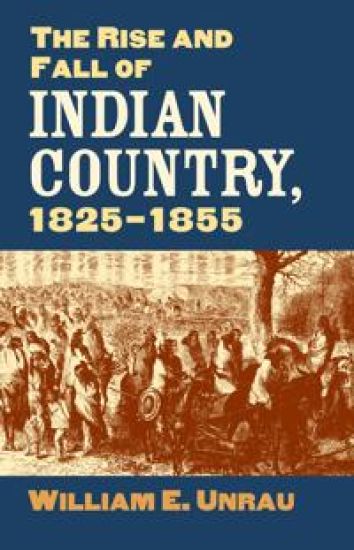
The Indian Trade and Intercourse Act of 1834 represented what many considered the ongoing benevolence of the United States toward Native Americans, establishing a congressionally designated refuge for displaced Indians to protect them from exploitation by white men. Others came to see it as a legally sanctioned way to swindle them out of their land. This first book-length study of ""Indian country"" focuses on Section 1 of the 1834 Act - which established its boundaries - to show that this legislation was ineffectual from the beginning. William Unrau challenges conventional views that the act was a continuation of the government's benevolence toward Indians, revealing it instead as little more than a deceptive stopgap that facilitated white settlement and development of the trans-Missouri West. Encompassing more than half of the Louisiana Purchase and stretching from the Red River to the headwaters of the Missouri, Indian country was designated as a place for Native survival and improvement. Unrau shows that, although many consider that the territory merely fell victim to Manifest Destiny, the concept of Indian country was flawed from the start by such factors as distorted perceptions of the region's economic potential, tribal land compressions, government complicity in overland travel and commerce, and blatant disregard for federal regulations. Chronicling the encroachments of land-hungry whites, which met with little resistance from negligent if not complicit lawmakers and bureaucrats, he tells how the protection of Indian country lasted only until the needs of westward expansion outweighed those associated with the presumed solution to the ""Indian problem"" and how subsequent legislation negated the supposed permanence of Indian lands. When thousands of settlers began entering Kansas Territory in 1854, the government appeared powerless to protect Indians - even though it had been responsible for carving Kansas out of Indian country in the first place. Unrau's work shows that there has been a general misunderstanding of Indian country both then and now - that it was never more or less than what the white man said it was, not what the Indians were told or believed - and represents a significant chapter in the shameful history of America's treatment of Indians.
The Rise and Fall of Indian Country, 1825-1855

The Rise and Fall of Indian Country, 1825-1855

William E. Unrau

UNIVERSITY PRESS OF KANSAS
2007
nidottu
The Indian Trade and Intercourse Act of 1834 represented what many considered the ongoing benevolence of the United States toward Native Americans, establishing a congressionally designated refuge for displaced Indians to protect them from exploitation by white men. Others came to see it as a legally sanctioned way to swindle them out of their land. This first book-length study of “Indian country” focuses on Section 1 of the 1834 Act—which established its boundaries—to show that this legislation was ineffectual from the beginning. William Unrau challenges conventional views that the act was a continuation of the government’s benevolence toward Indians, revealing it instead as little more than a deceptive stopgap that facilitated white settlement and development of the trans-Missouri West. Encompassing more than half of the Louisiana Purchase and stretching from the Red River to the headwaters of the Missouri, Indian country was designated as a place for Native survival and improvement. Unrau shows that, although many consider that the territory merely fell victim to Manifest Destiny, the concept of Indian country was flawed from the start by such factors as distorted perceptions of the region’s economic potential, tribal land compressions, government complicity in overland travel and commerce, and blatant disregard for federal regulations. Chronicling the encroachments of land-hungry whites, which met with little resistance from negligent if not complicit lawmakers and bureaucrats, he tells how the protection of Indian country lasted only until the needs of westward expansion outweighed those associated with the presumed solution to the “Indian problem” and how subsequent legislation negated the supposed permanence of Indian lands. When thousands of settlers began entering Kansas Territory in 1854, the government appeared powerless to protect Indians—even though it had been responsible for carving Kansas out of Indian country in the first place. Unrau’s work shows that there has been a general misunderstanding of Indian country both then and now—that it was never more or less than what the white man said it was, not what the Indians were told or believed—and represents a significant chapter in the shameful history of America’s treatment of Indians.
White Man's Wicked Water

White Man's Wicked Water

William E. Unrau

University Press of Kansas
1996
nidottu
This text offers evidence that alcohol encouraged white conquest and destroyed Native Americans. It presents the motivations of the government and its people in promulgating and prohibiting alcohol among Indians. It recounts the devastating role that intoxicants had in the ""winning"" of the West.
White Man's Wicked Water

White Man's Wicked Water

William E. Unrau

University Press of Kansas
1996
sidottu
This work tells the story of how an alcohol-sodden society introduced drink to the Indians. It attempts to dispel racial-deficiency theories, and dispel the belief that prohibition was carried out by well-intended reformers.
Mixed Bloods and Tribal Dissolution

Mixed Bloods and Tribal Dissolution

William E. Unrau

University Press of Kansas
1989
sidottu
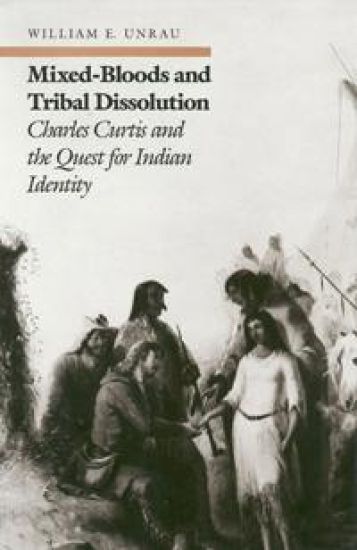
This book shows that without the cooperation of themixed-bloods, or part-Indians, dispossession of Indian lands by the U. S. government in the nineteenth and early twentieth centuries would have been much more difficult to accomplish. The relationship between the Metis and the loss of Indian lands, never before fully explored, is revealed in Unrau's study of Charles Curtis, a mixed-blood member of the Kansa-Kaws. Curtis is best remembered as Herbert Hoover's vice-president, but he also served in Congress for more than 30 years. A successful lawyer and Republican politician, Curtis had spent his early years on a reservation but grew up comfortably and fully integrated into the white world. By virtue of his celebrated status, he became the most important figure in the debate over federal Indian policy during the late nineteenth and early twentieth centuries. As the Indian expert in Congress, Curtis had significant power in formulating and carrying out the assimilationist program that had been instituted, particularly by the Dawes Act, in the 1880s. The strategy was to encourage reservation Indians to reject communal life and reap the rewards of individual enterprise. Central to these developments were questions of ownership, land claims, allotments, tribal inheritance laws, and what constituted the public domain. The underlying issues, however, were Indian identification and assimilation. The government's actions--affecting schools, the federal courts, Indian Office personnel, allotment and inheritance laws, mineral leases, and the absorption of the Indian Territory into the state of Oklahoma--all bore the mark of Curtis's hand.
The Kansa Indians

The Kansa Indians

William E. Unrau; H. Craig Miner; R. David Edmunds

University of Oklahoma Press
1986
nidottu
After their first contacts with whites in the seventeenth century, the Kansa Indians began migrating from the eastern United States to what is now eastern Kansas, by way of the Missouri Valley. Settling in villages mostly along the Kansas River, they led a semi-sedentary life, raising corn and a few vegetables and hunting buffalo in the spring and fall. It was an idyllic existence-until bad, and then worse, things began to happen. William E. Unrau tells how the Kansa Indians were reduced from a proud people with a strong cultural heritage to a remnant forced against their will to take up the whites' ways. He gives a balanced but hard-hitting account of an important and tragic chapter in American history.
The End of Indian Kansas

The End of Indian Kansas

H.Craig Miner; William E. Unrau

University Press of Kansas
1977
nidottu
When Kansas became a U. S. territory in 1854 literally all of its land area was guaranteed by treaty to Indians. More than 10,000 Kickapoos, Delawares, Sacs, Foxes, Shawnees, Potawatomis, Kansas, Ottawas, Wyandots, and Osages, not to mention a number of smaller tribes, inhabited Kansas. By 1875 there were only a couple of bands left. The forced removal of thousands of Indians from eastern Kansas between 1854 and 1871 affected more Indians and occupied more government time than the celebrated exploits of the military against the more warlike western tribes. In this volume Miner and Unrau show Kansas at mid-century to be a moral testing ground where the drama of Indian disinheritance was played out. They relate how railroad men, land speculators, and timber operations came to be firmly entrenched on Indian land in territorial Kansas. They examine remarkable incongruities in Indian policy, land policy, law, and administration, pointing to specific cases in which legal maneuvers by the federal government--within the framework of treaties, statutes, and executive pronouncements--helped to insure the pattern of tribal destruction. Separate chapters deal with internal factionalism in the Indian tribes, the practice of government chief-making, and the Indian Ring--the sub rosa alliances influencing the treaty or sale process. The authors also include revealing portraits of the individuals, from territorial governors to railroad officials, who helped engineer the end of Indian Kansas. The reader's perception of those brave, hard-working sod-house settlers may never be the same after reading this book.--American West.