Kirjojen hintavertailu – 12 859 819 kirjaa ja 27 kauppaa
Kirjailija
William Foote Whyte
Kirjat ja teokset yhdessä paikassa: 9 kirjaa, julkaisuja vuosilta 1975–2012, suosituimpiin kuuluu Street Corner Society. Vertaile teosten hintoja ja tarkista saatavuus suomalaisista kirjakaupoista.
Psychological Anthropology: Approaches to Culture and Personality is a comprehensive book written by Francis Lang Kwang Hsu that explores the relationship between culture and personality. The book provides a detailed analysis of how cultural norms, beliefs, and values shape individual behavior, emotions, and cognition. It also examines how personality traits, such as extraversion, neuroticism, and openness, are influenced by cultural factors. The book is divided into three parts. The first part introduces the basic concepts and theories of psychological anthropology, including the concept of culture, personality, and the relationship between the two. The second part focuses on specific cultural domains, such as kinship, gender, and religion, and how they influence personality development. The third part explores the applications of psychological anthropology in various fields, including education, health, and cross-cultural research. The author uses a wide range of case studies and examples from different cultures to illustrate the concepts and theories discussed in the book. The book is written in a clear and accessible style, making it suitable for students and scholars in psychology, anthropology, sociology, and related fields. It provides a valuable resource for anyone interested in understanding the complex interplay between culture and personality. Contributing Authors Include Edward Norbeck, George De Vos, Robert A. Levine, And Many Others. Dorsey Series In Anthropology And Sociology. This scarce antiquarian book is a facsimile reprint of the old original and may contain some imperfections such as library marks and notations. Because we believe this work is culturally important, we have made it available as part of our commitment for protecting, preserving, and promoting the world's literature in affordable, high quality, modern editions, that are true to their original work.
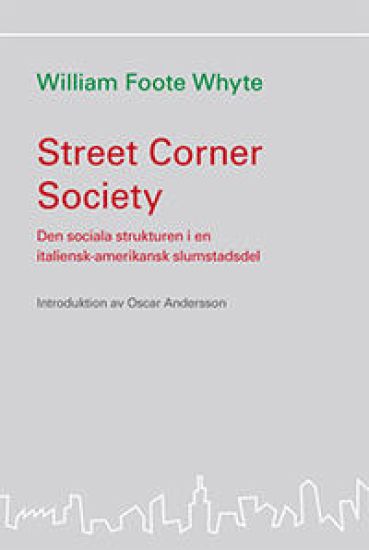
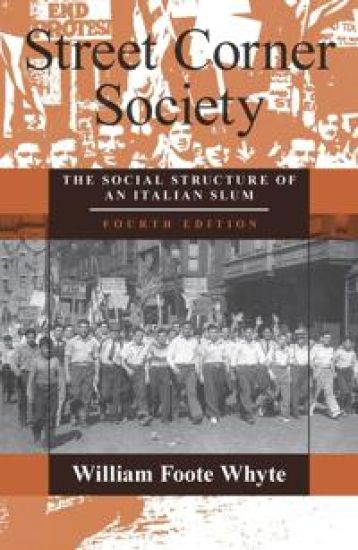
William Foote Whytes Street Corner Society från 1943 är en levande klassiker. Den handlar om socialt samspel, nätverk och vardagsliv bland unga män i den italiensk-amerikanska stadsdelen North End i Boston under 1930-talets depression. Whyte bodde själv i stadsdelen under åren 193640 och umgicks flitigt med de män, vilkas relationer och grupprocesser han studerade och som han fick kontakt med genom en person som han i boken kallar för Doc. Street Corner Society har inte minst varit ett föredöme för deltagande observation som sociologisk metod, och i den drygt 90 sidor långa bilaga A berättar författaren om hur han gick tillväga, vilka svårigheter han mötte och hur han hanterade dem. SCS känns fortfarande förvånansvärt aktuell trots att det är mer än 65 år sedan boken gavs ut för första gången. Det som tycks göra studien tidlös är att Whyte på ett nästintill oöverträffat sätt lyckas beskriva verkliga människors sociala världar i deras konkreta vardagliga sammanhang, skriver socialantropolog Oscar Andersson i sin utförliga introduktion. Street Corner Society har under årens lopp fått ständigt nya läsare men inte översatts till svenska förrän nu. Den svenska utgåvan baseras på Whytes egen utvidgade upplaga som gavs ut femtio år efter det att boken först publicerades. William Foote Whyte (19142000), lade fram Street Corner Society som sin doktorsavhandling i sociologi vid Chicagouniversitetet. Under större delen av sin akademiska karriär var han verksam vid School of Industrial and Labor Relations (ILR), Cornell University i USA. Under 1960-talet och därefter var han också involverad i omtalade forskningsprojekt i Peru och Mondragón i Baskien.
Street Corner Society is one of a handful of works that can justifiably be called classics of sociological research. William Foote Whyte's account of the Italian American slum he called "Cornerville"—Boston's North End—has been the model for urban ethnography for fifty years. By mapping the intricate social worlds of street gangs and "corner boys," Whyte was among the first to demonstrate that a poor community need not be socially disorganized. His writing set a standard for vivid portrayals of real people in real situations. And his frank discussion of his methodology—participant observation—has served as an essential casebook in field research for generations of students and scholars. This fiftieth anniversary edition includes a new preface and revisions to the methodological appendix. In a new section on the book's legacy, Whyte responds to recent challenges to the validity, interpretation, and uses of his data. "The Whyte Impact on the Underdog," the moving statement by a gang leader who became the author's first research assistant, is preserved." Street Corner Society broke new ground and set a standard for field research in American cities that remains a source of intellectual challenge."—Robert Washington, Reviews in Anthropology
This well-researched study should be read by anyone with an interest in worker cooperatives, community economic development, and work redesign programs.- Contemporary Sociology Since its founding in 1956 in Spain's Basque region, the MondragÓn Corporation has been a touchstone for the international cooperative movement. Its nearly three hundred companies and organizations span areas from finance to education. In its industrial sector MondragÓn has had a rich experience over many years in manufacturing products as varied as furniture, kitchen equipment, machine tools, and electronic components and in printing, shipbuilding, and metal smelting. Making MondragÓn is a groundbreaking look at the history of worker ownership in the Spanish cooperative. First published in 1988, it remains the best source for those looking to glean a rich body of ideas for potential adaptation and implementation elsewhere from MondragÓn's long and varied experience. This second edition, published in 1991, takes into account the major structural and strategic changes that were being implemented in 1990 to allow the enterprise to compete successfully in the European common market. MondragÓn has created social inventions and developed social structures and social processes that have enabled it to overcome some of the major obstacles faced by other worker cooperatives in the past. William Foote Whyte and Kathleen King Whyte describe the creation and evolution of the MondragÓn cooperatives, how they have changed through decades of experience, and how they have struggled to maintain a balance between their social commitments and economic realities. The lessons of MondragÓn apply most clearly to worker cooperatives and other employee-owned firms, but also extend to regional development and stimulating and supporting entrepreneurship, whatever the form of ownership.
Overall this volume should be valuable for readers . . . demonstrates the practical and theoretical advantages of incorporating participatory action research in the social science tool kit. --Agricultural Systems "I recommend this book for researchers, and I also suggest that it be considered seriously by persons grappling with philosophy of social issues." --Journal of Marketing Research "We have a book that deals with a potential revolution in the way organization science is done. . . . The last third of the book, dealing with PAR in agriculture, is of great value. . . . This is a formidable challenge for any of us to take on, but many useful and practical tips are scattered throughout the book, in chapters appropriately written by academics, managers, a union leader, and government administrators. Thus, the message of PAR is embodied in the structure of the book. It is a message we should heed." --Journal of Management "Provides a rich set of insights into the intricacies and challenges encountered in research in applied settings with an agenda toward action." --International Journal of Nursing Studies Participatory Action Research (PAR) is a powerful research tool that unites the work of researcher and client to improve both the topic researched and the research findings themselves. Yet, despite the fact that various forms of PAR have been practiced for decades, no single resource existed that detailed this practical research method. Now, in Participatory Action Research, a distinguished team of contributors takes you step-by-step through this research technique, from the initial design of a project, through data gathering and analysis, to final conclusions and actions arising out of the research. Contributors thoroughly outline the theory and methods behind PAR, weigh its strengths and weaknesses, then present a series of case studies taken both from organizational and agricultural settings. Organizational researchers and consultants, managers, sociologists, or anyone engaged in qualitative or applied research will find Participatory Action Research an invaluable tool.
There is increasing recognition, even among hard-nosed agricultural scientists, that progress in technology and in the scientific fields directly related to the growth of plants is necessary but not sufficient to produce major social and economic benefits. Agricultural scientists are therefore turning to behavioral scientists for advice and collaboration; they must search together for the solutions to problems of food shortages and rural development. Through an analysis of the procedures of agricultural extension agents, organizational frameworks. divisions of labor and social structures, William Foote Whyte proposes a reformulation of social theory that does not abandon humanistic values but requires us to examine the conditions and agencies for realization of these values by concentration upon the structural elements influencing behavior in agrarian societies. Only then can technological and agricultural innovations be introduced to rural areas with success.