Kirjojen hintavertailu – 12 903 725 kirjaa ja 27 kauppaa
Kirjailija
William G. McCallum
Kirjat ja teokset yhdessä paikassa: 18 kirjaa, julkaisuja vuosilta 2003–2022, suosituimpiin kuuluu Applied Calculus. Vertaile teosten hintoja ja tarkista saatavuus suomalaisista kirjakaupoista.
Deborah Hughes-Hallett; Patti Frazer Lock; Andrew M. Gleason; Daniel E. Flath; Sheldon P. Gordon; David O. Lomen; David Lovelock; William G. McCallum; Brad G. Osgood; Andrew Pasquale; Jeff Tecosky-Feldman; Joseph Thrash; Karen R. Rhea; Thomas W. Tucker
Hughes-Hallett Deborah; William G. McCallum; Gleason Andrew M.; Flath Daniel E.; Patti Frazer Lock; Gordon Sheldon P.; David O. Lomen; Lovelock David; Osgood Brad G.; Pasquale Andrew; Douglas Quinney; Tecosky-Feldman Jeff; Thrash Joseph; Karen R Rhea; Tucker Thomas W.
The Student Solutions Manual to CalculusCalculus teachers recognize this book as the leading resource among the reform projects that employ the rule of four and streamline the curriculum in order to deepen conceptual understanding. This edition uses all strands of the "Rule of Four" -- graphical, numeric, symbolic/algebraic, and verbal/applied presentations -- to make concepts easier to understand. The book focuses on exploring fundamental ideas rather than comprehensive coverage of multiple similar cases that are not fundamentally unique.
William G. McCallum; Hughes-Hallett Deborah; Gleason Andrew M.; David O. Lomen; Lovelock David; Tecosky-Feldman Jeff; Tucker Thomas W.; Flath Daniel E.; Thrash Joseph; Karen R Rhea; Pasquale Andrew; Gordon Sheldon P.; Douglas Quinney; Patti Frazer Lock
The Student Solutions Manual to CalculusCalculus teachers recognize this book as the leading resource among the reform projects that employ the rule of four and streamline the curriculum in order to deepen conceptual understanding. This edition uses all strands of the "Rule of Four" -- graphical, numeric, symbolic/algebraic, and verbal/applied presentations -- to make concepts easier to understand. The book focuses on exploring fundamental ideas rather than comprehensive coverage of multiple similar cases that are not fundamentally unique.
Hughes-Hallett Deborah; Gleason Andrew M.; William G. McCallum; Flath Daniel E.; Patti Frazer Lock; David O. Lomen; Lovelock David; Osgood Brad G.; Douglas Quinney; Karen R Rhea; Tecosky-Feldman Jeff; Tucker Thomas W.; Bretscher Otto K.; Gordon Sheldon P.; Pasquale Andrew; Thrash Joseph
Calculus teachers recognize Calculus as the leading resource among the "reform" projects that employ the rule of four and streamline the curriculum in order to deepen conceptual understanding. The Sixth Edition uses all strands of the 'Rule of Four' - graphical, numeric, symbolic/algebraic, and verbal/applied presentations - to make concepts easier to understand. The book focuses on exploring fundamental ideas rather than comprehensive coverage of multiple similar cases that are not fundamentally unique.
Deborah Hughes-Hallett; Patti Frazer Lock; Andrew M. Gleason; Daniel E. Flath; Sheldon P. Gordon; David O. Lomen; David Lovelock; William G. McCallum; Brad G. Osgood; Andrew Pasquale; Jeff Tecosky-Feldman; Joseph Thrash; Karen R. Rhea; Thomas W. Tucker
Calculus: Single and Multivariable, 7th Edition continues the effort to promote courses in which understanding and computation reinforce each other. The 7th Edition reflects the many voices of users at research universities, four-year colleges, community colleges, and secondary schools. This new edition has been streamlined to create a flexible approach to both theory and modeling. The program includes a variety of problems and examples from the physical, health, and biological sciences, engineering and economics; emphasizing the connection between calculus and other fields.
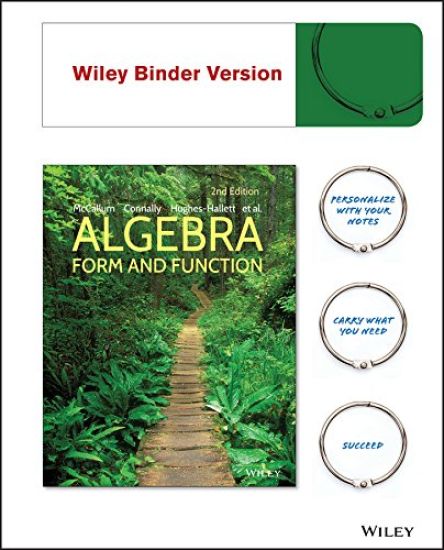
Algebra: Form and Function, 2nd Edition Binder Ready Version offers a fresh approach to algebra that focuses on teaching readers how to truly understand the principles, rather than viewing them merely as tools for other forms of mathematics. Meant for a College Algebra course, Algebra: Form and Function, 2nd Edition Binder Ready Version is an introduction to one of the fundamental aspects of modern society. Algebraic equations describe the laws of science, the principles of engineering, and the rules of business. The power of algebra lies in the efficient symbolic representation of complex ideas, which also presents the main difficulty in learning it. It is easy to forget the underlying structure of algebra and rely instead on a surface knowledge of algebraic manipulations. Most students rely on surface knowledge of algebraic manipulations without understanding the underlying structure of algebra that allows them to see patterns and apply it to multiple situations: McCallum focuses on the structure from the start. This is an unbound, binder-ready version.
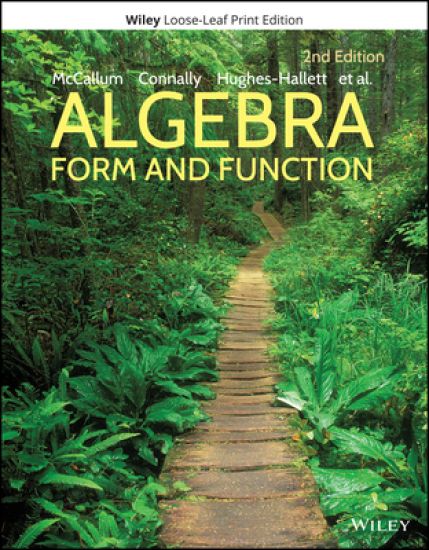
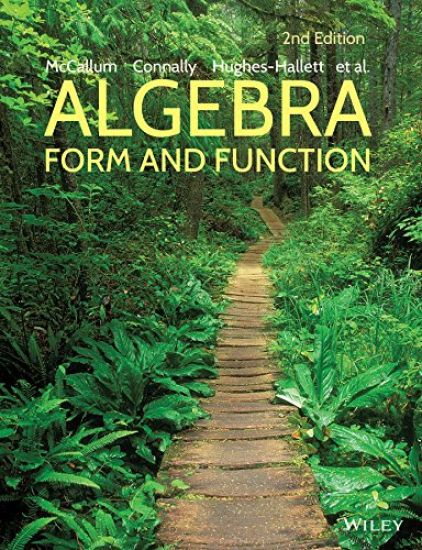
Algebra: Form and Function, 2nd Edition offers a fresh approach to algebra that focuses on teaching readers how to truly understand the principles, rather than viewing them merely as tools for other forms of mathematics. Meant for a College Algebra course, Algebra: Form and Function, 2nd Edition is an introduction to one of the fundamental aspects of modern society. Algebraic equations describe the laws of science, the principles of engineering, and the rules of business. The power of algebra lies in the efficient symbolic representation of complex ideas, which also presents the main difficulty in learning it. Most students rely on surface knowledge of algebraic manipulations without understanding the underlying structure of algebra that allows them to see patterns and apply it to multiple situations; McCallum focuses on the structure from the start.
Algebra: Form and Function, 2nd Edition offers a fresh approach to algebra that focuses on teaching readers how to truly understand the principles, rather than viewing them merely as tools for other forms of mathematics. Meant for a College Algebra course, Algebra: Form and Function, 2nd Edition is an introduction to one of the fundamental aspects of modern society. Algebraic equations describe the laws of science, the principles of engineering, and the rules of business. The power of algebra lies in the efficient symbolic representation of complex ideas, which also presents the main difficulty in learning it. It is easy to forget the underlying structure of algebra and rely instead on a surface knowledge of algebraic manipulations. Most students rely on surface knowledge of algebraic manipulations without understanding the underlying structure of algebra that allows them to see patterns and apply it to multiple situations: McCallum focuses on the structure from the start.
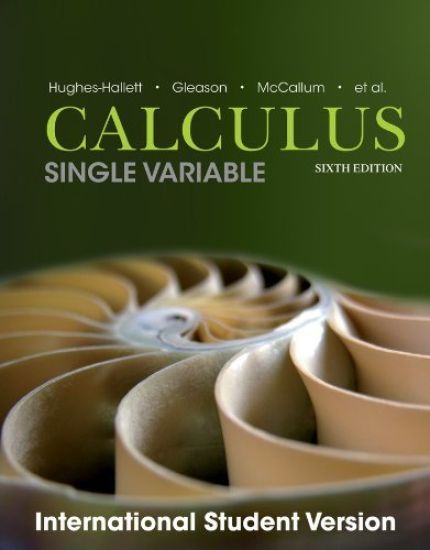
This Sixth Edition of Calculus continues the effort to promote courses in which understanding and computation reinforce each other. Calculus: Single Variable 6th Edition reflects the many voices of users at research universities, four-year colleges, community colleges, and secondary schools. This new edition has been streamlined to create a flexible approach to both theory and modeling. For instructors wishing to emphasize the connection between calculus and other fields, the text includes a variety of problems and examples from the physical, health, and biological sciences, engineering and economics. In addition, new problems on the mathematics of sustainability and new case studies on calculus in medicine by David E. Sloane, MD have been added.
This Sixth Edition of Calculus continues the effort to promote courses in which understanding and computation reinforce each other. Calculus: Multivariable 6th Edition reflects the many voices of users at research universities, four-year colleges, community colleges, and secondary schools. This new edition has been streamlined to create a flexible approach to both theory and modeling. For instructors wishing to emphasize the connection between calculus and other fields, the text includes a variety of problems and examples from the physical, health, and biological sciences, engineering and economics. In addition, new problems on the mathematics of sustainability and new case studies on calculus in medicine by David E. Sloane, MD have been added.
Chapter 1. A Library of Functions Chapter 2. Key Concept: The Derivative Chapter 3. Short–Cuts to Differentiation Chapter 4. Using the Derivative Chapter 5. Key Concept: The Definite Integral Chapter 6. Constructing Antiderivatives Chapter 7. Integration Chapter 8. Using the Definite Integral Chapter 9. Series Chapter 10. Approximating Functions Chapter 11. Differential Equations Appendices Calculus Easy Reference
Chapter 1. A Library of Functions Chapter 2. Key Concept: The Derivative Chapter 3. Short–Cuts to Differentiation Chapter 4. Using the Derivative Chapter 5. Key Concept: The Definite Integral Chapter 6. Constructing Antiderivatives Chapter 7. Integration Chapter 8. Using the Definite Integral Chapter 9. Series Chapter 10. Approximating Functions Chapter 11. Differential Equations Chapter 12. Functions of Several Variables Chapter 13. A Fundamental Tool: Vectors Chapter 14. Differentiating Functions of Many Variables Chapter 15. Optimization: Local and Global Extrema Chapter 16. Integrating Functions of Many Variables Chapter 17. Parameterized Curves and Vector Fields Chapter 18. Line Integrals Chapter 19. Flux Integrals Chapter 20. Calculus of Vector Fields Appendices Calculus Easy Reference