Kirjojen hintavertailu – 12 859 829 kirjaa ja 27 kauppaa

Kirjailija

William H. Sewell

Kirjat ja teokset yhdessä paikassa: 4 kirjaa, julkaisuja vuosilta 1994–2001, suosituimpiin kuuluu Silence and Voice in the Study of Contentious Politics. Vertaile teosten hintoja ja tarkista saatavuus suomalaisista kirjakaupoista.

Nimi esiintyy myös muodoissa: William H Sewell

4 kirjaa

Kirjojen julkaisuvuodet: 1994–2001.

Silence and Voice in the Study of Contentious Politics

Silence and Voice in the Study of Contentious Politics

Ronald R. Aminzade; Jack A. Goldstone; Doug McAdam; Elizabeth J. Perry; William H. Sewell; Sidney Tarrow; Charles Tilley

Cambridge University Press
2001
pokkari
The aim of this book is to highlight and begin to give ‘voice’ to some of the notable ‘silences’ evident in recent years in the study of contentious politics. The seven co-authors take up seven specific topics in the volume: the relationship between emotions and contention; temporality in the study of contention; the spatial dimensions of contention; leadership in contention; the role of threat in contention; religion and contention; and contention in the context of demographic and life-course processes. The seven spent three years involved in an ongoing project designed to take stock, and attempt a partial synthesis, of various literatures that have grown up around the study of non-routine or contentious politics. As such, it is likely to be viewed as a groundbreaking volume that not only undermines conventional disciplinary understanding of contentious politics, but also lays out a number of provocative new research agendas.
Silence and Voice in the Study of Contentious Politics

Silence and Voice in the Study of Contentious Politics

Ronald R. Aminzade; Jack A. Goldstone; Doug McAdam; Elizabeth J. Perry; William H. Sewell; Sidney Tarrow; Charles Tilley

Cambridge University Press
2001
sidottu
The aim of this book is to highlight and begin to give 'voice' to some of the notable 'silences' evident in recent years in the study of contentious politics. The seven co-authors take up seven specific topics in the volume: the relationship between emotions and contention; temporality in the study of contention; the spatial dimensions of contention; leadership in contention; the role of threat in contention; religion and contention; and contention in the context of demographic and life-course processes. The seven spent three years involved in an ongoing project designed to take stock, and attempt a partial synthesis, of various literatures that have grown up around the study of non-routine or contentious politics. As such, it is likely to be viewed as a groundbreaking volume that not only undermines conventional disciplinary understanding of contentious politics, but also lays out a number of provocative new research agendas.
A Rhetoric of Bourgeois Revolution

A Rhetoric of Bourgeois Revolution

William H Sewell

Duke University Press
1994
pokkari
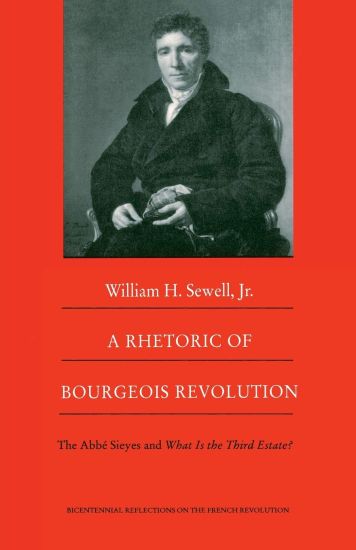
What Is the Third Estate? was the most influential pamphlet of 1789. It did much to set the French Revolution on a radically democratic course. It also launched its author, the AbbÉ Sieyes, on a remarkable political career that spanned the entire revolutionary decade. Sieyes both opened the revolution by authoring the National Assembly’s declaration of sovereignty in June of 1789 and closed it in 1799 by engineering Napoleon Bonaparte’s coup d’État. This book studies the powerful rhetoric of the great pamphlet and the brilliant but enigmatic thought of its author. William H. Sewell’s insightful analysis reveals the fundamental role played by the new discourse of political economy in Sieyes’s thought and uncovers the strategies by which this gifted rhetorician gained the assent of his intended readers-educated and prosperous bourgeois who felt excluded by the nobility in the hierarchical social order of the old regime. He also probes the contradictions and incoherencies of the pamphlet’s highly polished text to reveal fissures that reach to the core of Sieyes’s thought-and to the core of the revolutionary project itself. Combining techniques of intellectual history and literary analysis with a deep understanding of French social and political history, Sewell not only fashions an illuminating portrait of a crucial political document, but outlines a fresh perspective on the history of revolutionary political culture.
A Rhetoric of Bourgeois Revolution

A Rhetoric of Bourgeois Revolution

William H Sewell

Duke University Press
1994
sidottu
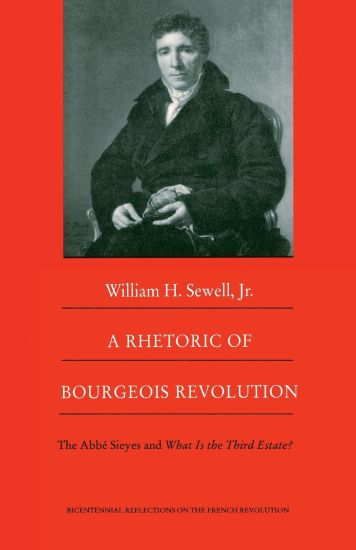
What Is the Third Estate? was the most influential pamphlet of 1789. It did much to set the French Revolution on a radically democratic course. It also launched its author, the AbbÉ Sieyes, on a remarkable political career that spanned the entire revolutionary decade. Sieyes both opened the revolution by authoring the National Assembly’s declaration of sovereignty in June of 1789 and closed it in 1799 by engineering Napoleon Bonaparte’s coup d’État. This book studies the powerful rhetoric of the great pamphlet and the brilliant but enigmatic thought of its author. William H. Sewell’s insightful analysis reveals the fundamental role played by the new discourse of political economy in Sieyes’s thought and uncovers the strategies by which this gifted rhetorician gained the assent of his intended readers-educated and prosperous bourgeois who felt excluded by the nobility in the hierarchical social order of the old regime. He also probes the contradictions and incoherencies of the pamphlet’s highly polished text to reveal fissures that reach to the core of Sieyes’s thought-and to the core of the revolutionary project itself. Combining techniques of intellectual history and literary analysis with a deep understanding of French social and political history, Sewell not only fashions an illuminating portrait of a crucial political document, but outlines a fresh perspective on the history of revolutionary political culture.