Kirjojen hintavertailu – 12 903 725 kirjaa ja 27 kauppaa
Kirjailija
William Kingdon Clifford
Kirjat ja teokset yhdessä paikassa: 45 kirjaa, julkaisuja vuosilta 1896–2025, suosituimpiin kuuluu The Ethics of Belief and Other Essays. Vertaile teosten hintoja ja tarkista saatavuus suomalaisista kirjakaupoista.
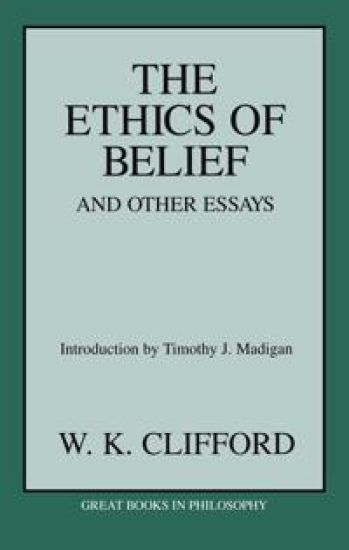
"It is wrong always, everywhere, and for anyone, to believe anything upon insufficient evidence." -- W. K. Clifford The above forthright assertion of mathematician and educator W. K. Clifford (1845-1879) in his famous essay "The Ethics of Belief" drew an immediate response from Victorian-era critics, who took issue with his reasoned and brilliantly presented attack on beliefs "not founded on fair inquiry." An advocate of evolutionary theory, Clifford recognized that working hypotheses and assumptions are necessary for belief formation and that testing and assessing one's beliefs in light of new evidence strengthens those worthy of being held. "The Ethics of Belief" is presented here in complete form, along with an insightful biographical introduction by editor Timothy J. Madigan. Also included are four other noteworthy essays by Clifford: "On the Aims and Instruments of Scientific Thought," "Right and Wrong," "The Ethics of Religion," and "The Influence upon Morality of a Decline in Religious Belief."
William Kingdon Clifford's excellent treatise The Ethics of Belief is in this edition united with The Will to Believe; the spirited response by William James. This book brings together the two essays which comprise the famous philosophical exchange between the mathematician William Kingdon Clifford and William James, a psychologist and philosopher. Famous for articulating the arguments and morality surrounding belief, these two papers are united in a single compact edition for the consideration and study of the reader. The chief difference in opinion between Clifford and James, surrounds the matter of evidence. Clifford argued that belief in anything without supporting evidence is folly; individuals should hold an intellectual duty as well as a moral duty in what they believe. Wishful thinking, supposition, assumptions, or blind faith are therefore unacceptable and can act to damage one's intellect and ability to reason. William James, in opposition to Clifford's view, states that the formation of beliefs is justifiable. He uses the athlete as one example; self-belief in one's abilities or capacity for achievement can provision a psychological edge that results in such beliefs being realized. James then proceeds to outline a number of conditions which seek to justify the phenomena of religious belief as an intellectual and moral occurrence. That the issue of whether God exists is intellectually undecidable is central to James's thesis: a person can, without impinging on their intellect or morals, choose to believe or not to believe in a deity. Both Clifford and James draw upon the established epistemic norms of philosophy, these being the principles which seekers of knowledge and truth should hold when acquiring a belief. Their exchange served to refine the norms in scholarly circles, ushering in a renewed and sustained interest in belief morality. A total of almost two decades elapsed between Clifford and James papers, and Clifford himself died in 1879. However the succinctness of James' reply - which acts as an effective summary for the arguments within many of his lengthier works - brought both his paper and the paper of Clifford to prominence in academic circles.