Kirjojen hintavertailu – 12 859 829 kirjaa ja 27 kauppaa

Kirjailija

William Lazonick

Kirjat ja teokset yhdessä paikassa: 9 kirjaa, julkaisuja vuosilta 1992–2025, suosituimpiin kuuluu Approaches to Sustainable Development. Vertaile teosten hintoja ja tarkista saatavuus suomalaisista kirjakaupoista.

9 kirjaa

Kirjojen julkaisuvuodet: 1992–2025.

Innovation versus Financialization in the US Pharmaceutical Industry

Innovation versus Financialization in the US Pharmaceutical Industry

Öner Tulum; William Lazonick

Cambridge University Press
2025
sidottu
Mandated by the Inflation Reduction Act of 2022, the US government is negotiating with pharmaceutical companies over the 'maximum fair price' of ten drugs widely used by Medicare patients. The pharmaceutical companies contend that a 'fair' price is a 'value-based price' that enables their shareholders to capture the value the drug creates for society and warn that lowering drug prices will reduce investments in new drugs. This Element responds to these arguments by showing that pharmaceutical companies (a) should have their drug prices regulated, given scale economies in supplying drugs and price inelasticity of drug demand; (b) use their profits from unregulated drug prices to distribute cash dividends and stock buybacks to shareholders; (c) do not typically rely upon investment by shareholders to fund drug innovation; and (d) benefit from 'collective and cumulative learning' in foundational and translational research that is antecedent and external to their investments in clinical research.

Innovation versus Financialization in the US Pharmaceutical Industry

Innovation versus Financialization in the US Pharmaceutical Industry

Öner Tulum; William Lazonick

Cambridge University Press
2025
pokkari
Mandated by the Inflation Reduction Act of 2022, the US government is negotiating with pharmaceutical companies over the 'maximum fair price' of ten drugs widely used by Medicare patients. The pharmaceutical companies contend that a 'fair' price is a 'value-based price' that enables their shareholders to capture the value the drug creates for society and warn that lowering drug prices will reduce investments in new drugs. This Element responds to these arguments by showing that pharmaceutical companies (a) should have their drug prices regulated, given scale economies in supplying drugs and price inelasticity of drug demand; (b) use their profits from unregulated drug prices to distribute cash dividends and stock buybacks to shareholders; (c) do not typically rely upon investment by shareholders to fund drug innovation; and (d) benefit from 'collective and cumulative learning' in foundational and translational research that is antecedent and external to their investments in clinical research.
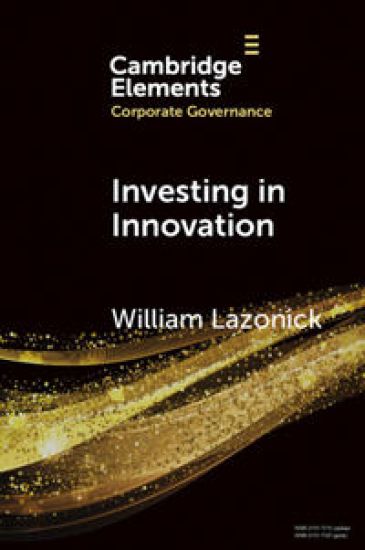
Investing in Innovation

Investing in Innovation

William Lazonick

Cambridge University Press
2023
pokkari
Business corporations interact with household units and government agencies to make investments in productive capabilities required to generate innovative goods and services. When they work harmoniously, these three types of organizations constitute 'the investment triad'. The Biden administration's Build Back Better agenda to restore sustainable prosperity in the United States has focused on investment in productive capabilities by government agencies and household units. Largely absent from the Biden agenda have been policy initiatives to ensure that, given government and household investment in productive capabilities, the governance of major U. S. business corporations supports investment in innovation. This Element explains how corporate financialization, manifested by predatory value extraction in the name of 'maximizing shareholder value', undermines investment in innovation in the United States. It concludes by outlining a policy framework, beginning with a ban on stock buybacks, that confronts predatory value extraction and puts in place social institutions that support sustainable prosperity.
From Financialisation to Innovation in UK Big Pharma

From Financialisation to Innovation in UK Big Pharma

Öner Tulum; Antonio Andreoni; William Lazonick

Cambridge University Press
2022
pokkari
The tension between innovation and financialisation is central to the business corporation. Innovation entails a 'retain-and-reinvest' allocation regime that can form a foundation for stable and equitable economic growth. Driven by shareholder-value ideology, financialisation entails a shift to 'downsize-and-distribute'. This Element investigates this tension in global pharmaceuticals, focusing on the two leading UK companies AstraZeneca and GlaxoSmithKline. In the 2000s both adopted US-style governance, including stock buybacks and stock-based executive pay. Over the past decade, however, first AstraZeneca and then GlaxoSmithKline transitioned to innovation. Critical was the cessation of buybacks to refocus capabilities on investing in an innovative drugs pipeline. Enabling this shift were UK corporate-governance institutions that mitigated US-style shareholder-value maximisation. Reinventing capitalism for the sake of stable and equitable economic growth means eliminating value destruction caused by financialisation and supporting value creation through collective and cumulative innovation. This title is also available as Open Access on Cambridge Core.
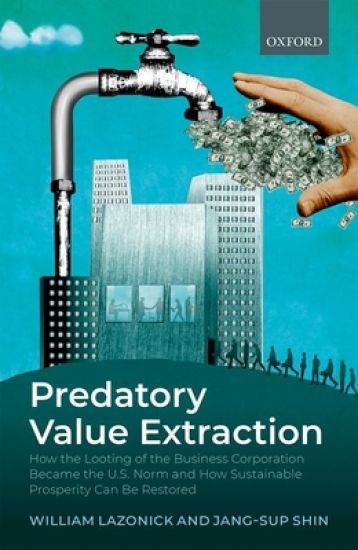
Predatory Value Extraction

Predatory Value Extraction

William Lazonick; Jang-Sup Shin

Oxford University Press
2019
sidottu
Predatory Value Extraction explains how an ideology of corporate resource allocation known as 'maximizing shareholder value' (MSV) that emerged in the 1980s came to dominate strategic thinking in business schools and corporate boardrooms in the United States. Undermining the social foundations of sustainable prosperity, it resulted in employment instability, income inequity, and slow productivity growth. In explaining what happened to sustainable prosperity, William Lazonick and Jang-Sup Shin focus on the growing imbalance between value creation and value extraction in the U. S. economy, and the corporate-governance institutions that determine this balance in the nation's major business corporations. The imbalance has become so extreme that predatory value extraction is now a central economic activity, to the point at which the U. S. economy as a whole can be aptly described as a value-extracting economy. Balancing the contributions of economic actors to value creation with their power to extract value provides the foundation for stable and equitable economic growth. When certain economic actors are able to assert their power to extract far more value than they contribute to the value-creation process, an imbalance occurs which, when extreme, leads to dire economic, political, and social consequences. This book not only explores these consequences, but also sets out an agenda for restoring sustainable prosperity.
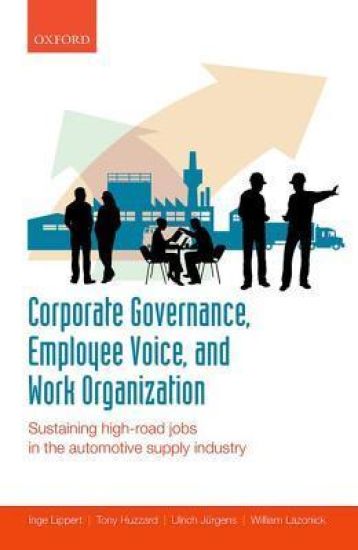
Corporate Governance, Employee Voice, and Work Organization

Corporate Governance, Employee Voice, and Work Organization

Inge Lippert; Tony Huzzard; Ulrich Jürgens; William Lazonick

Oxford University Press
2014
sidottu
Corporate Governance, Employee Voice, and Work Organization explores the dynamic relations between corporate governance, employee voice, and the organization of work in the automotive supply industry. It reports on research undertaken in three countries--Germany, Sweden, and the United States--that has sought to explore and compare historical patterns of the relationships between changing governance regimes, voice, and work at plant level in an era of financialization. It also explores the prospects for high-road, sustainable jobs in the sector. Three detailed case histories from each of the countries are presented which contrast companies facing three different levels of exposure to capital markets: companies relatively sheltered from stock markets; companies that are highly exposed to them; and thirdly companies owned by private equity firms. This design allows for analysis not just across different national contexts but also within them, and questions the usefulness of the 'varieties of capitalism' appraoch in understanding these differences. The cases show that governance compromises matter, that is, that recognising the role of employee voice in corporate governance regimes is essential in any comparative analysis and understanding of corporate governance.
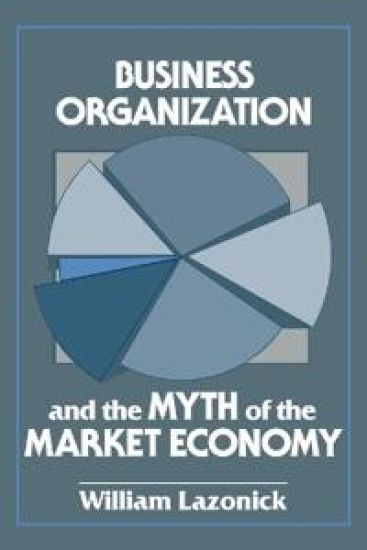
Business Organization and the Myth of the Market Economy

Business Organization and the Myth of the Market Economy

William Lazonick

Cambridge University Press
1993
pokkari
This book explains the transitions in twentieth-century industrial leadership from Britain to the United States and, most recently, to Japan, in terms of the changing business investment strategies and organizational structures in these nations. The author criticizes economists for failing to understand these historical changes. The book shows that this intellectual failure is not inherent in the discipline of economics; there are important traditions in economic thought that the mainstream of the economics profession has simply ignored.
Organization and Technology in Capitalist Development

Organization and Technology in Capitalist Development

William Lazonick

Edward Elgar Publishing Ltd
1992
sidottu
For more than 20 years, William Lazonick has been one of the world's leading analysts of the dynamics of industrial development and change in international economic leadership. This impressive volume presents a coherent selection of Professor Lazonick's most important work on industrial development in Britain and the United States. The first part of the book contains articles on the decline of the British economy, including a recent summary of the debates on the British cotton textile industry and international competition. The second part focuses on labour, management and technology in the rise and recent decline of the US economy, and includes an up-to-date summary essay on organizational capabilities in American industry. Professor Lazonick's essays make historical analysis relevant to the present and put economic analysis back in touch with evolving reality. This approach, together with his unique combination of historical, statistical and theoretical methodologies, will ensure that this volume proves invaluable to economists and historians alike.