Kirjojen hintavertailu – 12 903 725 kirjaa ja 27 kauppaa

Kirjailija

William Lee Miller

Kirjat ja teokset yhdessä paikassa: 6 kirjaa, julkaisuja vuosilta 1993–2013, suosituimpiin kuuluu Two Americans: Truman, Eisenhower and a Dangerous World. Vertaile teosten hintoja ja tarkista saatavuus suomalaisista kirjakaupoista.

6 kirjaa

Kirjojen julkaisuvuodet: 1993–2013.

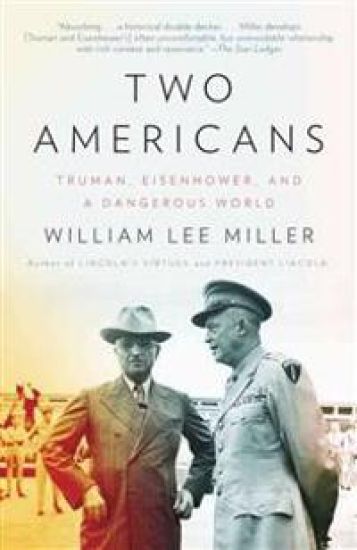
Two Americans: Truman, Eisenhower and a Dangerous World

Two Americans: Truman, Eisenhower and a Dangerous World

William Lee Miller

Knopf Doubleday Publishing Group
2013
nidottu
From William Lee Miller, the highly regarded biographer of Abraham Lincoln, a riveting dual examination of Harry Truman and Dwight Eisenhower that explores the similarities and equally striking differences of two remarkable men in the context of mid-twentieth-century American culture and politics. Two Americans weaves together the life stories of Truman and Eisenhower, showing how these future presidents, born six years apart from each other in small farming towns, were emblematic of their Midwestern upbringings and their generation. Miller also shows how their markedly different life experiences during World War I and between the world wars would shape their choices and the roles they played in the politics of the time, as Truman became the quintessential politician, and Eisenhower, the thoroughgoing anti-politician. Their personalities come alive in vividly described scenes of their collaboration during the war-torn 1940s; their dual, but different, roles in bringing the war to an end and shaping the postwar world; their growing disapproval of each other; and, finally, in 1952, the hostile bickering and maneuvering that characterized the passing of presidential power from one to the other.
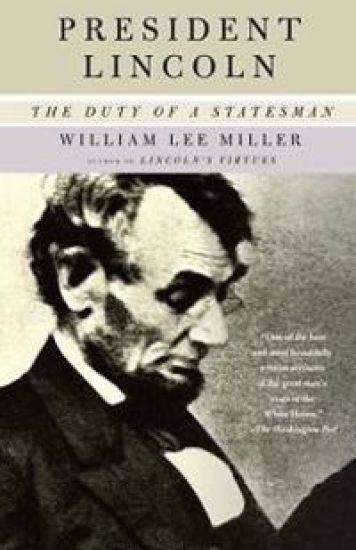
President Lincoln: The Duty of a Statesman
In his acclaimed book Lincoln's Virtues, William Lee Miller explored Abraham Lincoln's intellectual and moral development. Now he completes his "ethical biography," showing how the amiable and inexperienced backcountry politician was transformed by constitutional alchemy into an oath-bound head of state. Faced with a radical moral contradiction left by the nation's Founders, Lincoln struggled to find a balance between the universal ideals of Equality and Liberty and the monstrous injustice of human slavery. With wit and penetrating sensitivity, Miller brings together the great themes that have become Lincoln's legacy--preserving the United States of America while ending the odious institution that corrupted the nation's meaning--and illuminates his remarkable presidential combination: indomitable resolve and supreme magnanimity.
The First Liberty

The First Liberty

William Lee Miller

Georgetown University Press
2003
sidottu
At a time when the concept of religion-based politics has taken on new and sometimes ominous tones-even within the United States-it is not only right, but also urgently necessary that William Lee Miller revisit his profound exploration of the place of religious liberty and church and state in America. For this revised edition of The First Liberty, Miller has written a pointed new introduction, discussing how religious liberty has taken on deeper dimensions in a post-9/11 world. With new material on recent Supreme Court cases involving church-state relations and a new concluding chapter on America's religious and political landscape, this volume is an eloquent and thorough interpretation of how religious faith and political freedom have blended and fused to form part of our collective history-and most importantly, how each concept must respect the boundaries of the other. Though many claim the United States to be a "Christian Nation," Miller provides a fascinatingly vivid account of the philosophical skirmishes and political machinations that led to the "wall of separation" between church and state. That famous phrase is Jefferson's, though it does not appear in the Declaration of Independence nor in the Constitution. But Miller follows this seminal idea from three great standard-bearers of religious liberty: Jefferson, Madison, and Roger Williams. Jefferson, who wrote the Virginia Statute for Religious Freedom, the precursor of the First Amendment of the Constitution; James Madison, who was politically responsible for Virginia's acceptance of religious liberty and who, a few years later, helped draft the Bill of Rights; and the even earlier figure, the radical dissenter Roger Williams, who propounded the idea of religious freedom not as a rational secularist but out of a deeply held spiritual faith. Miller re-creates the fierce and vibrant debate among the founding fathers over the means of establishing public virtue in the absence of established religion-a debate that still reverberates in today's passionate arguments about civil rights, school prayer, abortion, Christmas creches, conscientious objection during warfare-and demonstrates how the right to hold *any* religious belief has dynamically shaped American political life.
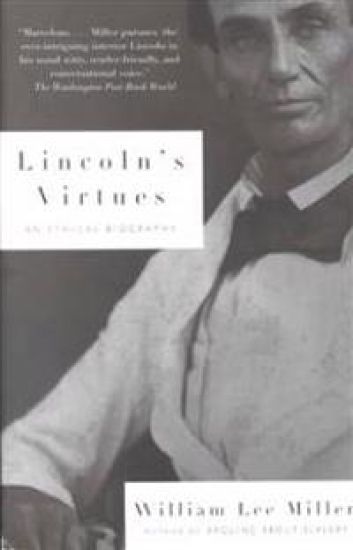
Lincoln's Virtues: An Ethical Biography

Lincoln's Virtues: An Ethical Biography

William Lee Miller

Knopf Doubleday Publishing Group
2003
nidottu

Halvin toimitettuna 25,40 €

William Lee Miller's ethical biography is a fresh, engaging telling of the story of Lincoln's rise to power. Through careful scrutiny of Lincoln's actions, speeches, and writings, and of accounts from those who knew him, Miller gives us insight into the moral development of a great politician -- one who made the choice to go into politics, and ultimately realized that vocation's fullest moral possibilities. As Lincoln's Virtues makes refreshingly clear, Lincoln was not born with his face on Mount Rushmore; he was an actual human being making choices -- moral choices -- in a real world. In an account animated by wit and humor, Miller follows this unschooled frontier politician's rise, showing that the higher he went and the greater his power, the worthier his conduct would become. He would become that rare bird, a great man who was also a good man. Uniquely revealing of its subject's heart and mind, it represents a major contribution to our understanding and of Lincoln, and to the perennial American discussion of the relationship between politics and morality.