Kirjojen hintavertailu – 12 859 819 kirjaa ja 27 kauppaa

Kirjailija

William S. Saunders

Kirjat ja teokset yhdessä paikassa: 3 kirjaa, julkaisuja vuosilta 2005–2016, suosituimpiin kuuluu Commodification and Spectacle in Architecture. Vertaile teosten hintoja ja tarkista saatavuus suomalaisista kirjakaupoista.

3 kirjaa

Kirjojen julkaisuvuodet: 2005–2016.

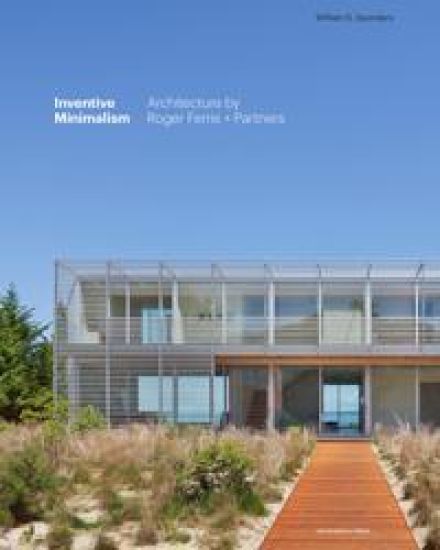
Inventive Minimalism

Inventive Minimalism

William S. Saunders; Roger Ferris; Robert M. Rubin; Robert Wilson

Monacelli Press
2016
sidottu
As rigorous as it is sumptuous, the work of Roger Ferris + Partners blends high style and modernist principles. This is the firm's first monograph. From family houses to historic restorations, hotels, and high-tech office spaces - the architectural firm of Roger Ferris + Partners has pursued uncommonly diverse projects at vastly different scales, all with an approach to design that synthesizes imagination and logic. Whether a 1,500-square-foot house on a narrow lot overlooking Long Island Sound, or the Royal Bank of Scotland’s US headquarters in Stamford, Connecticut - with a six-story glazed atrium and a “courtyard in the sky” on the roof of its two-story trading floor - a building that is “well conceived and artfully executed, cannot help but be beautiful.” Among Ferris’ major projects are a golf clubhouse that has turned a conservative typology on its ear with bladelike forms inspired by a racing engine turbine, and a partially sunken service entrance in which impresario Robert Wilson has staged theatrical productions. A design for a restaurant includes not only a central, glass-enclosed kitchen elevated 18 inches above the floor, but an art installation that periodically projects scrolling text on the dining room wall. In every project, the fulfillment of the client’s functional needs is rendered in the most elemental and legible way, resulting in both formal elegance and dramatic power.
Urban Planning Today

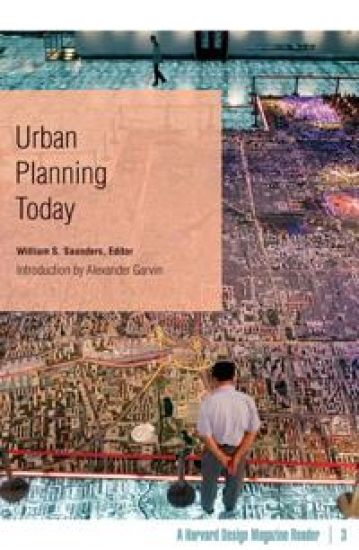
Urban Planning Today

William S. Saunders

University of Minnesota Press
2006
nidottu
American cities' penchants for single-use zoning and free-market development in pursuit of economic growth have produced problems that have long been recognized: grueling commutes and dependency on automobiles, social isolation, expensive public infrastructure, needless destruction of countryside. Eminent domain disputes rage on, despite recent Supreme Court decisions. Outdated public housing and failed single-function projects litter the landscape. Addressing these urgent problems and debating the public's role in urban planning, the contributors to Urban Planning Today report on real projects in Atlanta, Boston, Chicago, New York, Omaha, Portland, and Vancouver. They bring varying, and sometimes divergent, perspectives from backgrounds in urban design and development, city and regional planning, criticism, and law to bear on the mixed bag of results observed in these cities. Noting the increasing influence of local nonprofit developers—such as Bridge Housing in San Francisco and Phipps Houses Group, Community Preservation Corporation, and NYC2012 in New York—as well as national organizations, the contributors also imagine clear and effective roles for government leaders. By creating a dialogue of cities' planning successes and failures, this book illustrates that adopting a single model universally will not work and that effective planning must indisputably demonstrate that any public action and private market reaction will be in the local community's interest—physically, functionally, financially, politically, aesthetically, and spiritually. Contributors: Jonathan Barnett, Lynn Becker, Peter Calthorpe, Susan Fainstein, Bent Flyvbjerg, John Kaliski, Jerold Kayden, Matthew J. Kiefer, Hubert Murray, Richard Plunz, Leonie Sandercock, Michael Sheridan. William S. Saunders is editor of Harvard Design Magazine and the books Commodification and Spectacle in Architecture and Sprawl and Suburbia, both from Minnesota. He is assistant dean for external relations at the Harvard Design School, and author of Modern Architecture: Photographs by Ezra Stoller. Alexander Garvin is president and CEO of Alex Garvin & Associates Inc. and adjunct professor of urban planning and management at Yale University.
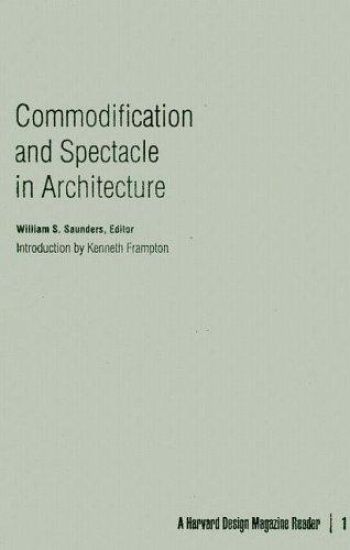
Commodification and Spectacle in Architecture

Commodification and Spectacle in Architecture

William S. Saunders

University of Minnesota Press
2005
sidottu
Presents diverse points of view on the relationship between design and capitalism. Volume 1 of the "Harvard Design Magazine Readers", a new series drawn from the pages of "Harvard Design Magazine" featuring prominent thinkers, writers, and photographers in international architecture and design today. More than ever, architectural design is seen as a means to promote commercial goals rather than as an end in itself. Frank Gehry's Guggenheim Museum in Bilbao, for example, simply cannot be considered apart from its intended role as a catalyst for the economic revitalization of Bilbao and its ability to attract tourist dollars, regardless of its architectural merits. A built environment intended to seduce consumers is more likely to offer instant gratification than to invite independent thought and reflection. But how harmful, if at all, is this unprecedented commercialization of architecture? Framed with a provocative introduction by Kenneth Frampton, the contributions to "Commodification and Spectacle in Architecture" stake out a variety of positions in the debate over the extent to which it is possible - or desirable - to escape from, resist, or suggest plausible alternatives to the dominant culture of consumer capitalism. Rejecting any dreamy nostalgia for an idealized present or past in which design is completely divorced from commerce - and, in some cases, celebrating the pleasures of spectacle - the individual essays range from indictments of particular architects and critiques of the profession to broader concerns about what the phenomenon of commodification means for the practice of democracy and the health of society. Bringing together an impressive and varied group of critics and practitioners, "Commodification and Spectacle in Architecture" will help to sharpen the discussion of how design can respond to our hyper-commodified culture.