Kirjailija
William Shakespeare
Kirjat ja teokset yhdessä paikassa: 4 976 kirjaa, julkaisuja vuosilta 1798–2027, suosituimpiin kuuluu Hamlet. Vertaile teosten hintoja ja tarkista saatavuus suomalaisista kirjakaupoista.
4 976 kirjaa
Kirjojen julkaisuvuodet: 1798–2027.
William Shakespeare: K nig Heinrich V. Lesefreundlicher Gro druck in 16-pt-Schrift Gro format, 210 x 297 mm Berliner Ausgabe, 2020 Durchgesehener Neusatz bearbeitet und eingerichtet von Theodor Borken Erstmals ins Deutsche bersetzt von Johann Joachim Eschenburg (1776). Die vorliegende bersetzung stammt von August Wilhelm Schlegel. Erstdruck in: Shakspeare's dramatische Werke. bersetzt von August Wilhelm Schlegel, Bd. 7, Berlin (Johann Friedrich Unger) 1801. Textgrundlage ist die Ausgabe: William Shakespeare: S mtliche Werke in vier B nden. Band 3, Herausgegeben von Anselm Schl sser. Berlin: Aufbau, 1975. Umschlaggestaltung von Thomas Schultz-Overhage unter Verwendung des Bildes: Henry Fuseli, Heinrich V. entdeckt die Verschw rer, 1780. Gesetzt aus der Minion Pro, 16 pt. Henricus Edition Deutsche Klassik UG (haftungsbeschr nkt)

The authoritative edition of King John from The Folger Shakespeare Library, the trusted and widely used Shakespeare series for students and general readers. Like most of Shakespeare's history plays, King John presents a struggle for the English crown. The struggle this time, however, is strikingly cold-blooded and brutal. John, the younger brother of the late Richard I, is the king, and a savage one. His opponent is a boy, his nephew Arthur, supported by the King of France and the Duke of Austria. After Arthur falls into John's hands, John plots to torture him. Arthur's capture gives Louis, the Dauphin of France, the opportunity to lay claim to John's crown. John's nobles support Louis, but he schemes to betray them. The play finds its hero in another figure: the Bastard, Sir Richard Plantagenet, an illegitimate son of Richard I. Although he has an appetite for war, he also has a strong conscience and speaks with trenchant irony. This edition includes: -Freshly edited text based on the best early printed version of the play -Full explanatory notes conveniently placed on pages facing the text of the play -Scene-by-scene plot summaries -A key to the play's famous lines and phrases -An introduction to reading Shakespeare's language -An essay by a leading Shakespeare scholar providing a modern perspective on the play -Fresh images from the Folger Shakespeare Library's vast holdings of rare books -An annotated guide to further reading Essay by Deborah T. Curren-Aquino The Folger Shakespeare Library in Washington, DC, is home to the world's largest collection of Shakespeare's printed works, and a magnet for Shakespeare scholars from around the globe. In addition to exhibitions open to the public throughout the year, the Folger offers a full calendar of performances and programs. For more information, visit Folger.edu.
The authoritative edition of Timon of Athens from The Folger Shakespeare Library, the trusted and widely used Shakespeare series for students and general readers. The real Timon of Athens lived there in the fifth century BCE, making him a contemporary of Socrates and Pericles. Shakespeare presents Timon as a figure who suffers such profound disillusionment that he becomes a misanthrope, or man-hater. This makes him a more interesting character than the caricature he had become to Shakespeare's contemporaries, for whom "Timonist" was a slang term for an unsociable man. Shakespeare's play includes the wealthy, magnificent, and extravagantly generous figure of Timon before his transformation. Timon expects that, having received as gifts all that he owned, his friends will be equally generous to him. Once his creditors clamor for repayment, Timon finds that his idealization of friendship is an illusion. He repudiates his friends, abandons Athens, and retreats to the woods. Yet his misanthropy arises from the destruction of an admirable illusion, from which his subsequent hatred can never be entirely disentangled. This edition includes: -Freshly edited text based on the best early printed version of the play -Full explanatory notes conveniently placed on pages facing the text of the play -Scene-by-scene plot summaries -A key to the play's famous lines and phrases -An introduction to reading Shakespeare's language -An essay by a leading Shakespeare scholar providing a modern perspective on the play -Fresh images from the Folger Shakespeare Library's vast holdings of rare books -An annotated guide to further reading Essay by Copp lia Kahn The Folger Shakespeare Library in Washington, DC, is home to the world's largest collection of Shakespeare's printed works, and a magnet for Shakespeare scholars from around the globe. In addition to exhibitions open to the public throughout the year, the Folger offers a full calendar of performances and programs. For more information, visit Folger.edu.
Was ihr wollt
William Shakespeare; Christoph Martin Wieland
Hansebooks
2020
pokkari
Halvin toimitettuna 21,60 €
Was ihr wollt - Translation of Twelfth Night ist ein unver nderter, hochwertiger Nachdruck der Originalausgabe. Hansebooks ist Herausgeber von Literatur zu unterschiedlichen Themengebieten wie Forschung und Wissenschaft, Reisen und Expeditionen, Kochen und Ern hrung, Medizin und weiteren Genres. Der Schwerpunkt des Verlages liegt auf dem Erhalt historischer Literatur. Viele Werke historischer Schriftsteller und Wissenschaftler sind heute nur noch als Antiquit ten erh ltlich. Hansebooks verlegt diese B cher neu und tr gt damit zum Erhalt selten gewordener Literatur und historischem Wissen auch f r die Zukunft bei.
A New Variorum Edition of Shakespeare
William Shakespeare; Horace H. Furness
Hansebooks
2020
nidottu
A New Variorum Edition of Shakespeare
William Shakespeare; Horace H. Furness
Hansebooks
2020
nidottu
A New Variorum Edition of Shakespeare
William Shakespeare; Horace H. Furness
Hansebooks
2020
nidottu
A New Variorum Edition of Shakespeare
William Shakespeare; Horace H. Furness
Hansebooks
2020
nidottu
When in love, our heart overflows. Whether love is requited or remains a hope and dream, love compels us to express ourselves. This original collection, culled from William Shakespeare's works, testifies to the essential link between love and language, between the experience of falling in love and the urge to express this unique feeling with our beloved and the world. Shakespeare's inventiveness and facility with words is such that even brief lines seem to contain whole galaxies of meaning. This allows us to read the brilliant passages gathered in this book without needing the whole context-the way we can marvel at a gem mined from a vast mountain without accounting for all that compressed it into a spark of beauty. Since their first publication more than four hundred years ago, Shakespeare's lines describe the pangs, pains, and pleasure of love like no other writer before or after him.
This book has been considered by academicians and scholars of great significance and value to literature. This forms a part of the knowledge base for future generations. So that the book is never forgotten we have represented this book in a print format as the same form as it was originally first published. Hence any marks or annotations seen are left intentionally to preserve its true nature.
Shakspere's Lucrece
William Shakespeare; Frederick J. Furnivall; John Masefield
Hansebooks
2020
nidottu
Romeo and Juliet is a tragedy written by William Shakespeare early in his career near the end of the 16th century. This story of a love that can never be truly realized and the tragedy that ensues, involves two young star-crossed lovers whose deaths ultimately reconcile their feuding families, the Montagues and the Capulets, who had been engaged in a blood feud for many years. Based upon an Italian tale which was translated by 16th century English poet Arthur Brooke into the narrative poem "The Tragical History of Romeus and Juliet," Shakespeare's Romeo and Juliet was among his most popular plays during the Bard's lifetime and along with Hamlet, is one of his most frequently performed plays today. Romeo and Juliet had a profound influence on subsequent literature. The archetypal young lovers in Romeo and Juliet, regarded as one of the greatest and most tragic love stories of all time, has generated the most, and most varied, adaptations, including prose and verse narratives, drama, opera, orchestral and choral music, ballet, film, television, and painting. Before then, romance had not even been viewed as a worthy topic for tragedy. As Harold Bloom writes, Shakespeare "invented the formula that the sexual becomes the erotic when crossed by the shadow of death." The word "Romeo" has even become synonymous with "male lover" in English.
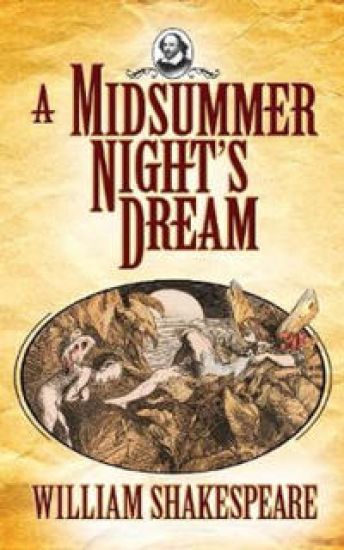
Witness the stages of love, marriage and jealousy as well as all of the mysterious images of romantic desire in this beautiful edition of A Midsummer Night's Dream. A Midsummer Night's Dream, a romantic comedy play by William Shakespeare, is believed to have been written between 1590 and 1596. It is one of Shakespeare's most popular works for the stage and is widely performed throughout the world. Theseus and Hippolyta, wonderful figures from classical mythology, are about to marry. In the woods outside Athens, two young men and two young women finally sort themselves out into couples after first forming one love triangle, and then another. By presenting them as almost interchangeable, Shakespeare probes the mystery of how lovers find compelling, life-shaping differences where there seem to be only likenesses. In the same woods, controlled and manipulated by the fairies who inhabit the forest, we find yet other images of desire in Oberon and Titania, the king and queen of Fairyland, and Bottom, an Athenian weaver who had been magically transformed into an ass-headed monster by Oberon's helper, hobgoblin Robin Goodfellow. King Oberon who is engaged in a near epic battle with Queen Titania over the custody of an orphan boy, uses magic to make the queen fall in love with Bottom, who had come into the woods with his companions - six amateur actors - to rehearse a play for the king's wedding. This "Beauty and the Beast" story adds another dimension as it brings in the power of infatuation to transform the image of the beloved in the lover's eyes.
Much Ado About Nothing is a comedy by William Shakespeare thought to have been written in 1598 and 1599, as Shakespeare was approaching the middle of his career. The play was included in the First Folio, published in 1623. By means of "noting" (which, in Shakespeare's day, sounded similar to "nothing" as in the play's title, and which means gossip, rumour, and overhearing), Benedick and Beatrice are tricked into confessing their love for each other, and Claudio is tricked into rejecting Hero at the altar in the erroneous belief that she has been unfaithful. At the end, Benedick and Beatrice join forces to set things right, and the others join in a dance celebrating the marriages of the two couples. Characters: Benedick, a lord and soldier from Padua; companion of Don PedroBeatrice, niece of LeonatoDon Pedro, Prince of AragonDon John, "the Bastard Prince", brother of Don PedroClaudio, of Florence; a count, companion of Don Pedro, friend to BenedickLeonato, governor of Messina; Hero's fatherAntonio, brother of LeonatoBalthasar, attendant on Don Pedro, a singerBorachio, follower of Don JohnConrade, follower of Don JohnInnogen, a 'ghost character' in early editions as Leonato's wifeHero, daughter of LeonatoMargaret, waiting-gentlewoman attendant on HeroUrsula, waiting-gentlewoman attendant on HeroDogberry, the constable in charge of Messina's night watchVerges, the Headborough, Dogberry's partnerFriar Francis, a priesta Sexton, the judge of the trial of Borachioa Boy, serving BenedickThe Watch, watchmen of MessinaAttendants and Messengers
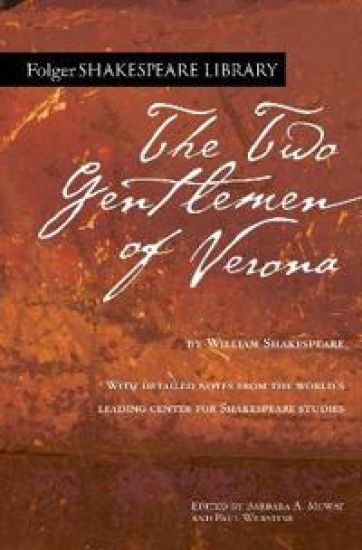
The authoritative edition of The Two Gentlemen of Verona from The Folger Shakespeare Library, the trusted and widely used Shakespeare series for students and general readers. While the word “gentlemen” suggests that its heroes are adults, The Two Gentlemen of Verona is more intelligible if we think of them as boys, leaving home for the first time. One has a crush on a girl, Julia, though he hasn’t yet told her. Sent to court to learn to be “perfect gentlemen,” Valentine and Proteus are derailed by their attraction to Sylvia, the ruler’s daughter. Valentine’s mental denseness does not deter Sylvia from returning his love, but he is caught, and banished, when he tries to elope with her. Proteus’s desire for Sylvia wipes out his former love, leading him into despicable acts that win scorn from Sylvia and wound Julia, who has pursued him disguised as a boy. When Sylvia follows Valentine into banishment, Proteus follows Sylvia, and Julia follows Proteus, the stage is set for a disturbing ending. But the stage is also set for the “gentlemen” to take small steps toward maturity. This edition includes: -Freshly edited text based on the best early printed version of the play -Full explanatory notes conveniently placed on pages facing the text of the play -Scene-by-scene plot summaries -A key to the play’s famous lines and phrases -An introduction to reading Shakespeare’s language -An essay by a leading Shakespeare scholar providing a modern perspective on the play -Fresh images from the Folger Shakespeare Library’s vast holdings of rare books -An annotated guide to further reading Essay by Jeffrey Masten The Folger Shakespeare Library in Washington, DC, is home to the world’s largest collection of Shakespeare’s printed works, and a magnet for Shakespeare scholars from around the globe. In addition to exhibitions open to the public throughout the year, the Folger offers a full calendar of performances and programs. For more information, visit Folger.edu.
The authoritative edition of Coriolanus from The Folger Shakespeare Library, the trusted and widely used Shakespeare series for students and general readers. Set in the earliest days of the Roman Republic, Coriolanus begins with the common people, or plebeians, in armed revolt against the patricians. The people win the right to be represented by tribunes. Meanwhile, there are foreign enemies near the gates of Rome. The play explores one reason that Rome prevailed over such vulnerabilities: its reverence for family bonds. Coriolanus so esteems his mother, Volumnia, that he risks his life to win her approval. Even the value of family, however, is subordinate to loyalty to the Roman state. When the two obligations align, the combination is irresistible. Coriolanus is so devoted to his family and to Rome that he finds the decision to grant the plebians representation intolerable. To him, it elevates plebeians to a status equal with his family and class, to Rome's great disadvantage. He risks his political career to have the tribunate abolished--and is banished from Rome. Coriolanus then displays an apparently insatiable vengefulness against the state he idolized, opening a tragic divide within himself, pitting him against his mother and family, and threatening Rome's very existence. This edition includes: -Freshly edited text based on the best early printed version of the play -Full explanatory notes conveniently placed on pages facing the text of the play -Scene-by-scene plot summaries -A key to the play's famous lines and phrases -An introduction to reading Shakespeare's language -An essay by a leading Shakespeare scholar providing a modern perspective on the play -Fresh images from the Folger Shakespeare Library's vast holdings of rare books -An annotated guide to further reading Essay by Heather James The Folger Shakespeare Library in Washington, DC, is home to the world's largest collection of Shakespeare's printed works, and a magnet for Shakespeare scholars from around the globe. In addition to exhibitions open to the public throughout the year, the Folger offers a full calendar of performances and programs. For more information, visit Folger.edu.
The New Shaksperian Dictionary of Quotations
William Shakespeare; George S. Bellamy
Hansebooks
2020
nidottu