Kirjojen hintavertailu – 12 859 829 kirjaa ja 27 kauppaa
Kirjailija
William Swainson
Kirjat ja teokset yhdessä paikassa: 49 kirjaa, julkaisuja vuosilta 2007–2025, suosituimpiin kuuluu A Treatise on Malacology; or, Shells and Shell Fish. Vertaile teosten hintoja ja tarkista saatavuus suomalaisista kirjakaupoista.
Reprint of the original. The publishing house Anatiposi publishes historical books as reprints. Due to their age, these books may have missing pages or inferior quality. Our aim is to preserve these books and make them available to the public so that they do not get lost.
Reprint of the original. The publishing house Anatiposi publishes historical books as reprints. Due to their age, these books may have missing pages or inferior quality. Our aim is to preserve these books and make them available to the public so that they do not get lost.
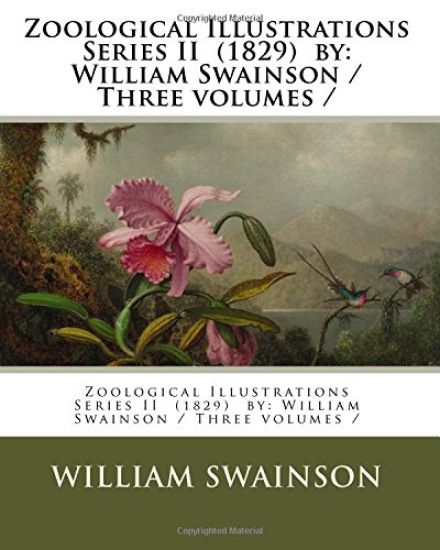
The volumes of William Swainson's Zoological Illustrations are testimony of a glorious era of explorations and scientific discoveries at the beginning of the XIX century. European naturalists traveled exotic places to bring back specimen and description of animals and plants never seen before. A great effort was spent to categorize them in a precise taxonomy that would show the differences and similarities of those new species. A competition, really, to win the honor of being the first to name a new bird or a new plant. The rich illustrations in this volumes, the detailed descriptions and the author's comments open a window on that time. This new edition is not just a reprint of the original work, it is meant to make it easier, for the contemporary reader, to enjoy the vivid images and immerse in the spirit of a now forgotten time. Either by just flipping through the images or by carefully reading the descriptions, we hope you will enjoy this book as we enjoyed giving them a new life.
William John Swainson October 1789 - 6 December 1855), was an English ornithologist, malacologist, conchologist, entomologist and artist. Swainson was born in Dover Place, St Mary Newington, London, the eldest son of John Timothy Swainson the Second (1756-1824), an original fellow of the Linnean Society. He was cousin of the amateur botanist Isaac Swainson. His father's family originated in Lancashire, and both grandfather and father held high posts in Her Majesty's Customs, the father becoming Collector at Liverpool. William, whose formal education was curtailed because of an impediment in his speech, joined the Liverpool Customs as a junior clerk at the age of 14. 3] He joined the Army Commissariat and toured Malta and Sicily He studied the ichthyology of western Sicily and in 1815, was forced by ill health to return to England where he subsequently retired on half pay. William followed in his father's footsteps to become a fellow of the Linnean Society in 1815. In 1806 he accompanied the English explorer Henry Koster to Brazil. Koster had lived in Brazil for some years and had become famous for his book Travels in Brazil (1816). There he met Dr Grigori Ivanovitch Langsdorff, also an explorer of Brazil, and Russian Consul General. They did not spend a long time on shore because of a revolution, but Swainson returned to England in 1818 in his words "a bee loaded with honey", with a collection of over 20,000 insects, 1,200 species of plants, drawings of 120 species of fish, and about 760 bird skins.
William John Swainson October 1789 - 6 December 1855), was an English ornithologist, malacologist, conchologist, entomologist and artist. Swainson was born in Dover Place, St Mary Newington, London, the eldest son of John Timothy Swainson the Second (1756-1824), an original fellow of the Linnean Society. He was cousin of the amateur botanist Isaac Swainson. His father's family originated in Lancashire, and both grandfather and father held high posts in Her Majesty's Customs, the father becoming Collector at Liverpool. William, whose formal education was curtailed because of an impediment in his speech, joined the Liverpool Customs as a junior clerk at the age of 14. 3] He joined the Army Commissariat and toured Malta and Sicily He studied the ichthyology of western Sicily and in 1815, was forced by ill health to return to England where he subsequently retired on half pay. William followed in his father's footsteps to become a fellow of the Linnean Society in 1815. In 1806 he accompanied the English explorer Henry Koster to Brazil. Koster had lived in Brazil for some years and had become famous for his book Travels in Brazil (1816). There he met Dr Grigori Ivanovitch Langsdorff, also an explorer of Brazil, and Russian Consul General. They did not spend a long time on shore because of a revolution, but Swainson returned to England in 1818 in his words "a bee loaded with honey", with a collection of over 20,000 insects, 1,200 species of plants, drawings of 120 species of fish, and about 760 bird skins.
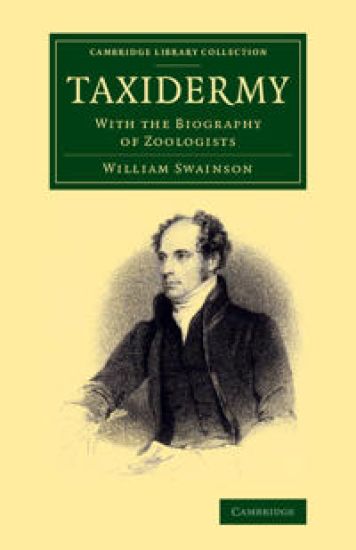
First published in 1840 as a volume in the Cabinet Cyclopaedia - a series published between 1830 and 1844, intended for the self-educating middle class - this work was written by the naturalist and artist William Swainson (1789–1855). The first part is a treatise on taxidermy, showcasing methods of Victorian science that may appear gruesome to modern readers. It discusses the best ways to collect, preserve and present animals for scientific study. Swainson gives detailed advice, making allowances for naturalists working in different locations and searching for a range of species. The directions for skinning and mounting animals are not for the faint-hearted, but they offer a fascinating insight into the practices of the time. The work's second part is a zoological bibliography, with short biographies of notable authors. Zoological painters and engravers, such as Thomas Bewick (1753–1828), are also featured.
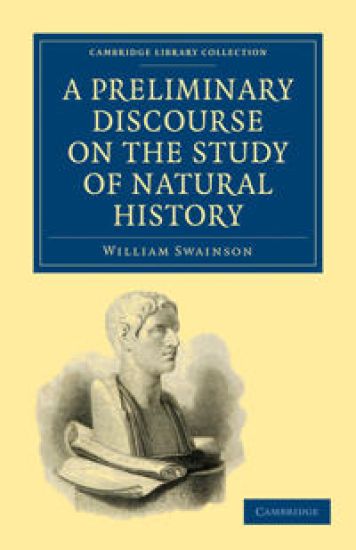
William Swainson F. R. S., was recognised principally as a zoologist, an ornithologist and a skilled and prolific illustrator. He also had a tremendous enthusiasm for seeking and identifying new species. In this 1834 volume however, Swainson addressed the nature of, foundations for and successful pursuit of zoology. It argues firmly for the key importance of taxonomy. Swainson was an ardent advocate of MacLeay's now entirely outmoded 'quinary' system of classification – even then a distinctly minority view. This sought affinities, patterns and analogies among organisms, in order to discern God's order. More than a mere curiosity, such work was of pivotal concern to enterprising naturalists of the 1820s and 1830s – including the young Charles Darwin. It also reached Robert Chambers, whose 1844 Vestiges of the Natural History of Creation was an important landmark in the development of the theory of evolution.