Kirjojen hintavertailu – 12 903 724 kirjaa ja 27 kauppaa

Kirjailija

William Taubman

Kirjat ja teokset yhdessä paikassa: 12 kirjaa, julkaisuja vuosilta 1983–2025, suosituimpiin kuuluu Khrushchev. Vertaile teosten hintoja ja tarkista saatavuus suomalaisista kirjakaupoista.

12 kirjaa

Kirjojen julkaisuvuodet: 1983–2025.

McNamara at War

McNamara at War

William Taubman; Philip Taubman

WW NORTON CO
2025
sidottu

Halvin toimitettuna 30,40 €

Robert S. McNamara was widely considered to be one of the most brilliant men of his generation. While he could be cold and arrogant, he was an invaluable friend to Presidents John F. Kennedy and Lyndon Johnson and had a deeply moving relationship with Jackie Kennedy. McNamara was the leading advocate for American escalation in Vietnam, even after he concluded that the war was unwinnable. In McNamara at War, Philip and William Taubman trace McNamara’s career from a young faculty member at Harvard Business School and his Second World War service to his leadership of the Ford Motor Company and the World Bank. McNamara at War is a portrait of a man at war with himself—riven by melancholy, guilt, zealous loyalty and a profound inability to admit his flawed thinking about Vietnam.
On My Country and the World

On My Country and the World

Mikhail Gorbachev; William Taubman

Columbia University Press
2019
pokkari

Halvin toimitettuna 36,00 €

Here is the whole sweep of the Soviet experiment and experience as told by its last steward. Drawing on his own experience, rich archival material, and a keen sense of history and politics, Mikhail Gorbachev speaks his mind on a range of subjects concerning Russia's past, present, and future place in the world. Here is Gorbachev on the October Revolution, Gorbachev on the Cold War, and Gorbachev on key figures such as Lenin, Stalin, and Yeltsin. The book begins with a look back at 1917. While noting that tsarist Russia was not as backward as it is often portrayed, Gorbachev argues that the Bolshevik Revolution was inevitable and that it did much to modernize Russia. He strongly argues that the Soviet Union had a positive influence on social policy in the West, while maintaining that the development of socialism was cut short by Stalinist totalitarianism. In the next section, Gorbachev considers the fall of the USSR. What were the goals of perestroika? How did such a vast superpower disintegrate so quickly? From the awakening of ethnic tensions, to the inability of democrats to unite, to his own attempts to reform but preserve the union, Gorbachev retraces those fateful days and explains the origins of Russia's present crises. But Gorbachev does not just train his critical eye on the past. He lays out a blueprint for where Russia needs to go in the twenty-first century, suggesting ways to strengthen the federation and achieve meaningful economic and political reforms. In the final section of the book, Gorbachev examines the "new thinking" in foreign policy that helped to end the Cold War and shows how such approaches could help resolve a range of crises, including NATO expansion, the role of the UN, the fate of nuclear weapons, and environmental problems. On My Country and the World reveals the unique vision of a man who was a powerful actor on the world stage and remains a keen observer of Russia's experience in the twentieth century. This anniversary edition features a new foreword by William Taubman, award-winning biographer of Khrushchev and Gorbachev.
On My Country and the World

On My Country and the World

Mikhail Gorbachev; William Taubman

Columbia University Press
2019
sidottu
Here is the whole sweep of the Soviet experiment and experience as told by its last steward. Drawing on his own experience, rich archival material, and a keen sense of history and politics, Mikhail Gorbachev speaks his mind on a range of subjects concerning Russia's past, present, and future place in the world. Here is Gorbachev on the October Revolution, Gorbachev on the Cold War, and Gorbachev on key figures such as Lenin, Stalin, and Yeltsin. The book begins with a look back at 1917. While noting that tsarist Russia was not as backward as it is often portrayed, Gorbachev argues that the Bolshevik Revolution was inevitable and that it did much to modernize Russia. He strongly argues that the Soviet Union had a positive influence on social policy in the West, while maintaining that the development of socialism was cut short by Stalinist totalitarianism. In the next section, Gorbachev considers the fall of the USSR. What were the goals of perestroika? How did such a vast superpower disintegrate so quickly? From the awakening of ethnic tensions, to the inability of democrats to unite, to his own attempts to reform but preserve the union, Gorbachev retraces those fateful days and explains the origins of Russia's present crises. But Gorbachev does not just train his critical eye on the past. He lays out a blueprint for where Russia needs to go in the twenty-first century, suggesting ways to strengthen the federation and achieve meaningful economic and political reforms. In the final section of the book, Gorbachev examines the "new thinking" in foreign policy that helped to end the Cold War and shows how such approaches could help resolve a range of crises, including NATO expansion, the role of the UN, the fate of nuclear weapons, and environmental problems. On My Country and the World reveals the unique vision of a man who was a powerful actor on the world stage and remains a keen observer of Russia's experience in the twentieth century. This anniversary edition features a new foreword by William Taubman, award-winning biographer of Khrushchev and Gorbachev.
Gorbachev

Gorbachev

William Taubman

Simon Schuster Ltd
2018
pokkari

Halvin toimitettuna 29,90 €

The definitive volume on one of the most important and controversial figures of the 20th century, a man who almost singlehandedly changed his country and the world.
Gorbachev

Gorbachev

William Taubman

WW Norton Co
2018
nidottu

Halvin toimitettuna 30,20 €

In the first comprehensive biography of Mikhail Gorbachev, William Taubman shows how a peasant boy clambered to the top of a system designed to keep people like him down, found common ground with America's arch-conservative president Ronald Reagan, and permitted the USSR and its East European empire to break apart without using force to preserve them. Drawing on interviews with Gorbachev himself, transcripts and documents from the Russian archives, and interviews with Kremlin aides and adversaries, Taubman's intensely personal portrait extends to Gorbachev's remarkable marriage to a woman he deeply loved. Nuanced and poignant, yet unsparing and honest, this sweeping account has all the amplitude of a great Russian novel.
Gorbachev: His Life and Times

Gorbachev: His Life and Times

William Taubman

W. W. Norton Company
2017
sidottu
When Mikhail Gorbachev became the leader of the Soviet Union in 1985, the USSR was one of the world's two superpowers. By 1989, his liberal policies of perestroika and glasnost had permanently transformed Soviet Communism, and had made enemies of radicals on the right and left. By 1990 he, more than anyone else, had ended the Cold War, and in 1991, after barely escaping from a coup attempt, he unintentionally presided over the collapse of the Soviet Union he had tried to save. In the first comprehensive biography of the final Soviet leader, William Taubman shows how a peasant boy became the Soviet system's gravedigger, how he clambered to the top of a system designed to keep people like him down, how he found common ground with America's arch-conservative president Ronald Reagan, and how he permitted the USSR and its East European empire to break apart without using force to preserve them. Throughout, Taubman portrays the many sides of Gorbachev's unique character that, by Gorbachev's own admission, make him "difficult to understand." Was he in fact a truly great leader, or was he brought low in the end by his own shortcomings, as well as by the unyielding forces he faced? Drawing on interviews with Gorbachev himself, transcripts and documents from the Russian archives, and interviews with Kremlin aides and adversaries, as well as foreign leaders, Taubman's intensely personal portrait extends to Gorbachev's remarkable marriage to a woman he deeply loved, and to the family that they raised together. Nuanced and poignant, yet unsparing and honest, this sweeping account has all the amplitude of a great Russian novel.
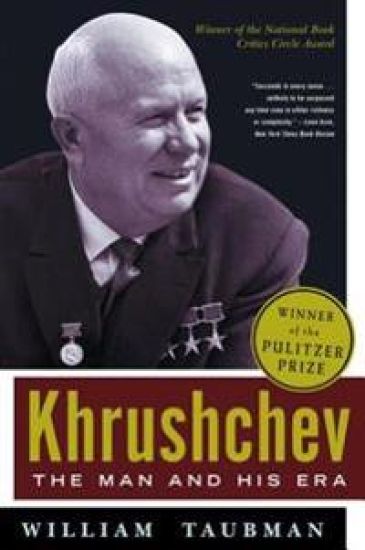
Khrushchev

Khrushchev

William Taubman

WW Norton Co
2004
pokkari

Halvin toimitettuna 28,90 €

The definitive biography of the mercurial Soviet leader who succeeded and denounced Stalin. Nikita Khrushchev was one of the most complex and important political figures of the twentieth century. Ruler of the Soviet Union during the first decade after Stalin's death, Khrushchev left a contradictory stamp on his country and on the world. His life and career mirror the Soviet experience: revolution, civil war, famine, collectivization, industrialization, terror, world war, cold war, Stalinism, post-Stalinism. Complicit in terrible Stalinist crimes, Khrushchev nevertheless retained his humanity: his daring attempt to reform communism prepared the ground for its eventual collapse; and his awkward efforts to ease the cold war triggered its most dangerous crises. This is the first comprehensive biography of Khrushchev and the first of any Soviet leader to reflect the full range of sources that have become available since the USSR collapsed. Combining a page-turning historical narrative with penetrating political and psychological analysis, this book brims with the life and excitement of a man whose story personified his era.
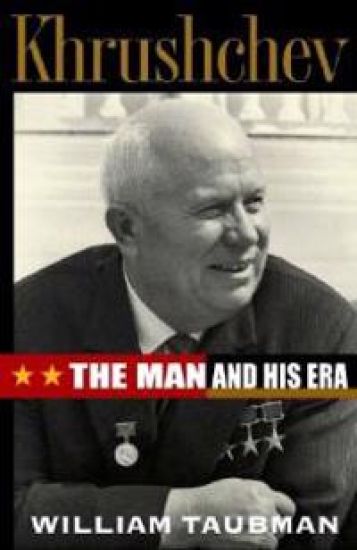
Khrushchev: The Man and His Era

Khrushchev: The Man and His Era

William Taubman

W. W. Norton Company
2003
sidottu
Remembered by many as the Soviet leader who banged his shoe at the United Nations, Nikita Khrushchev was in fact one of the most complex and important political figures of the twentieth century. Complicit in terrible Stalinist crimes, he managed to retain his humanity. His daring attempt to reform Communism--by denouncing Stalin and releasing and rehabilitating millions of his victims--prepared the ground for its eventual collapse. His awkward efforts to ease the Cold War triggered its most dangerous crises in Berlin and Cuba. The ruler of the Soviet Union during the first decade after Stalin's death, Khrushchev left his contradictory stamp on his country and the world. More than that, his life and career hold up a mirror to the Soviet age as a whole: revolution, civil war, famine, collectivization, industrialization, terror, world war, cold war, Stalinism, post-Stalinism. The first full and comprehensive biography of Khrushchev, and the first of any Soviet leader to reflect the full range of sources that have become available since the USSR collapsed, this book weaves together Khrushchev's personal triumphs and tragedy with those of his country. It draws on newly opened archives in Russia and Ukraine, the author's visits to places where Khrushchev lived and work, plus extensive interviews with Khrushchev family members, friends, colleagues, subordinates, and diplomats who jousted with him. William Taubman chronicles Khrushchev's life from his humble beginnings in a poor peasant village to his improbable rise into Stalin's inner circle; his stunning, unexpected victory in the deadly duel to succeed Stalin; and the startling reversals of fortune that led to his sudden, ignominious ouster in 1964. Combining a page-turning historical narrative with penetrating political and psychological analysis, this account brims with the life and excitement of a man whose story personifies his era. "A brilliant, stunning, magnificent book. One of the most important figures of the twentieth century, who had a lot to do with setting the stage for the twenty-first, Khrushchev finally has the biography he deserves--deep and detailed yet fast-paced, scholarly yet not stuffy, historical yet intensely human. Taubman brings Khrushchev alive in all his complexity, capturing both the humanity that somehow survived in him and became the bedrock for his political decency, and the cynicism that made him part of the brutality of the Soviet system. The book has the sweep of a Big Book about a Big Figure, yet its style is no-frills, no-nonsense, straight-from-the-shoulder, with judgments proferred judiciously. Taubman does a superb job of portraying the rogue's gallery of Soviet leaders while providing a colorful canvas of the country and its history. Having spent several years of my own life in Khrushchev's shadow, I couldn't be more admiring of what Taubman has accomplished." --Strobe Talbott, former U. S. deputy secretary of state, editor and translator of Khrushchev's memoirs "Monumental, definitive, rich in detail. Taubman pulls aside the curtain and shows us both a fascinating man and new facts about Soviet decision making during the most dangerous days of the Cold War. A highly readable, compelling story." --Anthony Lake, former U. S. national security adviser "The definitive account of Khrushchev's career and personality, this is also a wonderful page-turner about the deadly duel for power in the Kremlin. Altogether it is one of the best books ever written about the Soviet Union." --Constantine Pleshakov, co-author, Inside the Kremlin's Cold War "Few books in the field of Cold War history have been as eagerly awaited as William Taubman's biography of Nikita Khrushchev. Reflecting years of research as well as a keen sensitivity to culture, context, and personality, this extraordinary book more than matches the extraordinary character of its subject. It is a superb portrayal of one of the most attractive--but also dangerous--leaders of the twentieth century." --John Lewis Gaddis, professor of history, Yale University "A portrait unlikely to be surpassed any time soon in either richness or complexity. This volume, with its brisk, enjoyable narrative, succeeds in every sense: sweep, depth, liveliness, color, tempo. Each chapter shines with mastery and authority."--Leon Aron, The New York Times Book Review "Masterful and monumental...one should salute its author for a wonderful achievement.... Starting with a juicy subject... Taubman has drawn on a huge body of material, much of it from newly available Soviet sources.... He spent nearly twenty years on the book. The result is fun to read, full of insight and more than a little terrifying."--Robert G. Kaiser, Washington Post "Thanks to Taubman, one of the most important figures of the 20th century finally has the biography he deserves.... In reconstructing a single paradoxical life, he helps us understand better the complexity of the human condition."--Strobe Talbott, Los Angeles Times Book Review

Stalin's American Policy: From Entente to Detente to Cold War
How and why did the Cold War arise out of wartime entente? Here, in a study focused on Soviet foreign policy from 1941 to 1953, William Taubman describes an intermediate stage of d tente that Stalin abandoned reluctantly only after the Western powers did. Stalin, seen here as cautious and even conservative, viewed America as hostile and devious. His d tente was designed to undermine Western interests.