

Kirjailija
William Thomson
Kirjat ja teokset yhdessä paikassa: 112 kirjaa, julkaisuja vuosilta 1989–2026, suosituimpiin kuuluu Clinical records of injuries and diseases of the genito-urinary organs. Vertaile teosten hintoja ja tarkista saatavuus suomalaisista kirjakaupoista.
112 kirjaa
Kirjojen julkaisuvuodet: 1989–2026.


Sermons preached in Lincoln's Inn Chapel is an unchanged, high-quality reprint of the original edition of 1861. Hansebooks is editor of the literature on different topic areas such as research and science, travel and expeditions, cooking and nutrition, medicine, and other genres. As a publisher we focus on the preservation of historical literature. Many works of historical writers and scientists are available today as antiques only. Hansebooks newly publishes these books and contributes to the preservation of literature which has become rare and historical knowledge for the future.

Travels in Europe, Asia, and Africa is an unchanged, high-quality reprint of the original edition of 1782. Hansebooks is editor of the literature on different topic areas such as research and science, travel and expeditions, cooking and nutrition, medicine, and other genres. As a publisher we focus on the preservation of historical literature. Many works of historical writers and scientists are available today as antiques only. Hansebooks newly publishes these books and contributes to the preservation of literature which has become rare and historical knowledge for the future.

An idiosyncratic, richly illustrated guide to Britain's rivers, seas and shores, for everyone who loves the water and the natural world - a Norwegian Wood for Britain's watersThis is a book for those who want to understand better how the waters surrounding us affect our daily lives, how it imperceptibly but crucially shapes our actions, and has shaped our landscape for millenia. It's for anyone who knows and loves our coast, and who wants to understand, discover, surf, or sail it better. Inspired by his own witnessing of the power of the sea through travelling around Britain's coastline in a panel van with his young family, William Thomson tells the story of the cycles of the sea. He combines a lyrical, passionate narrative with graphically beautiful renderings of the main forms of water which affect Britain: Rip, Rapids, Swell, Stream, Tide, Wave, Whirlpool, Tsunami. The Book of Tides is a book for all of us who feel the pull of the sea and the tug of the tide.





A Practical Treatise On the Diseases of the Liver and Biliary Passages
William Thomson; William Twining
Palala Press
2016
sidottu


Remarks on a Review of the Report on the Cause & Extent of Typhoid Fever in Melbourne
William Thomson
Palala Press
2016
sidottu

Theory of Vibrations with Applications
William Thomson; Marie Dillon Dahleh
Pearson Education Limited
2013
pokkari
Junior or Senior level Vibration courses in Departments of Mechanical Engineering. A thorough treatment of vibration theory and its engineering applications, from simple degree to multi degree-of-freedom system.
Detailed advice on writing papers, giving presentations, and refereeing, plus an essential guide to the basics of being a graduate student in economics. This book is an invaluable handbook for young economists working on their dissertations, preparing their first articles for submission to professional journals, getting ready for their first presentations at conferences and job seminars, or undertaking their first refereeing assignments. In clear, concise language-a model in itself-William Thomson describes how to make written and oral presentations both engaging and efficient. Declaring "I would certainly take up arms for clarity, simplicity, and unity," Thomson covers the basics of clear exposition, including such nuts-and-bolts topics as titling papers, writing abstracts, presenting research results, and holding an audience's attention. This second edition features a substantial new chapter, "Being a Graduate Student in Economics," that offers guidance on such essential topics as the manners and mores of graduate school life, financial support, selecting an advisor, and navigating the job market. The chapter on giving talks has been rewritten to reflect the widespread use of presentation software, and new material has been added to the chapter on writing papers.
Reprint of Papers on Electrostatics and Magnetism
William Thomson
Cambridge University Press
2011
pokkari
William Thomson, Baron Kelvin (1824–1907), born with a great talent for mathematics and physics, was educated at Glasgow and Cambridge. While only in his twenties, he was appointed to the University of Glasgow's Chair in Natural Philosophy, which he was to hold for over fifty years. He is best known for lending his name to the Kelvin unit of measurement for temperature, after his development of an absolute scale of temperature. This book is a corrected 1884 edition of Kelvin's 1872 collection of papers on electrostatics and magnetism. It includes all his work on these subjects previously published as articles in journals including the Cambridge Mathematical Journal and the Transactions of the Royal Society. Kelvin also wrote several new items to fill gaps in this collection, so that its coverage of the state of electromagnetic research in the late nineteenth century is comprehensive.
William Thomson, Baron Kelvin (1824–1907), was educated at Glasgow and Cambridge. While only in his twenties, he was awarded the University of Glasgow's chair in natural philosophy, which he was to hold for over fifty years. He is best known through the Kelvin, the unit of measurement of temperature named after him in consequence of his development of an absolute scale of temperature. These volumes collect together Kelvin's lectures for a wider audience. In a convivial but never condescending style, he outlines a range of scientific subjects to audiences of his fellow scientists. The range of topics covered reflects Kelvin's broad interests and his stature as one of the most eminent of Victorian scientists. Volume 3, published in 1891, deals with the science of the seas and oceans, particularly as it relates to navigation, tides and magnetic forces.
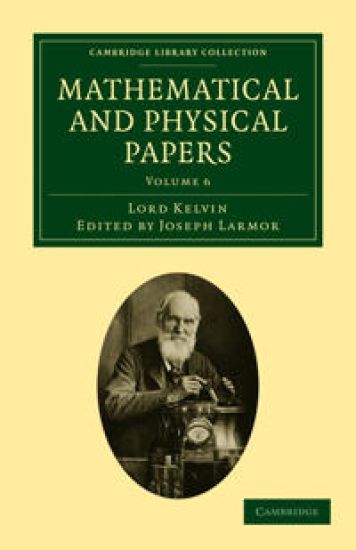
William Thomson, first Baron Kelvin (1824–1907), is best known for devising the Kelvin scale of absolute temperature and for his work on the first and second laws of thermodynamics, though throughout his 53-year career as a mathematical physicist and engineer at the University of Glasgow he investigated a wide range of scientific questions in areas ranging from geology to transatlantic telegraph cables. The extent of his work is revealed in the six volumes of his Mathematical and Physical Papers, published from 1882 until 1911, consisting of articles that appeared in scientific periodicals from 1841 onwards. Volume 6, published in 1911, includes articles from the period 1867–1907. The chapters in the first part of the work focus on voltaic theory and radioactivity, while later ones examine navigation and tides.
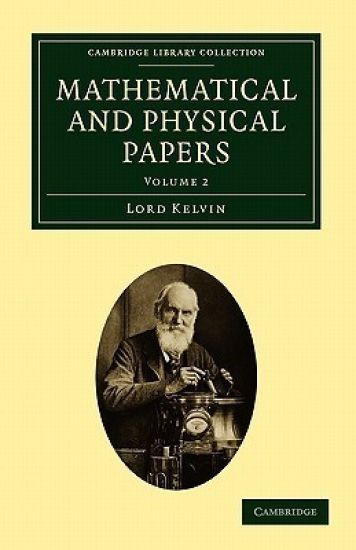
William Thomson, first Baron Kelvin (1824–1907), is best known for devising the Kelvin scale of absolute temperature and for his work on the first and second laws of thermodynamics, though throughout his 53-year career as a mathematical physicist and engineer at the University of Glasgow he investigated a wide range of scientific questions in areas ranging from geology to transatlantic telegraph cables. The extent of his work is revealed in the six volumes of his Mathematical and Physical Papers, published from 1882 until 1911, consisting of articles that appeared in scientific periodicals from 1841 onwards. Volume 2, published in 1884, includes articles from the period 1853–1856, and puts a special emphasis on the issue of the development of electric telegraphy. Also included is Thomson's Bakerian Lecture on the electro-dynamic qualities of metals.
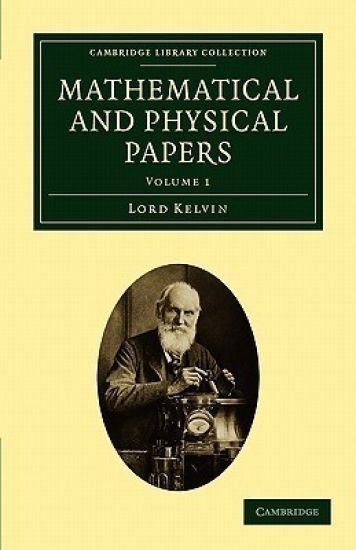
William Thomson, first Baron Kelvin (1824–1907), is best known for devising the Kelvin scale of absolute temperature and for his work on the first and second laws of thermodynamics, though throughout his 53-year career as a mathematical physicist and engineer at the University of Glasgow he investigated a wide range of scientific questions in areas ranging from geology to transatlantic telegraph cables. The extent of his work is revealed in the six volumes of his Mathematical and Physical Papers, published from 1882 until 1911, consisting of articles that appeared in scientific periodicals from 1841 onwards. Volume 1, published in 1882, includes articles from the period 1841–1853 and covers issues relating to heat, especially its linear motion and theories about it. Other topics include aspects of electricity, thermodynamics and research relating to magnetism.