Kirjojen hintavertailu – 12 859 819 kirjaa ja 27 kauppaa

Kirjailija

William W. Demastes

Kirjat ja teokset yhdessä paikassa: 10 kirjaa, julkaisuja vuosilta 1988–2025, suosituimpiin kuuluu Clifford Odets. Vertaile teosten hintoja ja tarkista saatavuus suomalaisista kirjakaupoista.

10 kirjaa

Kirjojen julkaisuvuodet: 1988–2025.

Clifford Odets

Clifford Odets

William W. Demastes

Greenwood Press
1991
sidottu
Best known as a revolutionary playwright of the 1930s, Clifford Odets may have reached his zenith when four of his plays were produced on Broadway in 1935: Waiting for Lefty, Till the Day I Die, Awake and Sing!, and Paradise Lost. His plays, however, also show a romantic strain and are at least as much inimate and personal as they are political, often reflecting the isolation and loneliness of individuals in family settings. Never achieving the acclaim of Eugene O'Neill, who came before, or Tennessee Williams and Arthur Miller, who followed, Odets bridged the gap between earlier melodramatic theatre and the mature post-World War II drama on the American stage, creating rich and varied drama well into the 1950s. That his plays continue to be appraised and performed is clearly evident in this detailed and carefully articulated sourcebook. A near-exhaustive resource for both literary and theatrical research materials on Odets's dramatic career, the volume is organized and indexed for quick reference. Included are a biographical essay; critical overview, production history, and plot summary of each dramatic product; annotated primary and secondary bibliographies and information on archival sources; and production credits. Essential for research libraries and theatre collections, the volume will be useful to theatre scholars and practitioners and to anyone interested in the work of this significant modern American playwright.
Western Drama Confronts Selfish Humanity

Western Drama Confronts Selfish Humanity

William W. Demastes

TAYLOR FRANCIS LTD
2025
sidottu
This book offers a timely exploration of how Western theatre has consistently challenged the notion that human nature is fundamentally selfish. Through millennia of dramatic works, the theatre has served as a vital platform for examining the complex interplay between selfish and selfless behavior, contributing to a debate that remains at the heart of contemporary culture wars. While traditional philosophical and scientific thought, particularly social-Darwinist theory, has emphasized selfishness as key to survival, recent developments have begun to question this paradigm. The theatre has long suggested a more nuanced perspective, proposing that selflessness and altruism are not merely idealistic concepts but essential components of human survival and flourishing. This groundbreaking work demonstrates how Western dramatic literature makes a compelling case for recognizing the evolutionary advantages of selflessness while challenging our culture's misguided celebration of individualism. Written for a diverse audience of college students, theatregoers, and scholars, the book illuminates the fascinating intersection of science and art in questioning our dominant cultural assumptions about human nature and virtue. In an era where the consequences of unbridled individualism are increasingly apparent, this examination of theatre's insights into human behavior offers both timely wisdom and hope for a more altruistic future.
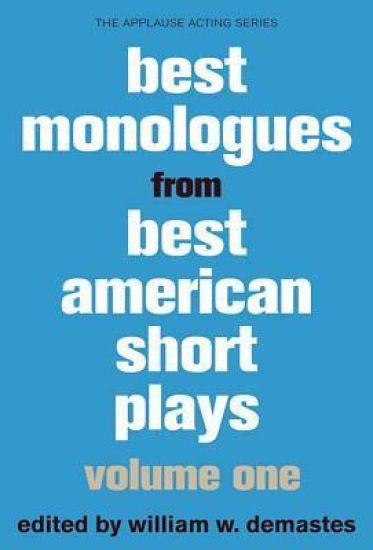
Best Monologues from Best American Short Plays

Best Monologues from Best American Short Plays

William W. Demastes

Applause Theatre Book Publishers
2013
pokkari
Best Monologues from Best American Short Plays, Volume One is a must for actors of all ages – beginners as well as seasoned veterans – and belongs in the libraries of all theater teachers looking for new and exciting material for their students. The monologues in this volume are excerpted from the outstanding series Best American Short Plays, an archive of works from many of the best playwrights active today, presenting taut, engaging single-character pieces that range from zany comedy to poignant tales of love and loss. Each monologue includes a short introduction and a reference identifying where to locate the entire play, should anyone choose to pursue production beyond the monologue. Long or short, serious or not, this collection is must-have material for anyone interested in acting. The monologues also succeed as excellent companions for the casual reader. Included in this volume are monologues by Liliana Almendarez, James Armstrong, Billy Aronson, Clay McLeod Chapman, Migdalla Cruz, Laura Shaine Cunningham, Eileen Fischer, Jill Elaine Hughes, Julia Jarcho, Zilvinas Jonusas, Adam Kraar, David Kranes, Neil LaBute, Daniel Frederick Levin, Bruce Levy, Carey Lovelace, Carol K. Mack, Dano Madden, Peter Maloney, Joe Maruzzo, Mark Medoff, Susan Miller, Julie Rae (Pratt) Mollenkamp, Rick Pulos, Ronald Ribman, Murray Schisgal, Pamela Sneed, and co-writers Polly Frost and Ray Sawhill.
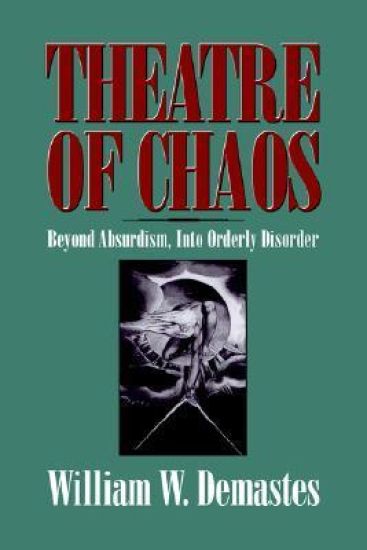
Theatre of Chaos

Theatre of Chaos

William W. Demastes

Cambridge University Press
2005
pokkari
In this unique and invigorating study, chaos theory and quantum mechanics are employed as the basis for a clearer understanding of the often confusing contemporary theatre world. Examining numerous antecedents to contemporary thought on chaos and the cultural roots of the notion of chaos, links are provided to playwrights ranging from Shakespeare to Ibsen and Tom Stoppard to Sam Shepard. William Demastes investigates parallel developments across the arts and sciences: connections between the dramatic naturalism of the late nineteenth century and Newtonian thought, and theatre of the absurd and disorderly chaos theory. After centuries of isolation and increased specialisation, the author contends, it may once again be time to consider the 'arts' and 'sciences' not as two isolated enterprises but to acknowledge interrelations between them.
Staging Consciousness

Staging Consciousness

William W. Demastes

The University of Michigan Press
2002
sidottu
Staging Consciousness argues that theater is a living invalidation of the Western dualism of mind and body, activating human consciousness through its embodiment of thought in performance. While consciousness theory has begun to find ways to bridge dualist gaps, Staging Consciousness suggests that theater has anticipated these advances, given the ways in which the physical theater promotes nonphysical thought, connecting the two realms in unique and ingenious ways. William W. Demastes makes use of the writings of such varied theater practitioners as Antonin Artaud, Jerzy Grotowski, Samuel Beckett, Tony Kushner, Sam Shepard, Spalding Gray, Peter Shaffer, and others, illuminating theater as proof that mind is an extension of body. The living stage incubates and materializes thought in a way that highlights the processes of daily existence outside the theater. This book offers a new way for theater practitioners to look at the unique value of the theater and an invitation for philosophers and scientists to search for new paradigms in theater, the oldest of art forms. William W. Demastes is Professor of English, Louisiana State University. His previous books include Theatre of Chaos: Beyond Absurdism, into Disorderly Order.
Irish Playwrights, 1880-1995

Irish Playwrights, 1880-1995

William W. Demastes; Bernice Schrank

Greenwood Press
1997
sidottu
Irish playwrights such as Sean O'Casey, George Bernard Shaw, and John Millington Synge have made enormous contributions to world drama. This reference provides detailed entries for 32 Irish playwrights active from 1880 to 1995. Each entry includes a biographical sketch, a summary of productions, a critical assessment of the dramatist's work, and extensive bibliographical information. The volume concludes with a selected, general bibliography. Though Irish dramatists have been writing plays for centuries, Irish drama is largely a product of the last hundred years and is deeply rooted in the political and social ferment out of which Ireland emerged as an independent nation. The creation of Irish drama is primarily the story of the Abbey Theatre, founded in 1897 as the Irish Literary Theatre by Lady Gregory, Edward Martyn, and William Butler Yeats. Though the Abbey remains Ireland's national theatre, its existence and role have been challenged and critiqued by individuals who rejected its Irishness and who sought to introduce Irish audiences to the drama of continental Europe. Through its extended entries for 32 playwrights, this reference charts the history of Irish drama from the late 19th century to 1995. Included are profiles of some of the most important names in literature, such as George Bernard Shaw, John Millington Synge, Oscar Wilde, Sean O'Casey, and Samuel Beckett; along with more recent and less canonical authors whose works are nonetheless distinguished. Entries are written by expert contributors and are arranged alphabetically. Each entry includes a brief biographical sketch, production histories for major works, a critical assessment of the playwright's career, and extensive archival and bibliographical information. As an aid to locating general works on Irish drama, the volume concludes with a selected, general bibliography.
British Playwrights, 1880-1956

British Playwrights, 1880-1956

William W. Demastes; Katherine Kelly

Greenwood Press
1996
sidottu
From 1880 to 1956, when John Osborne transformed the British theater world with Look Back in Anger, British playwrights made numerous lasting contributions and provided a foundation for the innovations of dramatists during the latter half of the 20th century. This reference profiles the life and work of some 40 British playwrights active during the late 19th and early 20th centuries, many of whom are also known for their work as novelists and poets. Included are figures such as W. H. Auden, Max Beerbohm, Noel Coward, T. S. Eliot, John Galsworthy, Graham Greene, D. H. Lawrence, W. Somerset Maugham, George Bernard Shaw, and Oscar Wilde. Each entry provides a biographical overview; a list of major plays and summaries of their critical reception; a list of minor plays, adaptations, and productions; an assessment of the playwright's career; and archival and bibliographical information. Included in this reference book are alphabetically arranged entries for some 40 British playwrights active from 1880 through 1956. Entries are written by expert contributors, with each entry providing a biographical overview; a list of major plays, premieres, and significant revivals, along with a summary of the critical reception of these works; a listing of additional plays, adaptations, and productions; an assessment of the playwright's career and contributions, with reference to published evaluations in magazines, journals, dissertations, and books; a listing of locations housing unpublished archival material, if available; a selected bibliography of the dramatist's published plays and of essays and articles by the playwright on aspects of the theater; a selected bibliography of secondary sources; and, when available, a listing of previously published bibliographies on the playwright.
British Playwrights, 1956-1995

British Playwrights, 1956-1995

William W. Demastes

Greenwood Press
1996
sidottu
The year 1956 marked a point when British drama and theater fell into the hands of a group of young playwrights who revolutionized the stage. During that time, playwrights such as Samuel Beckett and Harold Pinter made the British theater as rich, varied, and vital as any national theater in history. This reference chronicles the history of British theater from 1956 to 1995 by providing detailed information about the playwrights of that period. Included are entries for some three dozen British playwrights active between 1956 and 1995. Entries are arranged alphabetically to facilitate use. Each entry supplies biographical information, the production history for particular plays, a survey of the playwright's critical reception, an assessment of the dramatist's work, and primary and secondary bibliographies. A selected, general bibliography at the end of the volume directs the reader to important sources of additional information about this period in theater history.
American Playwrights, 1880-1945

American Playwrights, 1880-1945

William W. Demastes

Greenwood Press
1994
sidottu
During the years 1880 to 1945, American theatre grew up, moving from entertainment-driven motives and melodramatic formulas to serious confrontations with issues of its time and to an experimentation with forms that would allow those confrontations to be frank and earnest. Many of the playwrights of this time wrote works of lasting significance, while others have impacted the work of contemporary dramatists. This reference is a guide to American theatre during this formative period. The volume includes alphabetically arranged entries for 40 American playwrights active between 1880 and 1945. Included are the most frequently canonized figures, as well as previously neglected women and minority playwrights whose work is a vital part of American theatre history. Each entry includes a biographical overview, a summary of the critical reception of major productions and significant revivals, a critical assessment of the playwright's career, and a listing of archival, primary, and secondary bibliographic material.
Beyond Naturalism

Beyond Naturalism

William W. Demastes

Praeger Publishers Inc
1988
sidottu
Demastes, in his interesting study of the work of David Rabe, David Mamet, Sam Shepard, Charles Fuller, Beth Henley, and Marsha Norman, examines how these playwrights utilize the realist format to redirect perception of human life, how they cope with the consciously taken 'task of challenging old systems of thought from a base of new perspective.' The analyses of individual plays are preceded by a brief review of some earlier dramatic theories of realism revealing the roots and antecedents of the new forms. . . . Beyond Naturalism is a very useful and valuable contribution to drama and theatre studies. American LiteratureDemastes explores the work of a group of playwrights who have moved beyond the often-maligned naturalist approach to create what he terms the new realism in American theatre. Demastes argues that this new realism is separate and distinct from the narrow focus of naturalism and is the result of tapping into a growing tradition inherited from the experimental work of prior decades such as absurdist theatre and experimentation of the 1960s. The playwrights who most exemplify the new realism--David Rabe, David Mamet, Sam Shepard, Charles Fuller, Beth Henley, and Marsha Norman--are examined in depth. Each has separately taken on the challenge to modify the forms of traditional realism to fit more modern visions of existence. In the process, they have broken from naturalism, infusing realism with fresh and contemporary perspectives of the world around them. Demastes shows that even though these playwrights' return to realism has won them larger audiences and greater accessibility, the break from naturalist logic has sometimes confused American critics and audiences--leading them to conclude such works to be bad drama. To uncover the various points of confusion, Demastes not only analyzes the playwrights' contributions but also examines the critical impressions of their productions to assess the reactions of a theatre-going public raised on naturalist assumptions and now asked to adapt to the new alterations confronting them. This two-pronged approach enables the reader to both explore the evolution of new realism and assess the degree to which it can legitimately be considered a new form of American theatre.