

Kirjailija
William Walker Atkinson
Kirjat ja teokset yhdessä paikassa: 869 kirjaa, julkaisuja vuosilta 1908–2026, suosituimpiin kuuluu Thought Vibration. Vertaile teosten hintoja ja tarkista saatavuus suomalaisista kirjakaupoista.
869 kirjaa
Kirjojen julkaisuvuodet: 1908–2026.
The Master Mind: Or, The Key to Positive Mental Power and Efficiency; Developing Perception and Attention
William Walker Atkinson; Theron Q. Dumont
Lulu.com
2019
nidottu
In this outstanding book, we find demonstrated various intricate and advanced thought processes, and discover how to employ them in order to achieve The Master Mind. For the author, individuals are split into two categories. Firstly, there are those who possess normal, sub-optimal minds; this group comprises the vast majority of humanity. The second group are those who, whether through conscious effort of will, self-belief, mindfulness or otherwise have achieved a higher, self-actualized state; those with a 'Master Mind'. Through sheer conscious will, and careful tending over a span of months and years, such a mind can be cultivated. This practical and instructive text tells us how to properly make use of our mental faculties, that we may increase our mental efficiency and thereby achieve goals in life. Such success may be simply intellectual; the desire to learn and recall knowledge as a good unto itself. It may be related to lifestyle; an outlook required to succeed in life and career.

William Walker Atkinson's 'Thought Vibration' is a classic treatise of new age philosophy. Atkinson examines the nature of mental thought and its power to affect one's life in a thought-provoking discourse that elucidates the power of positive mental thought. The New Thought movement of the early 20th century vehemently believed in the concept of 'mind over matter, ' and one of the most influential thinkers of this early 'New Age' philosophy promises to show you how to harness the extraordinary mental powers you already possess
William Walker Atkinson's 'Thought Vibration' is a classic treatise of new age philosophy. Atkinson examines the nature of mental thought and its power to affect one's life in a thought-provoking discourse that elucidates the power of positive mental thought. The New Thought movement of the early 20th century vehemently believed in the concept of 'mind over matter, ' and one of the most influential thinkers of this early 'New Age' philosophy promises to show you how to harness the extraordinary mental powers you already possess

How to Heal Oneself and Others - Mental Therapeutics (Unabridged)
William Walker Atkinson
E-Artnow
2019
pokkari
"I wish to invite you to the consideration of a great principle of Nature-a great natural force that manifests its activities in the phenomena of Dynamic Mentation-a great Something the energies of which I have called MIND-POWER." My thought on the subject is based upon the fundamental conception that THERE EXISTS IN NATURE A DYNAMIC MENTAL PRINCIPLE-A MIND-POWER-PERVADING ALL SPACE-IMMANENT IN ALL THINGS-MANIFESTING IN AN INFINITE VARIETY OF FORMS, DEGREES, AND PHASES. I hold that this energy, or force, or dynamic principle, is no respecter of persons. Its service, like that of the sun and rain, and all natural forces, is open to all-just and unjust; good and bad; high and low; rich and poor. It responds to the proper efforts, no matter by whom exerted, or for what purpose called into effect. But the proper effort must be exerted, consciously or unconsciously, else there will be no operation of the force." - William Walker Atkinson William Walker Atkinson (1862-1932) was a prolific writer. His works treat themes related to the mental world, occultism, divination, psychic reality, and mankind's nature. They constitute a basis for what Atkinson called "New Psychology" or "New Thought".
In this book we have given you the essence, substance, gist, and spirit of the best teachings concerning the Solar Plexus, or Abdominal Brain, -teachings both Oriental and Occidental, both ancient and modern. The instruction has been condensed and compressed into a small space, and, therefore must be most carefully read and studied in order to obtain the full contents thereof. We ask you to read and re-read this book a number of times; taking it up from time to time to refresh your memory concerning its teachings. The subject is an important one, and the methods and instruction given you herein are practical and easily applied. Here you have the gist of the Solar Plexus Teaching stated in condensed form, without fanciful trimming, fringes, or additions attached in order to make the teachings "fit in" with some particular metaphysical theory. (William Walker Atkinson, The Solar Plexus) William Walker Atkinson (1862-1932) was a prolific writer. His works treat themes related to the mental world, occultism, divination, psychic reality, and mankind's nature. They constitute a basis for what Atkinson called "New Psychology" or "New Thought".
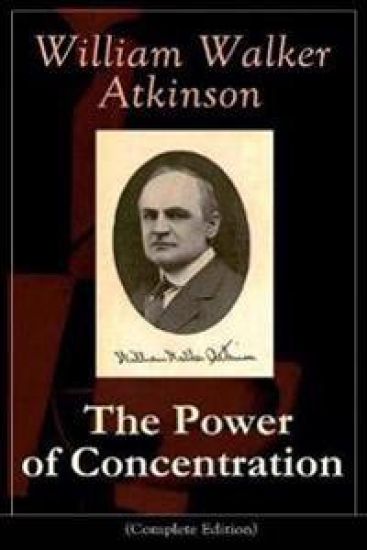
William Walker Atkinson (1862-1932) was an attorney, merchant, publisher, and author, as well as an occultist and an American pioneer of the New Thought movement. He is also known to have been the author of the pseudonymous works attributed to Theron Q. Dumont and Yogi Ramacharaka. Excerpt: "We all know that in order to accomplish a certain thing we must concentrate. It is of the utmost value to learn how to concentrate. To make a success of anything you must be able to concentrate your entire thought upon the idea you are working out. Do not become discouraged, if you are unable to hold your thought on the subject very long at first. There are very few that can. It seems a peculiar fact that it is easier to concentrate on something that is not good for us, than on something that is beneficial. This tendency is overcome when we learn to concentrate consciously. If you will just practice a few concentration exercises each day you will find you will soon develop this wonderful power."

The Hindu-Yogi Science of Breath
Yogi Ramacharaka; William Walker Atkinson
Martino Fine Books
2018
nidottu
Halvin toimitettuna 19,30 €

Your Mind and How to Use It
William Walker Atkinson
Createspace Independent Publishing Platform
2018
nidottu

Practical Mind-Reading - A Course of Lessons on Tranference, Telepathy, Mental Currents, Mental Rapport, &c.
William Walker Atkinson
Lulu.com
2018
pokkari
CONTENTS. Lesson I -- The Nature Of Mind Reading - A plain, practical, scientific explanation of this Vast, Mysterious Subject Lesson II -- The Proofs Of Mind Reading - The result of the latest scientific experiments and investigations regarding this subject Lesson III -- Contact Mind Reading - Pull instruction regarding the ""Nerve Currents"" passing from the human Transmitter to the human Receiver Lesson IV -- Development Exercises - How to develop yourself; how to grow proficient in practice; how to find Locations; how to find Objects Lesson V -- Simple Demonstrations - Public or Parlor Demonstrations. Fourteen Practical Demonstrations are explained Lesson VI -- Difficult Demonstrations - Explanations and instructions given for their performance. The Banknote Test; the Blackboard Feats; Telepathic Chess and Checkers, etc Lesson VII -- Sensational Feats - The Driving Feat; the Combination Lock Feat Lesson VIII -- Higher Phenomena - Demonstrations without contact. Development Directions
In this outstanding book, we find demonstrated various intricate and advanced thought processes, and discover how to employ them in order to achieve The Master Mind. For the author, individuals are split into two categories. Firstly, there are those who possess normal, sub-optimal minds; this group comprises the vast majority of humanity. The second group are those who, whether through conscious effort of will, self-belief, mindfulness or otherwise have achieved a higher, self-actualized state; those with a 'Master Mind'. Through sheer conscious will, and careful tending over a span of months and years, such a mind can be cultivated. This practical and instructive text tells us how to properly make use of our mental faculties, that we may increase our mental efficiency and thereby achieve goals in life. Such success may be simply intellectual; the desire to learn and recall knowledge as a good unto itself. It may be related to lifestyle; an outlook required to succeed in life and career.

This excellent book represents one of the first and best presentations of Eastern wisdom in the English language. It concerns ancient Hindu traditions and the Yogic practice of observing and regulating the breath. We begin with an admission that Western students are often confused by what exactly Yoga is, and what it is meant to accomplish. Stereotypes of the yogi as spindly, dirty and disheveled men commonly seen sitting in fixed posture at a roadside or marketplace abound. Yet these dismissive images serve only to neglect the spiritual substance and ancient wisdom of yogi science. Seeking to dispel the negative stereotypes and present the vivid truth, Atkinson discusses the multiple schools of yoga and their general purpose. Some emphasize control over the body's motions, while others favor inner development of the spirit. Several however emphasize the control of the breath; and it a practical explanation of this that Atkinson relays in the remaining fifteen chapters of this book.

This excellent book represents one of the first and best presentations of Eastern wisdom in the English language. It concerns ancient Hindu traditions and the Yogic practice of observing and regulating the breath. We begin with an admission that Western students are often confused by what exactly Yoga is, and what it is meant to accomplish. Stereotypes of the yogi as spindly, dirty and disheveled men commonly seen sitting in fixed posture at a roadside or marketplace abound. Yet these dismissive images serve only to neglect the spiritual substance and ancient wisdom of yogi science. Seeking to dispel the negative stereotypes and present the vivid truth, Atkinson discusses the multiple schools of yoga and their general purpose. Some emphasize control over the body's motions, while others favor inner development of the spirit. Several however emphasize the control of the breath; and it a practical explanation of this that Atkinson relays in the remaining fifteen chapters of this book.