Kirjojen hintavertailu – 12 903 724 kirjaa ja 27 kauppaa

Kirjailija

Wim Dehaene

Kirjat ja teokset yhdessä paikassa: 13 kirjaa, julkaisuja vuosilta 2009–2020, suosituimpiin kuuluu Efficient Design of Variation-Resilient Ultra-Low Energy Digital Processors. Vertaile teosten hintoja ja tarkista saatavuus suomalaisista kirjakaupoista.

13 kirjaa

Kirjojen julkaisuvuodet: 2009–2020.

Efficient Design of Variation-Resilient Ultra-Low Energy Digital Processors

Efficient Design of Variation-Resilient Ultra-Low Energy Digital Processors

Hans Reyserhove; Wim Dehaene

Springer Nature Switzerland AG
2020
nidottu
This book enables readers to achieve ultra-low energy digital system performance. The author’s main focus is the energy consumption of microcontroller architectures in digital (sub)-systems. The book covers a broad range of topics extensively: from circuits through design strategy to system architectures. The result is a set of techniques and a context to realize minimum energy digital systems. Several prototype silicon implementations are discussed, which put the proposed techniques to the test. The achieved results demonstrate an extraordinary combination of variation-resilience, high speed performance and ultra-low energy.

Efficient Design of Variation-Resilient Ultra-Low Energy Digital Processors

Efficient Design of Variation-Resilient Ultra-Low Energy Digital Processors

Hans Reyserhove; Wim Dehaene

Springer Nature Switzerland AG
2019
sidottu
This book enables readers to achieve ultra-low energy digital system performance. The author’s main focus is the energy consumption of microcontroller architectures in digital (sub)-systems. The book covers a broad range of topics extensively: from circuits through design strategy to system architectures. The result is a set of techniques and a context to realize minimum energy digital systems. Several prototype silicon implementations are discussed, which put the proposed techniques to the test. The achieved results demonstrate an extraordinary combination of variation-resilience, high speed performance and ultra-low energy.
Ultra-Low-Voltage Design of Energy-Efficient Digital Circuits

Ultra-Low-Voltage Design of Energy-Efficient Digital Circuits

Nele Reynders; Wim Dehaene

Springer International Publishing AG
2016
nidottu
This book focuses on increasing the energy-efficiency of electronic devices so that portable applications can have a longer stand-alone time on the same battery. The authors explain the energy-efficiency benefits that ultra-low-voltage circuits provide and provide answers to tackle the challenges which ultra-low-voltage operation poses. An innovative design methodology is presented, verified, and validated by four prototypes in advanced CMOS technologies. These prototypes are shown to achieve high energy-efficiency through their successful functionality at ultra-low supply voltages.
Continuous-Time Digital Front-Ends for Multistandard Wireless Transmission

Continuous-Time Digital Front-Ends for Multistandard Wireless Transmission

Pieter A. J. Nuyts; Patrick Reynaert; Wim Dehaene

Springer International Publishing AG
2016
nidottu
This book describes the design of fully digital multistandard transmitter front-ends which can directly drive one or more switching power amplifiers, thus eliminating all other analog components. After reviewing different architectures, the authors focus on polar architectures using pulse width modulation (PWM), which are entirely based on unclocked delay lines and other continuous-time digital hardware. As a result, readers are enabled to shift accuracy concerns from the voltage domain to the time domain, to coincide with submicron CMOS technology scaling. The authors present different architectural options and compare them, based on their effect on the signal and spectrum quality. Next, a high-level theoretical analysis of two different PWM-based architectures – baseband PWM and RF PWM – is made. On the circuit level, traditional digital components and design techniques are revisited from the point of view of continuous-time digital circuits. Important design criteria are identified and different solutions are presented, along with their advantages and disadvantages. Finally, two chips designed in nanometer CMOS technologies are described, along with measurement results for validation.
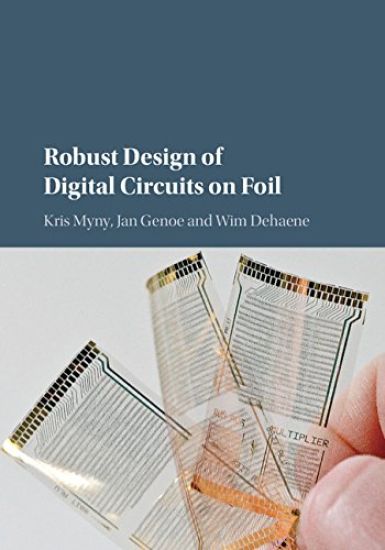
Robust Design of Digital Circuits on Foil

Robust Design of Digital Circuits on Foil

Kris Myny; Jan Genoe; Wim Dehaene

Cambridge University Press
2016
sidottu
Covering both TFT technologies, and the theory and practice of circuit design, this book equips engineers with the technical knowledge and hands-on skills needed to make circuits on foil with organic or metal oxide based TFTs for applications such as flexible displays and RFID. It provides readers with a solid theoretical background and gives an overview of current TFT technologies including device architecture, typical parameters, and a theoretical framework for comparing different logical families. Concrete, real-world design cases, such as RFID circuits, and organic and metal oxide TFT-based 8-bit microprocessors, enable readers to grasp the practical potential of these design techniques and how they can be applied. This is an essential guide for students and professionals who need to make better transistors on foil.
Temperature- and Supply Voltage-Independent Time References for Wireless Sensor Networks

Temperature- and Supply Voltage-Independent Time References for Wireless Sensor Networks

Valentijn De Smedt; Georges Gielen; Wim Dehaene

Springer International Publishing AG
2016
nidottu
This book investigates the possible circuit solutions to overcome the temperature and supply voltage-sensitivity of fully-integrated time references for ultra-low-power communication in wireless sensor networks. The authors provide an elaborate theoretical introduction and literature study to enable full understanding of the design challenges and shortcomings of current oscillator implementations. Furthermore, a closer look to the short-term as well as the long-term frequency stability of integrated oscillators is taken. Next, a design strategy is developed and applied to 5 different oscillator topologies and 1 sensor interface. All 6 implementations are subject to an elaborate study of frequency stability, phase noise and power consumption. In the final chapter all blocks are compared to the state of the art.
Ultra-Low-Voltage Design of Energy-Efficient Digital Circuits

Ultra-Low-Voltage Design of Energy-Efficient Digital Circuits

Nele Reynders; Wim Dehaene

Springer International Publishing AG
2015
sidottu
This book focuses on increasing the energy-efficiency of electronic devices so that portable applications can have a longer stand-alone time on the same battery. The authors explain the energy-efficiency benefits that ultra-low-voltage circuits provide and provide answers to tackle the challenges which ultra-low-voltage operation poses. An innovative design methodology is presented, verified, and validated by four prototypes in advanced CMOS technologies. These prototypes are shown to achieve high energy-efficiency through their successful functionality at ultra-low supply voltages.
Temperature- and Supply Voltage-Independent Time References for Wireless Sensor Networks

Temperature- and Supply Voltage-Independent Time References for Wireless Sensor Networks

Valentijn De Smedt; Georges Gielen; Wim Dehaene

Springer International Publishing AG
2014
sidottu
This book investigates the possible circuit solutions to overcome the temperature and supply voltage-sensitivity of fully-integrated time references for ultra-low-power communication in wireless sensor networks. The authors provide an elaborate theoretical introduction and literature study to enable full understanding of the design challenges and shortcomings of current oscillator implementations. Furthermore, a closer look to the short-term as well as the long-term frequency stability of integrated oscillators is taken. Next, a design strategy is developed and applied to 5 different oscillator topologies and 1 sensor interface. All 6 implementations are subject to an elaborate study of frequency stability, phase noise and power consumption. In the final chapter all blocks are compared to the state of the art.
SRAM Design for Wireless Sensor Networks

SRAM Design for Wireless Sensor Networks

Vibhu Sharma; Francky Catthoor; Wim Dehaene

Springer-Verlag New York Inc.
2014
nidottu
This book features various, ultra low energy, variability resilient SRAM circuit design techniques for wireless sensor network applications. Conventional SRAM design targets area efficiency and high performance at the increased cost of energy consumption, making it unsuitable for computation-intensive sensor node applications. This book, therefore, guides the reader through different techniques at the circuit level for reducing energy consumption and increasing the variability resilience. It includes a detailed review of the most efficient circuit design techniques and trade-offs, introduces new memory architecture techniques, sense amplifier circuits and voltage optimization methods for reducing the impact of variability for the advanced technology nodes.
Continuous-Time Digital Front-Ends for Multistandard Wireless Transmission

Continuous-Time Digital Front-Ends for Multistandard Wireless Transmission

Pieter A. J. Nuyts; Patrick Reynaert; Wim Dehaene

Springer International Publishing AG
2014
sidottu
This book describes the design of fully digital multistandard transmitter front-ends which can directly drive one or more switching power amplifiers, thus eliminating all other analog components. After reviewing different architectures, the authors focus on polar architectures using pulse width modulation (PWM), which are entirely based on unclocked delay lines and other continuous-time digital hardware. As a result, readers are enabled to shift accuracy concerns from the voltage domain to the time domain, to coincide with submicron CMOS technology scaling. The authors present different architectural options and compare them, based on their effect on the signal and spectrum quality. Next, a high-level theoretical analysis of two different PWM-based architectures – baseband PWM and RF PWM – is made. On the circuit level, traditional digital components and design techniques are revisited from the point of view of continuous-time digital circuits. Important design criteria are identified and different solutions are presented, along with their advantages and disadvantages. Finally, two chips designed in nanometer CMOS technologies are described, along with measurement results for validation.
SRAM Design for Wireless Sensor Networks

SRAM Design for Wireless Sensor Networks

Vibhu Sharma; Francky Catthoor; Wim Dehaene

Springer-Verlag New York Inc.
2012
sidottu
This book features various, ultra low energy, variability resilient SRAM circuit design techniques for wireless sensor network applications. Conventional SRAM design targets area efficiency and high performance at the increased cost of energy consumption, making it unsuitable for computation-intensive sensor node applications. This book, therefore, guides the reader through different techniques at the circuit level for reducing energy consumption and increasing the variability resilience. It includes a detailed review of the most efficient circuit design techniques and trade-offs, introduces new memory architecture techniques, sense amplifier circuits and voltage optimization methods for reducing the impact of variability for the advanced technology nodes.
Energy Scalable Radio Design

Energy Scalable Radio Design

Marian Verhelst; Wim Dehaene

Springer
2011
nidottu
Smart energy management, both at design time and at run time, is indispensable in modern radios. It requires a careful trade-off between the system’s performance, and its power consumption. Moreover, the design has to be dynamically reconfigurable to optimally balance these parameters at run time, depending on the current operating conditions. Energy Scalable Radio Design describes and applies an energy-driven design strategy to the design of an energy-efficient, highly scalable, pulsed UWB receiver, suitable for low data rate communication and sub-cm ranging. This book meticulously covers the different design steps and the adopted optimizations: System level air interface selection, architectural/algorithmic design space exploration, algorithmic refinement (acquisition, synchronization and ranging algorithms) and circuit level (RTL) implementation based on the FLEXmodule-concept. Measurement results demonstrate the effectiveness and necessity of the energy-driven design strategy.
Energy Scalable Radio Design

Energy Scalable Radio Design

Marian Verhelst; Wim Dehaene

Springer
2009
sidottu
Smart energy management, both at design time and at run time, is indispensable in modern radios. It requires a careful trade-off between the system’s performance, and its power consumption. Moreover, the design has to be dynamically reconfigurable to optimally balance these parameters at run time, depending on the current operating conditions. Energy Scalable Radio Design describes and applies an energy-driven design strategy to the design of an energy-efficient, highly scalable, pulsed UWB receiver, suitable for low data rate communication and sub-cm ranging. This book meticulously covers the different design steps and the adopted optimizations: System level air interface selection, architectural/algorithmic design space exploration, algorithmic refinement (acquisition, synchronization and ranging algorithms) and circuit level (RTL) implementation based on the FLEXmodule-concept. Measurement results demonstrate the effectiveness and necessity of the energy-driven design strategy.