Kirjojen hintavertailu – 12 903 725 kirjaa ja 27 kauppaa
Kirjailija
Winston S. Churchill
Kirjat ja teokset yhdessä paikassa: 87 kirjaa, julkaisuja vuosilta 1986–2026, suosituimpiin kuuluu Ian Hamilton's March (the Boer War). Vertaile teosten hintoja ja tarkista saatavuus suomalaisista kirjakaupoista.
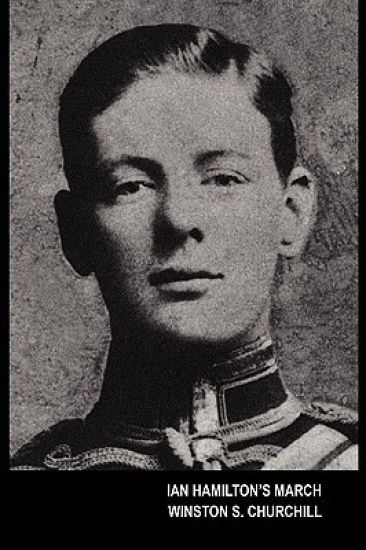
Ian Hamilton's March is Winston S. Churchill's gripping firsthand account of the latter stages of the Boer War, following British General Ian Hamilton's campaign across South Africa. As a war correspondent, Churchill documents key battles, military strategies, and the challenges faced by British forces as they advance toward victory. Blending vivid battlefield descriptions with political and strategic insights, this book serves as both a historical record and a personal narrative of war, perseverance, and empire-building.
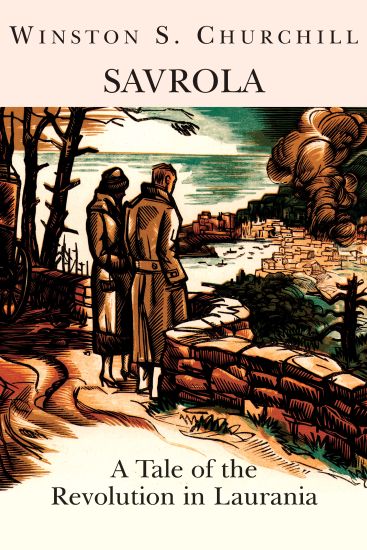
Savrola is Winston S. Churchill’s first major literary effort and his only full-length work of fiction. The novel was first published in 1900, and its subtitle, A Tale of the Revolution in Laurania, demonstrates the author’s focus on significant change in political regimes. Savrola contains the seeds of Churchill’s exceptional talents as a statesman, a political philosopher, and a man of literature. The ambition of the book’s eponymous protagonist Savrola to rule foreshadows Churchill’s own career as the greatest democratic leader of the twentieth century. He sketches a model of the education needed for modern statesmanship and describes the kind of rhetoric that appeals to a modern democratic people, all in a style that anticipates his writing in the books for which he later won the Nobel Prize for Literature. This edition of Savrola contains extensive introductory materials, notes, and an appendix. It is lavishly illustrated with reproductions of the André Collot woodcuts made for a limited French-language edition.
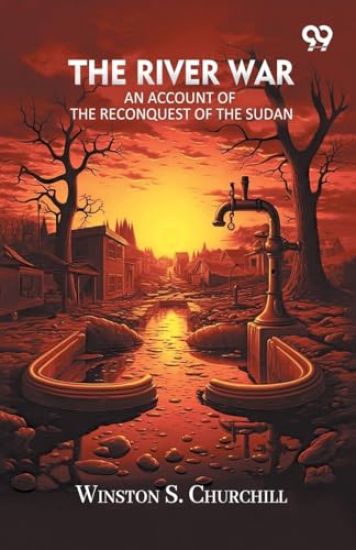
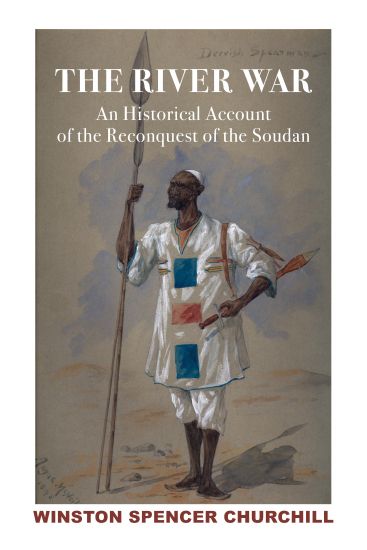
The River War is Winston S. Churchill's detailed account of Britain's military campaign against the Mahdist forces in Sudan (1896-1899). Combining firsthand observations with historical analysis, Churchill explores the politics, strategy, and brutal realities of colonial warfare as British and Egyptian forces, led by General Kitchener, seek to reclaim Sudan. With vivid descriptions of battles, including the pivotal Battle of Omdurman, and reflections on imperialism, this work remains a compelling study of 19th-century military conflict and geopolitics.
"While I was attached to the Malakand Field Force I wrote a series of letters for the London Daily Telegraph. The favourable manner in which these letters were received encouraged me to attempt a more substantial work. This volume is the result." -- Sir Winston S. Churchill
The River War is Winston S. Churchill's detailed account of Britain's military campaign against the Mahdist forces in Sudan (1896-1899). Combining firsthand observations with historical analysis, Churchill explores the politics, strategy, and brutal realities of colonial warfare as British and Egyptian forces, led by General Kitchener, seek to reclaim Sudan. With vivid descriptions of battles, including the pivotal Battle of Omdurman, and reflections on imperialism, this work remains a compelling study of 19th-century military conflict and geopolitics.
London to Ladysmith via Pretoria is Winston S. Churchill's firsthand account of the Boer War (1899-1902), based on his experiences as a war correspondent. Covering key battles, military strategies, and his own dramatic capture and daring escape from a Boer prison, Churchill provides a vivid and insightful perspective on the conflict. Blending reportage, personal adventure, and historical analysis, this book offers a compelling narrative of war, resilience, and empire during one of Britain's most challenging colonial conflicts." This small book is mainly a personal record of my adventures and impressions during the first five months of the African War. It may also be found to give a tolerably coherent account of the operations conducted by Sir Redvers Buller for the Relief of Ladysmith. The correspondence of which it is mainly composed appeared in the columns of the Morning Post newspaper, and I propose, if I am not interrupted by the accidents of war, to continue the series of letters. The stir and tumult of a camp do not favour calm or sustained thought, and whatever is written herein must be regarded simply as the immediate effect produced by men powerfully moved, and scenes swiftly changing upon what I hope is a truth-seeking mind." -- Winston S. Churchill
London to Ladysmith via Pretoria is Winston S. Churchill's firsthand account of the Boer War (1899-1902), based on his experiences as a war correspondent. Covering key battles, military strategies, and his own dramatic capture and daring escape from a Boer prison, Churchill provides a vivid and insightful perspective on the conflict. Blending reportage, personal adventure, and historical analysis, this book offers a compelling narrative of war, resilience, and empire during one of Britain's most challenging colonial conflicts." This small book is mainly a personal record of my adventures and impressions during the first five months of the African War. It may also be found to give a tolerably coherent account of the operations conducted by Sir Redvers Buller for the Relief of Ladysmith. The correspondence of which it is mainly composed appeared in the columns of the Morning Post newspaper, and I propose, if I am not interrupted by the accidents of war, to continue the series of letters. The stir and tumult of a camp do not favour calm or sustained thought, and whatever is written herein must be regarded simply as the immediate effect produced by men powerfully moved, and scenes swiftly changing upon what I hope is a truth-seeking mind." -- Winston S. Churchill
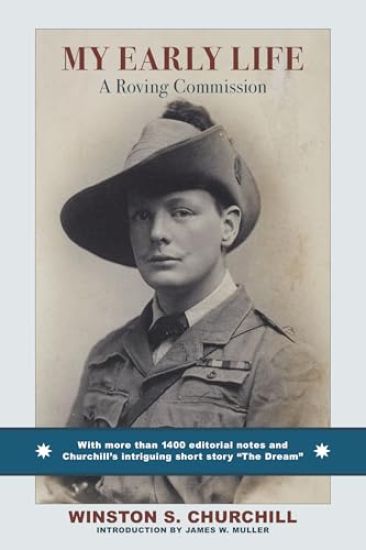
In My Early Life, Churchill describes his education and his experience in four wars on three continents as a young officer and newspaper correspondent, including his cavalry charge against the Dervishes at Omdurman in the Sudan and his capture and escape from a Boer prisoner of war camp in South Africa. He explains how he wrote his first five books and launched his political career before taking his seat in the House of Commons at twenty-six. By the time he wrote this book, the First World War had ushered in many changes, not all of them good, and Churchill perceived a low spirit in his countrymen. He thinks a time may come when young Britons will need more love of “adventure, and adventure for adventure’s sake,” which his early life exemplifies, and he offers “the new generation” his own “story of youthful endeavour” to encourage and rekindle the spirited part of their souls. Giving an account of his own life is a summons to young people who are drifting in an eddy of mass effects to surmount their fear of death, aiming to stir up unselfish endeavor in them. Lest anyone mistake his intention in writing the book, he dedicates it “TO A NEW GENERATION.” This edition of My Early Life includes “The Dream.” This short story was first mooted at a family meal at Churchill’s country house at Chartwell in late November 1947, in the company of Winston and Clementine Churchill’s children, Diana and Randolph. Diana asked her father, if he could conjure up anyone, who would fill an empty chair in the dining room. He replied that he would choose to dine with his own father, Lord Randolph Churchill, who had died more than fifty years earlier. He went on to describe a story he meant to write, based on a dream in which Lord Randolph returned to his son’s painting studio to inquire what had occurred in the intervening half-century. Encouraged by his family’s enthusiasm, Churchill wrote the story soon afterwards but, after revising it, set it aside to be published later. This “Private Article,” as he styled it, first appeared a year after his death in the Sunday Telegraph, January 30, 1966, which described it as “his last story—locked away in a box for years—now published for the first time.” By permission of Churchill College, it is reprinted, with explanatory editorial notes, as a fitting epilogue to Churchill’s autobiography.
The River War - An Historical Account of the Reconquest of the Soudan, in Two Volumes - Vol. 1 is an unchanged, high-quality reprint of the original edition of 1899. Hansebooks is editor of the literature on different topic areas such as research and science, travel and expeditions, cooking and nutrition, medicine, and other genres. As a publisher we focus on the preservation of historical literature. Many works of historical writers and scientists are available today as antiques only. Hansebooks newly publishes these books and contributes to the preservation of literature which has become rare and historical knowledge for the future.
Winston Churchill wrote five books before he was elected to Parliament at the age of twenty-five. The most impressive of these books, The River War tells the story of Britain’s arduous and risky campaign to reconquer the Sudan at the end of the nineteenth century. More than half a century of subjection to Egypt had ended a decade earlier when Sudanese Dervishes rebelled against foreign rule and killed Britain’s envoy Charles Gordon at his palace in Khartoum in 1885. Political Islam collided with European imperialism. Herbert Kitchener’s Anglo-Egyptian army, advancing hundreds of miles south along the Nile through the Sahara Desert, defeated the Dervish army at the battle of Omdurman on September 2, 1898. Churchill, an ambitious young cavalry officer serving with his regiment in India, had already published newspaper columns and a book about fighting on the Afghan frontier. He yearned to join Kitchener’s campaign. But the general, afraid of what he would write about it, refused to have him. Churchill returned to London. With help from his mother and the prime minister, he managed to get himself attached to an English cavalry regiment sent to strengthen Kitchener’s army. Hurriedly travelling to Egypt, Churchill rushed upriver to Khartoum, catching up with Kitchener’s army just in time to take part in the climactic battle. That day he charged with the 21st Lancers in the most dangerous fighting against the Dervish host. He wrote fifteen dispatches for the Morning Post in London. As Kitchener had expected, Churchill’s dispatches and his subsequent book were highly controversial. The precocious officer, having earlier seen war on two other continents, showed a cool independence of his commanding officer. He even resigned from the army to be free to write the book as he pleased. He gave Kitchener credit for his victory but found much to criticize in his character and campaign. Churchill’s book, far from being just a military history, told the whole story of the Egyptian conquest of the Sudan and the Dervishes’ rebellion against imperial rule. The young author was remarkably even-handed, showing sympathy for the founder of the rebellion, Muhammad Ahmed, and for his successor the Khalifa Abdullahi, whom Kitchener had defeated. He considered how the war in northeast Africa affected British politics at home, fit into the geopolitical rivalry between Britain and France, and abruptly thrust the vast Sudan, with the largest territory in Africa, into an uncertain future in Britain’s orbit. In November 1899, The River War was published in “two massive volumes, my magnum opus (up to date), upon which I had lavished a whole year of my life,” as Churchill recalled later in his autobiography. The book had twenty-six chapters, five appendices, dozens of illustrations, and colored maps. Three years later, in 1902, it was shortened to fit into one volume. Seven whole chapters, and parts of every other chapter, disappeared in the abridgment. Many maps and most illustrations were also dropped. Since then the abridged edition has been reprinted regularly, and eventually it was even abridged further. But the full two-volume book, which is rare and expensive, was never published again—until now. St. Augustine’s Press, in collaboration with the International Churchill Society, brings back to print in two handsome volumes The River War: An Historical Account of the Reconquest of the Soudan unabridged, for the first time since 1902. Every chapter and appendix from the first edition has been restored. All the maps are in it, in their original colors, with all the illustrations by Churchill’s brother officer Angus McNeill. More than thirty years in the making, under the editorship of James W. Muller, this new edition of The River War will be the definitive one for all time. The whole book is printed in two colors, in black and red type, to show what Churchill originally wrote and how it was abridged or altered later. For the first time, a new appendix reproduces Churchill’s Sudan dispatches as he wrote them, before they were edited by the Morning Post. Other new appendices reprint Churchill’s subsequent writings on the Sudan. Thousands of new footnotes have been added to the book by the editor, identifying Churchill’s references to people, places, writings, and events unfamiliar to readers today. Professor Muller’s new introduction explains how the book fits into Churchill’s career as a writer and an aspiring politician. He examines the statesman’s early thoughts about war, race, religion, and imperialism, which are still our political challenges in the twenty-first century. Half a century after The River War appeared, this book was one of a handful of his works singled out by the Swedish Academy when it awarded Churchill the Nobel Prize for Literature in 1953. Now, once again, its reader can follow Churchill back to the war he fought on the Nile, beginning with the words of his youngest daughter. Before she died, Mary Soames wrote a new foreword, published here, which concludes that “In this splendid new edition…we have, in effect, the whole history of The River War as Winston Churchill wrote it—and it makes memorable reading.”