Kirjojen hintavertailu – 12 903 725 kirjaa ja 27 kauppaa

Kirjailija

Wolfgang Klein

Kirjat ja teokset yhdessä paikassa: 17 kirjaa, julkaisuja vuosilta 1979–2025, suosituimpiin kuuluu Schnapsideen und Heimatgefühle. Vertaile teosten hintoja ja tarkista saatavuus suomalaisista kirjakaupoista.

17 kirjaa

Kirjojen julkaisuvuodet: 1979–2025.

Looking at Language

Looking at Language

Wolfgang Klein

De Gruyter Mouton
2019
isokokoinen pokkari
The volume presents an essential selection collected from the essays of Wolfgang Klein. In addition to journal and book articles, many of them published by Mouton, this book features new and unpublished texts by the author. It focuses, among other topics, on information structure, the expression of grammatical categories and the structure of learner varieties.
Köln-Nippes

Köln-Nippes

Reinhold Kruse; Wolfgang Klein

Sutton Verlag GmbH
2018
nidottu
Nippes, erstmals 1549 urkundlich als Wohnort "am Nippes" belegt, ist seit 120 Jahren ein Kölner Stadtteil. Ursprünglich gehörte er zur Herrlichkeit Mauenheim, die wiederum Teil des Kurfürstentums Kölns war. Sie lag nördlich der von einer mittelalterlichen Stadtmauer umgebenen Freien Reichsstadt Köln. Von der Eigelsteintorburg erreichte man "am Nippes" über die Neusser Chaussee nach etwa 1,5 Kilometern. Am 1. April 1888 wurde Nippes, das seit Anfang 1887 zusammen mit dem Nachbarort Riehl eine selbstständige Bürgermeisterei bildete, in die Stadt Köln eingemeindet. Jenes Datum markiert auch den Ausgangspunkt für diesen Bildband. Anhand von rund 200 bislang unveröffentlichten Fotos dokumentieren Reinhold Kruse und Wolfgang Klein, profunde Kenner der Geschichte von Nippes, die Geschichte ihres Stadtteils bis in die 1970er-Jahre. Die lebendigen Aufnahmen, die zumeist aus privaten Fotoalben stammen, zeigen vor allem den Alltag in Nippes, private und öffentliche Feste und Feiern, kirchliches und schulisches Leben, die Vereine und die Arbeitswelt. Sie illustrieren nicht nur die Entwicklung des Stadtteils, sondern lassen auch Erinnerungen wach werden und laden zu Neuentdeckungen ein.

Looking at Language

Looking at Language

Wolfgang Klein

De Gruyter Mouton
2018
sidottu
The volume presents an essential selection collected from the essays of Wolfgang Klein. In addition to journal and book articles, many of them published by Mouton, this book features new and unpublished texts by the author. It focuses, among other topics, on information structure, the expression of grammatical categories and the structure of learner varieties.
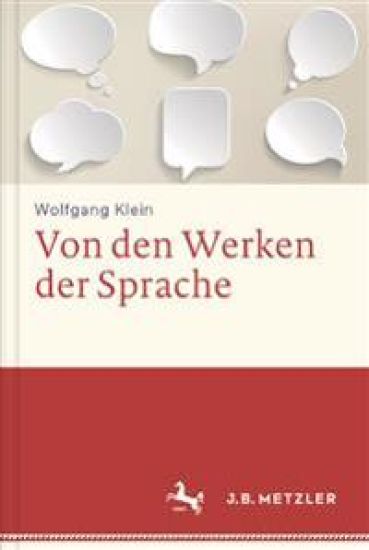
Von den Werken der Sprache

Von den Werken der Sprache

Wolfgang Klein

Springer-Verlag Berlin and Heidelberg GmbH Co. KG
2015
sidottu
Die in diesem Band versammelten Aufsätze - erschienen zwischen 1978 und 2008 in der Zeitschrift für Literaturwissenschaft und Linguistik - beweisen, dass die Erforschung der menschlichen Sprache und ihrer verschiedenen Hervorbringungen eine spannende Sache sein kann. Den Beiträgen, die auf oft überraschende Weise, aber stets sorgfältig begründet, eine Fülle von Themen behandeln, ist eines gemeinsam: Es geht ihnen um die Beschaffenheit der menschlichen Sprache, der gesprochenen oder geschriebenen Texte, die mit ihrer Hilfe hervorgebracht werden, und der Traditionen und Denkweisen, die von in diesen Texten getragen werden und sie tragen.
Time in Language

Time in Language

Wolfgang Klein

Routledge
2014
nidottu
This book looks at the various ways in which time is reflected in natural language. All natural languages have developed a rich repetoire of devices to express time, but linguists have tended to concentrate on tense and aspect, rather than discourse principles. Klein considers the four main ways in which language expresses time - the verbal categories of tense and aspect; inherent lexical features of the verb; and various types of temporal adverbs. Klein looks at the interaction of these four devices and suggests new or partly new treatments of these devices to express temporality.
Recht Verstehen

Recht Verstehen

Professor Angelika (Max Planck Institute Becker; Wolfgang Klein

De Gruyter
2008
sidottu
In Deutschland wie in vielen andern Ländern gilt das "Transparenzgebot" - Verträge mit Verbrauchern müssen so formuliert sein, dass sie für jedermann klar und verständlich sind. Trifft das beispielsweise für den folgenden Satz aus den Allgemeinen Versicherungsbedingungen der Riester-Rente zu? "Der Abzug beträgt 0,2 Prozent der Differenz zwischen dem zum vereinbarten Rentenbeginn vorhandenen Deckungskapital und dem zum Zeitpunkt der Beitragsfreistellung vorhandenen Deckungskapital." Die Antwort ist "Nein". Das ist eines von vielen Ergebnissen einer Studie, in der - erstmals in Deutschland - exemplarisch untersucht wurde, wie verständlich die "Sprache des Rechts" denn tatsächlich für die davon Betroffenen ist. Durchgeführt wurde sie von einer interdisziplinären Arbeitsgruppe an der Berlin-Brandenburgischen Akademie der Wissenschaften. Die Untersuchung zeigt, dass nicht nur Laien, sondern auch Juristen und Versicherungsvertreter erhebliche Schwierigkeiten mit ganz alltäglichen Rechtstexten haben können.
Time in Language

Time in Language

Wolfgang Klein

Routledge
1994
sidottu
This book looks at the various ways in which time is reflected in natural language. All natural languages have developed a rich repetoire of devices to express time, but linguists have tended to concentrate on tense and aspect, rather than discourse principles. Klein considers the four main ways in which language expresses time - the verbal categories of tense and aspect; inherent lexical features of the verb; and various types of temporal adverbs. Klein looks at the interaction of these four devices and suggests new or partly new treatments of these devices to express temporality.
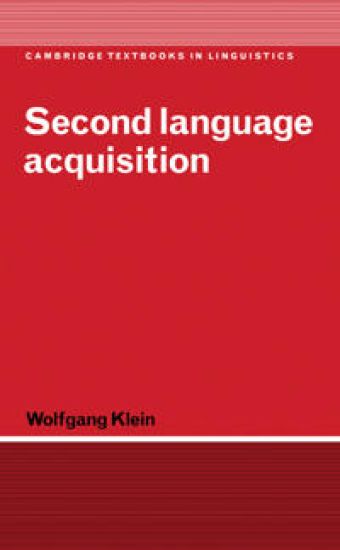
Second Language Acquisition

Second Language Acquisition

Wolfgang Klein

Cambridge University Press
1986
sidottu
This 1986 textbook presents an account of the main concerns, problems and theoretical and practical issues raised by second language acquisition research. Research in this field had been mainly pedagogically oriented, but since the 1970s linguists and psychologists have become increasingly interested in the principles that underlie second language acquisition for the light these throw on how human language processing functions in general. Moreover, it is only through an understanding of these principles that foreign language teaching can become maximally effective. In the first part of his book, Wolfgang Klein provides a critical assessment of the state of the art at the time. The second part, 'from the learner's point of view', is devoted to four central problems which anyone learning a second language (either through everyday communication or in the classroom) is faced with, and whose solution constitutes the acquisition process. This accessible introduction provides students of linguistics and applied linguistics and anyone concerned with foreign language teaching with a real understanding of the fundamental issues in the field.
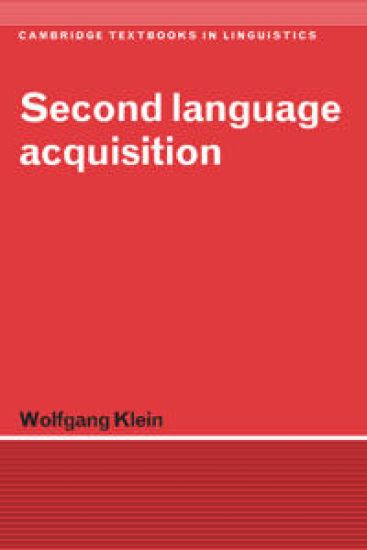
Second Language Acquisition

Second Language Acquisition

Wolfgang Klein

Cambridge University Press
1986
pokkari

Halvin toimitettuna 53,70 €

This textbook presents an up-to-date account of the main concerns, problems and theoretical and practical issues raised by second language acquisition research. Research in this field has until recently been mainly pedagogically oriented, but since the 1970s linguists and psychologists have become increasingly interested in the principles that underlie second language acquisition for the light these throw on how human language processing functions in general. Moreover, it is only through an understanding of these principles that foreign language teaching can become maximally effective. In the first part of his book, Wolfgang Klein provides a critical assessment of the current state of the art. The second part, ‘from the learner’s point of view’, is devoted to four central problems which anyone learning a second language (either through everyday communication or in the classroom) is faced with, and whose solution constitutes the acquisition process. This accessible introduction provides students of linguistics and applied linguistics and anyone concerned with foreign language teaching with a real understanding of the fundamental issues in the field, or the advances that have not yet been solved and sometimes not even approached.