Kirjojen hintavertailu – 12 903 724 kirjaa ja 27 kauppaa

Kirjailija

Wolfgang Lefèvre

Kirjat ja teokset yhdessä paikassa: 4 kirjaa, julkaisuja vuosilta 2003–2026, suosituimpiin kuuluu Theory of Nature and Mode of Production. Vertaile teosten hintoja ja tarkista saatavuus suomalaisista kirjakaupoista.

4 kirjaa

Kirjojen julkaisuvuodet: 2003–2026.

Theory of Nature and Mode of Production

Theory of Nature and Mode of Production

Wolfgang Lefèvre

Springer Nature Switzerland AG
2026
sidottu
It argues that the dominant ideas, images, and philosophies of nature of that time were conditioned by humans’ practical and technological relationship with nature, and that they changed in accordance with the historical development of early capitalist society.
Minerva Meets Vulcan: Scientific and Technological Literature – 1450–1750
This book offers a comprehensive study and account of the co-evolution of technological and scientific literature in the early modern period (1450-1750). It examines the various relationships of these literatures in six areas of knowledge – Architecture, Chemistry, Gunnery, Mechanical Engineering, Mining, and Practical Mathematics – which represent the main types of advanced technological and scientific knowledge of the era. These six fields of technologically advanced knowledge and their interrelations and interactions with learned knowledge are investigated and discussed through a specific lens: by focusing on the technological literature. Among present-day historians of science, it hardly remains controversial that contact and exchange between educated and practical knowledge played a significant role in the development of the natural sciences and technology in early modern Europe. Several paths for such exchange arose from the late Middle Ages onward due to the formationof an economy of knowledge that fostered contacts and exchange between the two worlds. How can this development be adequately described and how, on the basis of such a description, can the significance of this process for the early modern history of knowledge in the West be assessed? These are the overarching questions this book tries to answer. There exists a considerable amount of literature concerning several stations and events in the course of this long development process as well as its various aspects. As meritorious and indispensable as many of these studies are, none of them tried to portray this process as a whole with its most essential branches. What is more, many of them implicitly or explicitly took physics as a model of science, and thus highlighted mechanics and mechanical engineering as the model of all interrelations of practical and learned knowledge. By contrast, this book aims at a more complete portrait of the early modern interrelations and interactions between learned and practical knowledge. It tries to convey a new idea of the variety and disunity of these relations by discussing and comparing altogether six widely different fields of knowledge and practice. The targeted audience of this book is first of all the historians of science and technology. As one of the peer reviewers suggested – the book could very well become a textbook used for teaching the history of science and technology at universities. Furthermore, since the book addresses fundamental aspects of the significance emergence and development of modern science has for the self-image of the West, it can be expected that it will attract the attention and interest of a wider readership than professional historians.

Minerva Meets Vulcan: Scientific and Technological Literature – 1450–1750
This book offers a comprehensive study and account of the co-evolution of technological and scientific literature in the early modern period (1450-1750). It examines the various relationships of these literatures in six areas of knowledge – Architecture, Chemistry, Gunnery, Mechanical Engineering, Mining, and Practical Mathematics – which represent the main types of advanced technological and scientific knowledge of the era. These six fields of technologically advanced knowledge and their interrelations and interactions with learned knowledge are investigated and discussed through a specific lens: by focusing on the technological literature. Among present-day historians of science, it hardly remains controversial that contact and exchange between educated and practical knowledge played a significant role in the development of the natural sciences and technology in early modern Europe. Several paths for such exchange arose from the late Middle Ages onward due to the formationof an economy of knowledge that fostered contacts and exchange between the two worlds. How can this development be adequately described and how, on the basis of such a description, can the significance of this process for the early modern history of knowledge in the West be assessed? These are the overarching questions this book tries to answer. There exists a considerable amount of literature concerning several stations and events in the course of this long development process as well as its various aspects. As meritorious and indispensable as many of these studies are, none of them tried to portray this process as a whole with its most essential branches. What is more, many of them implicitly or explicitly took physics as a model of science, and thus highlighted mechanics and mechanical engineering as the model of all interrelations of practical and learned knowledge. By contrast, this book aims at a more complete portrait of the early modern interrelations and interactions between learned and practical knowledge. It tries to convey a new idea of the variety and disunity of these relations by discussing and comparing altogether six widely different fields of knowledge and practice. The targeted audience of this book is first of all the historians of science and technology. As one of the peer reviewers suggested – the book could very well become a textbook used for teaching the history of science and technology at universities. Furthermore, since the book addresses fundamental aspects of the significance emergence and development of modern science has for the self-image of the West, it can be expected that it will attract the attention and interest of a wider readership than professional historians.

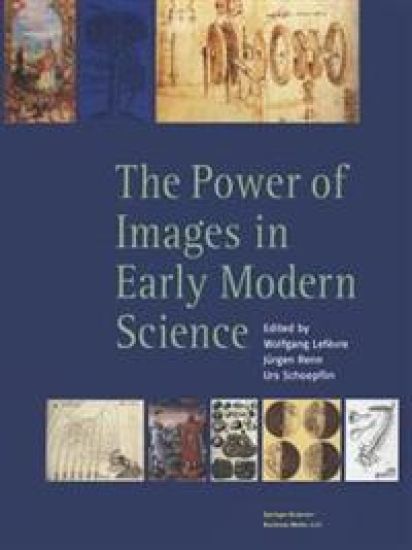
The Power of Images in Early Modern Science

The Power of Images in Early Modern Science

Wolfgang Lefèvre; Jürgen Renn; Urs Schoepflin

Birkhauser Verlag AG
2003
nidottu
Wolfgang Lefevre, Jiirgen Renn, and Vrs Schoepflin General The origin of this volume is a workshop held has a deeper, more complex structure which in 1997 in Berlin as part of a series of work­ must be assumed if its analysis is only based shops organized in the framework of the on text. In fact, the analysis of the function of Network on Science and the Visual Images images in the early modern period shows that 1500 - 1800 funded by the European Science they mediated not only between science and Foundation and initiated by William Shea. its cultural context, but also between practi­ Meanwhile a selection of contributions was cal knowledge and its theoretical reflection thoroughly revised and prepared for publica­ in scientific theories. tion together with additionally invited papers The analysis of images thus constitutes an for this book. The result is a volume which important branch of the history of science we hope corresponds to the original inten­ that on the one hand is conceived of as part tion of the Network to contribute to a histori­ of a more general history of culture and on cal reconstruction of the role of images in the the other hand as a historical epistemology of history of science, still neglected because of knowledge. This book is not a systematic and the traditional focus of the history of science comprehensive account of scientific images on texts corresponding to a concentration on and the early modern period.