Kirjojen hintavertailu – 12 903 725 kirjaa ja 27 kauppaa
Kirjailija
Wolfgang Wurmnest
Kirjat ja teokset yhdessä paikassa: 4 kirjaa, julkaisuja vuosilta 2004–2012, suosituimpiin kuuluu Third-Party Liability of Classification Societies. Vertaile teosten hintoja ja tarkista saatavuus suomalaisista kirjakaupoista.
Vor dem Hintergrund der in ganz Europa geführten Debatte um den "more economic approach" im Kartellrecht stellt Wolfgang Wurmest die Missbrauchsaufsicht über marktbeherrschende Unternehmen auf den Prüfstand. Auf Grundlage einer rechtsökonomischen Analyse und eines Vergleichs mit dem US-amerikanischen Recht zeigt er auf, wie das deutsche und das europäische Missbrauchsverbot auszulegen und anzuwenden sind, so dass unter Berücksichtigung der Eigengesetzlichkeiten des Rechts modernen ökonomischen Erkenntnissen Rechnung getragen wird. Die zweite Auflage bringt das Werk auf den Stand von April 2012 und berücksichtigt bereits den Regierungsentwurf für die 8. GWB-Novelle, mit der eine Neuordnung der deutschen Missbrauchskontrolle angestrebt wird." Pflichtlektüre für alle Kartellrechtler" Volker Emmerich Die Aktiengesellschaft 2011,724 "Die große Stärke der Arbeit liegt […] darin, die grundlegenden Ausführungen schlüssig mit der Analyse von spezifischen Anwendungsproblemen der Missbrauchsaufsicht zu verbinden. […] Insgesamt kann die vorliegende Arbeit daher als sehr gelungen gelten." Arndt Christiansen Wirtschaft und Wettbewerb 2011, 621-622
During the last decade the European Commission has progressively adopted what is called a A more economic approach A| toward competition policy. This approach, which draws on U. S. antitrust policy, puts greater emphasis on possible welfare effects of business practices and is less concerned with competitive market structures. Under this school of thought concentration cannot be said to impede effective competition to the extent that efficiency gains outweigh market distortions. In order to stimulate the debate on this basic reorientation, in January 2009 the Max Planck Institute for Comparative and International Private Law at Hamburg convened economists, legal scholars, and practitioners for an exchange of views on these A new A| methodological foundations of EU competition policy and competition law. Two especially controversial elements were chosen for in-depth discussion: the prohibition of abuses of dominant positions and the review of State aid. This book reproduces fourteen papers from this conference, representing the considered views of prominent European lawyers, economists, academics, policymakers, and enforcement officials in the competition field on matters such as: A { the objectives of EU competition law; A { the current enforcement guidelines of the EU Commission regarding Article 102 TFEU A { measuring market power A { abusive low pricing strategies A { the economics of competition law enforcement A { recent developments in EU State aid law A { economic justifications for State aid A critical assessment of the Commission A|s State aid action plan by the German Monopolies Commission is appended in English. Applying law and economics theory to competition law, this book shows that the A more economic A| approach is exerting a considerable impact on various sectors of competition law. The authors clearly demonstrate the progress that can be made when lawyers and economists take notice of and respect the characteristics of each other A|s discipline. Moreover, the authors show how new insights of economic theory may be integrated into the relevant legal analysis. The book will therefore be appreciated by academics, practitioners, and officials representing both fields.
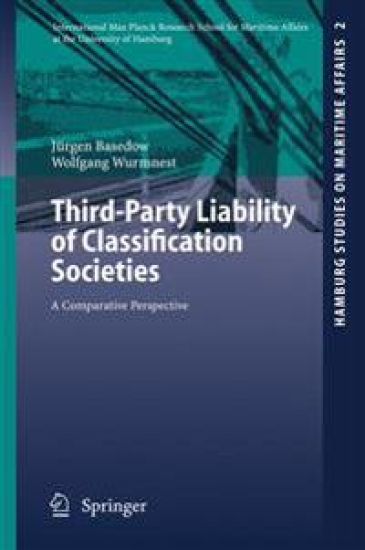
Classification societies are charged with the technical supervision of maritime shipping to enhance the safety of life and property at sea by securing high te- nical standards of design, manufacture, construction and maintenance of seagoing vessels. Each and every shipping catastrophe caused by a technical defect reminds the maritime world of the central importance of the vessel’s proper technical supervision. Correspondingly, the liability of classification societies has become a particularly discussed issue over the past years. Their contractual liability is usually limited by general terms and conditions incorporated in the classification rules and cases brought by typical contracting partners of classification societies, such as ship owners and ship yards, are not an issue in the current debate. H- ever, one can note a substantial worldwide increase of actions brought by parties who are not in privity with classification societies. This study focuses on third-party liability of classification societies. It ori- nates in an expert opinion on selected issues relating to third-party liability which the authors compiled for the German classification society Germanischer Lloyd AG. Driven by the highly interesting legal issues and unexplored shores in this area of law, we continued our research and are able to present a relatively c- prehensive overview on the law on third-party liability of classification societies. Given the origins of our work, the discussion of limitations of liability clauses is based on the standard terms and conditions of the Germanischer Lloyd, version 2005.
Klassifikationsgesellschaften sind die technischen Überwachungsorganisationen der Seeschiffahrt. In jüngerer Zeit sind sie verstärkt Ansprüchen Dritter ausgesetzt, mit denen sie keine Vertragsbeziehungen unterhalten. Diese Tendenz ist weltweit zu beobachten, wie aktuelle Fälle vor englischen, neuseeländischen und US-amerikanischen Gerichten belegen. Dritte versuchen sich vor allem im Anschluß an Schiffskatastrophen, aber auch im Zuge von Schiffsverkäufen, an einer Klassifikationsgesellschaft schadlos zu halten. Jürgen Basedow und Wolfgang Wurmnest untersuchen, welche Ansprüche solchen Dritten nach deutschem Recht gegen eine Klassifikationsgesellschaft zustehen und welche Bedeutung hierbei Haftungsbeschränkungen zukommt, die eine Klassifikationsgesellschaft mit ihren Vertragspartnern vereinbart. Somit steht die privatrechtliche Haftung von Klassifikationsgesellschaften im Mittelpunkt dieses Buches; ihre Haftung für hoheitliches Handeln wird nur am Rande gestreift. Die Autoren arbeiten die Problematik rechtsvergleichend auf und beziehen dabei das australische, englische, französische, neuseeländische und US-amerikanische Recht ein. Die von ihnen vertretene Lösung steht im Einklang mit dem fein austarierten System der Haftungsverteilung und -beschränkung des internationalen Seerechts, welches maßgeblich durch völkerrechtliche Übereinkommen geprägt wird.