
Kirjailija
Woodrow Wilson
Kirjat ja teokset yhdessä paikassa: 351 kirjaa, julkaisuja vuosilta 1966–2026, suosituimpiin kuuluu Present Day Conditions in Europe; The United States and the Armenian Mandate; Report of the American Military Mission to Armenia. Vertaile teosten hintoja ja tarkista saatavuus suomalaisista kirjakaupoista.
351 kirjaa
Kirjojen julkaisuvuodet: 1966–2026.
The mark of a great book is one that is meant to be read with pleasure. Written in a conversational manner that was his trademark as an author, Woodrow Wilson's On Being Human is meant not only to be read but also to be pondered thorou AUTHOR BIO: (Thomas) Woodrow Wilson, Ph. D., Litt. D., LL. D. (1856-1924) was born in Virginia and graduated from Princeton University. Eventually turning from law practice to postgraduate work in political science at Johns Hopkins University, he received his Ph. D. i With the aid of the New Jersey Democratic machine, he secured the gubernatorial nomination and went on to win the governorship of New Jersey. Wilson's gubernatorial record brought him to the forefront of national politics, and he was elected to th Wilson's writings on history and jurisprudence include Division and Reunion, 1829-1889 (1893), George Washington (1896), the five-volume History of the American People (1902), and Constitutional Government in the United States (1908). These books
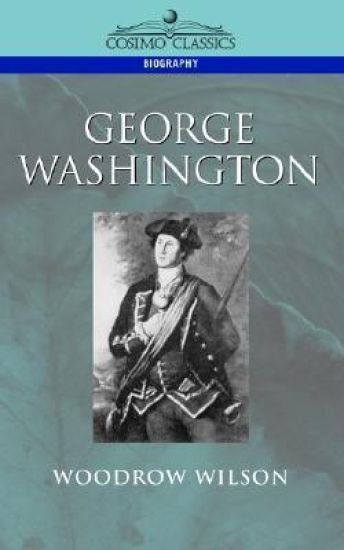
"George Washington" is an intriguing biography of America's first president as told by the man who would later become its twenty-eighth, Woodrow Wilson. Wilson takes us on a journey from a look at Washington's times to h
The government of the United States is a living system. As such, it is subject to subtle change and modification over time, but still maintains a constancy via its central nervous system-a congressional form of rule. Woodrow Wilson saw congressional government as "Committee" government. It is administered by semi-independent executive agents who obey the dictates of a legislature, though the agents themselves are not of ultimate authority or accountability. Written by Wilson when he was a twenty-eight-year-old graduate student, this is an astounding examination of the American legislative branches, especially in light of the fact that Wilson had not yet even visited Congress at the time of its composition. Wilson divides Congressional Government into six parts. In part one, his introductory statement, Wilson analyzes the need for a federal Constitution and asks whether or not it is still a document that should be unquestioningly venerated. In part two, Wilson describes the make-up and functions of the House of Representatives in painstaking detail. Part three is concerned with taxation and financial administration by the government and its resulting economic repercussions. Part four is an explanation of the Senate's role in the legislative process. The electoral system and responsibilities of the president are the central concerns of part five. And Wilson concludes, in part six, with a both philosophical and practical summarization of the congressional form of the United States government, in which he also compares it to European modes of state governance. In a new introduction specially prepared for this edition, William F. Connelly, Jr. compares Wilson, as a professional politician, to former Speaker of the House Newt Gingrich. He notes that Wilson's ideas, which have had a lasting influence, helped form Gingrich's outlook on the role of the Constitution and the executive branch in the legislative process. He also investigates Wilson's criticism of Madison's separation of powers. Congressional Government is a document of continuing relevance, and will be essential for those interested in politics and American history.
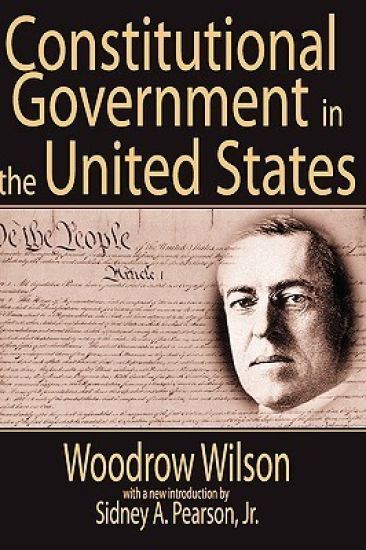
One of the genuine classics of American political science literature, Constitutional Government in the United States is also a subtle and influential criticism of the American founding fathers produced during the Progressive Era. Wilson's interpretation of the Constitution shaped the thought of scholars and students of American politics. His definition of constitutional government and the place of the United States in the development of constitutional theory continues to shape discourse today. Wilson discusses the three branches of government in the United States, the relation between the states and the federal government and party government in a manner quite distinct from the founding fathers. Constitutional Government has its origins in a series of lectures Wilson delivered at Columbia University in 1907. It is carefully organized around three separate but mutually supporting arguments. First, is the idea that constitutional government evolves historically from primitive beginnings of the state toward a universal and ideal form. Second, this idea of historical evolution contains within it an analysis of how and where the Constitution fits into the evolutionary process as a whole. Third, the historical thesis itself provides a prescription for bringing American government, and with it the Constitution, into accord with his first principle of the ideal form of modern government. In his new introduction, Sidney A. Pearson explores how, with Constitutional Government in the United States, Wilson helped create a new genre of political writing using the point of view of a "literary politician." He discusses Wilson's intention to replace the constitutional argument of the founders with one of his own based on the application of Darwinian metaphor in a political science framework. And he examines the differences between the views launched by Wilson and those set forth by James Madison in The Federalist. This is an essential work for all interested in the evolution of American political thought.
This is the last volume of The Papers of Woodrow Wilson. It contains not only the cumulative contents and index for Volumes 53 to 68 but also a retrospective essay by the editor.
Volume 68 is the last narrative volume in The Papers of Woodrow Wilson, and it concludes with Wilson's death and the ceremonies that marked it. Before that, however, the volume deals with his partial recovery from the aftermath of his stroke of October 2, 1919, and his struggle to produce "The Document," which he intended to use as the Democratic platform in an attempt to win a third presidential term in 1924. During this period Wilson took a strong interest in the success of Democrats and insurgents in wresting control of Congress from the Harding administration in the congressional election of 1922. He looked forward confidently to the presidential election two years hence, remained as convinced as ever of the desirability of American membership in the League of Nations, and received the homage of the crowds who came constantly to his home. Meanwhile, he maintained a voluminous correspondence and stayed in close touch with old colleagues. On January 16 he welcomed the members of the Democratic National Committee and a host of friends in his home. Serious talk in the newspapers about his candidacy in 1924 encouraged him to work on his acceptance speech and a third inaugural address. On January 27 and 28, however, his health suddenly began to fail, and he continued to decline until his peaceful death on February 3, at 11:55 in the morning.
This volume opens on Christmas Eve, 1920, in the waning days of the Wilson administration. Wilson and his advisers have no program other than to bring the administration to a decent end. The Cabinet meets for the last time on March 1, 1921. Emotions run high as various members recall the battles they have fought with their chief, and Wilson, tears rolling down his cheeks, dismisses them with the benediction: "Gentlemen, it is one of the handicaps of my physical condition that I cannot control myself as I've been accustomed to do. God bless you all." The end of the Wilson presidency evokes an outpouring of letters to Wilson and editorials in leading newspapers. These documents review his entire public career, from the presidency of Princeton University to the end of his presidency of the United States, and describe the Wilsonian legacy: high standards of educational and public service, courageous leadership in domestic reform, constancy of principle, and a new vision of the world united for progress, democracy, human rights, and peace. Wilson participates in the formalities preceding Harding's inauguration, and the transition from the White House to a new home on S Street proceeds smoothly. As Wilson's health improves, he forms a law partnership with his former Secretary of State, Bainbridge Colby, and privately seeks political influence, while maintaining absolute silence on affairs of state.